
7 min read
In this guide
- Why buyers are comparing Vietnam and Bangladesh right now
- Where Vietnam garment manufacturing has a concrete edge
- Where Bangladesh wins and the numbers behind it
- Vietnam vs Bangladesh: Category-by-Category Head-to-Head
- Frequently Asked Questions
- Next Steps
1. Why Buyers Are Comparing Vietnam and Bangladesh Right Now
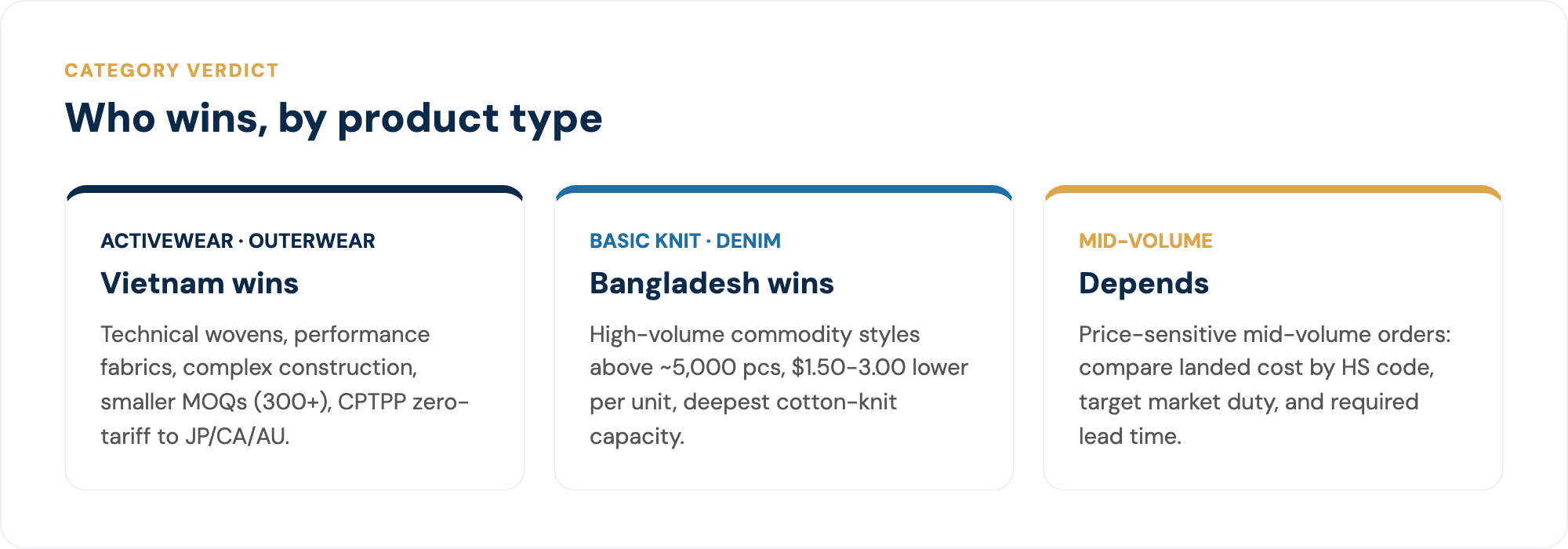
Vietnam wins on activewear, outerwear, and technical wovens with smaller MOQs; Bangladesh wins on high-volume basic knitwear and denim. Choose by product category, not by country.
Both countries rank in the global top five for garment exports. Vietnam shipped roughly $40 billion in textile and apparel exports in 2023, according to VITAS, with the United States, EU, and Japan accounting for roughly 70% of volume. Bangladesh posted roughly $36 billion in garment exports the same year, per BGMEA, led by EU and US orders.
The comparison is gaining urgency for three reasons. First, US-China tariff escalation since 2018 pushed buyers to diversify out of China, and Vietnam and Bangladesh absorbed most of that volume. Second, buyers who moved to one country are now benchmarking the other as a second-source or full replacement. Third, sustainability mandates from EU buyers (CSRD, CSDDD) are forcing a closer look at factory audit coverage in both countries.
What this guide does not do is declare an overall winner. Vietnam and Bangladesh serve genuinely different buyer profiles. Understanding which country fits which product is the faster path to a sourcing decision than comparing unit costs in isolation.
2. Where Vietnam Garment Manufacturing Has a Concrete Edge
Vietnam’s garment industry is concentrated in Ho Chi Minh City, Binh Duong, and Dong Nai, with a secondary cluster in Hanoi and Hai Phong. The structure favors technical and higher-complexity categories.
Activewear and performance fabric. Vietnam has direct access to synthetic fabric mills producing wicking, compression, and bonded fabrics. Factories in Binh Duong supply brands including Adidas and Columbia on a contract basis. Bangladesh’s fabric base is heavier in cotton knit; sourcing technical synthetic fabric requires importing from China or Taiwan, which adds 15 to 25 days to lead time and $0.80 to $1.50 per unit in fabric cost.
Smaller minimum order quantities. CMT (cut, make, trim) factories in Vietnam commonly accept 150 to 500 pieces per style, making Vietnam the practical choice for brands in development or testing phase. Bangladesh’s factory floor economics require 3,000 pieces minimum at most mid-tier facilities, and many large facilities will not quote below 5,000 pieces.
CPTPP trade access. Vietnam is a signatory to the Comprehensive and Progressive Agreement for Trans-Pacific Partnership. Garments that meet the yarn-forward rule of origin qualify for 0% tariff into Japan, Canada, Australia, and eight other member markets. Bangladesh has no equivalent multilateral FTA covering these destinations. For buyers selling into Japan or Australia, this tariff differential can represent $2 to $6 per unit depending on category.
Sample turnaround. Most Vietnam factories complete pre-production samples in 14 to 21 days. The smaller average factory size means production managers respond faster to revision requests. Bangladesh averages 21 to 35 days for samples, partly due to larger factory scale and longer internal approval chains.
Internal reference: use the Landed Cost Calculator to model CPTPP savings versus standard MFN rates for your product category.
3. Where Bangladesh Wins and the Numbers Behind It
Bangladesh’s competitive position rests on two decades of investment in a single category cluster: cotton knitwear. The country concentrates on basic cotton items like T-shirts and holds a structural cost advantage that Vietnam factories cannot replicate without fundamental changes to their labor and fabric supply chains.
Basic knitwear unit economics. At 10,000 pieces of a standard cotton crew-neck T-shirt, Bangladesh factories quote $2.50 to $4.00 per unit including fabric and CMT. Vietnam quotes for the same spec run $4.50 to $6.00. The gap narrows on premium knit (Pima, supima, organic) but does not close entirely.
Denim production. Bangladesh is the world’s second-largest denim producer after China. More than 40 denim mills operate within the country, providing vertical integration from yarn to finished garment. Vietnam has only a handful of denim-capable vertical mills, none at Bangladesh scale. For buyers sourcing jeanswear above 5,000 units per style, Bangladesh is the default choice.
UK market access. Bangladesh qualifies under the UK’s Developing Countries Trading Scheme (DCTS) with preferential (near-zero) tariffs on garments. Vietnam does not have a UK free trade agreement as of mid-2026. Buyers selling into UK retail face a meaningful cost disadvantage when sourcing from Vietnam versus Bangladesh for the same product.
Audit infrastructure. Following the 2013 Rana Plaza collapse, Bangladesh implemented the Accord/RSC building and fire safety mechanism, which covers roughly 1,600 export factories[3]. SMETA[2], BSCI, and WRAP certified facilities number in the thousands. Vietnam has a smaller but growing base of WRAP-certified factories. Buyers with SMETA-required vendor compliance programs will find Bangladesh’s certified factory pool significantly larger.
4. Vietnam vs Bangladesh: Category-by-Category Head-to-Head
| Factor | Vietnam | Bangladesh |
|---|---|---|
| Typical MOQ (basic styles) | 300 to 1,000 pcs | 3,000 to 10,000 pcs |
| Price per unit: basic cotton tee (5,000 pcs) | $4.50 to $6.00 | $2.50 to $4.00 |
| Price per unit: activewear jacket (1,000 pcs) | $18 to $28 | $22 to $35 |
| Sample lead time | 14 to 21 days | 21 to 35 days |
| CPTPP zero-tariff access | Yes (Japan, Canada, AU, NZ) | No |
| UK preferential tariff | No FTA as of 2026 | Yes (DCTS) |
| WRAP / BSCI certified factories | ~340 | 2,400+ |
| Best product fit | Activewear, outerwear, woven shirts, embroidery | Basic knitwear, denim, commodity T-shirts |
| Denim production capacity | Limited (<5 verticals) | World #2 (40+ denim mills) |
| Fabric tech for synthetics | Strong (mills in Binh Duong) | Weaker (import-dependent for synthetics) |
Verdict: For buyers sourcing activewear, woven shirts, or outerwear with CPTPP market access in mind, Vietnam is the stronger choice on quality, lead time, and trade terms. For commodity knitwear and denim at scale above 5,000 units, Bangladesh delivers lower unit costs that Vietnam factories cannot match without margin compression. The clearest signal: if your order is under 1,000 pieces or your product is technical, quote Vietnam first.
5. Frequently Asked Questions
Is Vietnam cheaper than Bangladesh for garment manufacturing?
Not for basic styles. Bangladesh runs $1.50 to $3.00 lower per unit on commodity cotton knitwear at volumes above 5,000 pieces. Vietnam’s cost advantage appears on technical garments (activewear, outerwear, complex wovens) where its fabric access and sewing skill justify a higher CMT rate than Bangladesh can match.
Which country accepts smaller garment orders?
Vietnam. Small CMT factories in Vietnam accept 150 to 500 pieces per style as standard. Bangladesh’s factory economics rarely accommodate below 3,000 pieces without a significant per-unit price penalty, and most large facilities will not quote orders below 5,000 pieces at all.
Do Vietnam garment exports qualify for zero tariff into the United States?
No. As of mid-2026, Vietnam does not have a free trade agreement with the United States. Standard MFN garment tariffs of 12 to 32% apply by HS code. Use the HS Code Lookup to confirm the rate for your specific category before modeling landed cost.
How do Vietnam and Bangladesh compare on ethical sourcing compliance?
Bangladesh has a larger certified factory pool. The RSC/Accord mechanism covers approximately 1,500 Bangladesh factories with building and fire safety audits, and over 2,400 factories hold SMETA or BSCI certification. Vietnam has roughly 340 WRAP-certified factories. For buyers with mandatory SMETA vendor requirements, Bangladesh offers more immediate options, though Vietnam’s factory-level incident rate is lower on average.
Which country is faster for product development and sampling?
Vietnam. Most Vietnam garment factories complete samples in 14 to 21 days, versus 21 to 35 days in Bangladesh. Smaller factory size in Vietnam means more direct access to production managers, and revision cycles tend to run 3 to 5 days faster per round.
Ready to source activewear, woven shirts, or technical garments from Vietnam?
Browse pre-vetted apparel and textile suppliers with verified MOQs, certifications, and audit records.
Sources
Source from Vietnam with an operating partner
Trade With Viet supports international buyers across 30+ countries with verified suppliers, compliance review, and first-order support, not just introductions.