
8 min read

In this guide
- Vietnam’s Apparel Industry: Scale, Geography, and Buyer Profile
- Fabric Sourcing: The Critical Variable for Vietnam Apparel
- Product Categories: What Vietnam Does Well and Where It Has Limits
- Pricing Benchmarks: What to Expect at Factory Gate (FOB)
- MOQ Structures and How to Negotiate Them
- Compliance Requirements for Apparel Buyers
- Building a Supplier Relationship for Long-Term Production
Vietnam’s Apparel Industry: Scale, Geography, and Buyer Profile
Vietnam’s garment sector employs approximately 2.8 million workers across roughly 6,000 factories. Production clusters around:
- Ho Chi Minh City and surrounding provinces (Binh Duong, Dong Nai, Long An): Largest cluster, accounting for approximately 60% of total garment output. Strong for woven garments, uniforms, workwear, and mid-market sportswear
- Hanoi and Red River Delta: Significant concentration of knit manufacturers, activewear, and technical outerwear. Samsung-adjacent provinces (Bac Giang, Bac Ninh) have industrial garment operations
- Central coast (Da Nang, Hoi An corridor): Smaller cluster, niche factories serving luxury and boutique buyers; some of the strongest embroidery and detail work in country
The buyer profile skews toward US and EU brands purchasing at mid-to-large volume: minimum 5,000 units per style per season for mid-tier brands, 300-500 units per style for private label and smaller importers. Vietnam is competitive across this range but typically stronger at 1,000+ units where factory planning efficiency improves.
VietConnect lists 142 verified apparel and textile manufacturers, covering cut-and-sew, knit production, embroidery, uniform manufacturing, and swimwear. Browse at tradewithviet.com/suppliers/apparel.
Fabric Sourcing: The Critical Variable for Vietnam Apparel
 [1] ‘double transformation’ rule of origin for EU duty-free access.” loading=”lazy”>
This is where most apparel buyers encounter their first planning challenge. Vietnam imports approximately 55-60% of its fabric from China, South Korea, and Taiwan. Vietnamese-origin fabric exists but is concentrated in:
- Synthetic fabrics (polyester, nylon blends) from Vietnam’s own spinning and weaving mills
- Denim (growing domestic production, particularly in the south)
- Basic cotton knit fabrics from domestic mills
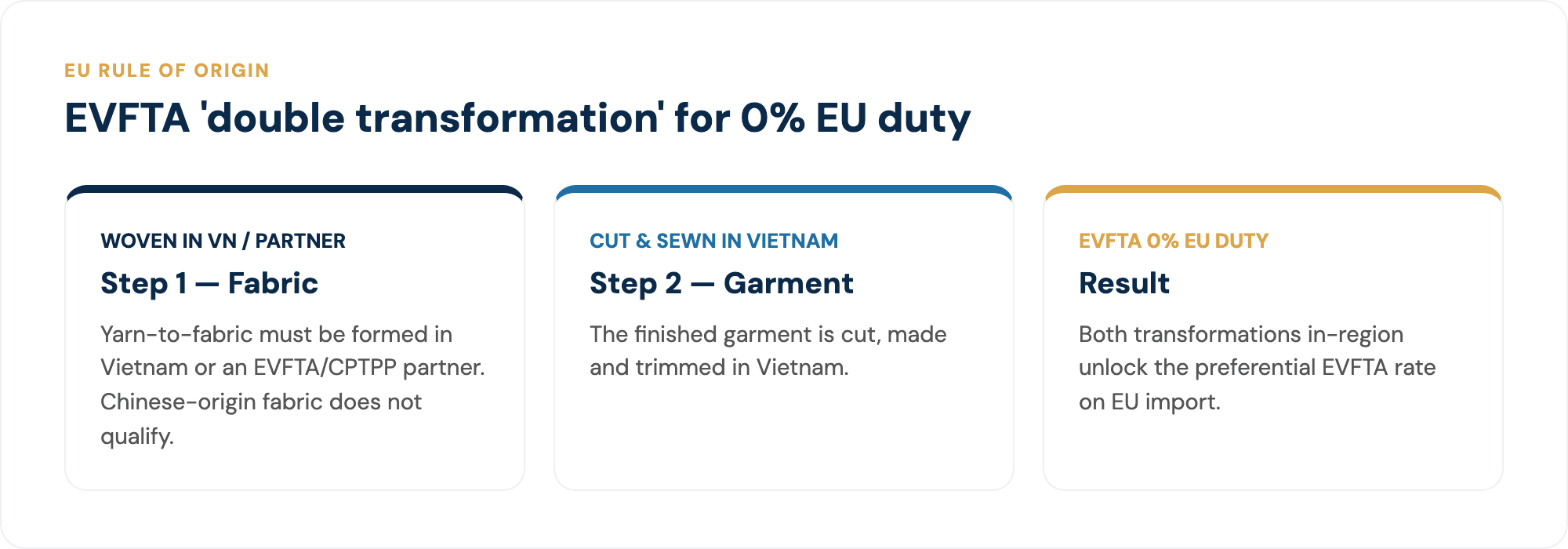
For EU buyers using EVFTA preferential rates, the “double transformation” rule of origin applies: fabric must be woven in Vietnam or a CPTPP[2]/EVFTA partner country, and the finished garment must be cut and sewn in Vietnam. Chinese-origin fabric does not qualify, which means your EVFTA duty benefit depends on sourcing your fabric from Vietnam or qualifying partners.
EVFTA’s “double transformation” rule means Chinese-origin fabric disqualifies your EU duty benefit. To claim EVFTA preferential rates, the fabric must be woven in Vietnam or a qualifying partner, then cut and sewn in Vietnam. Confirm your factory’s fabric origin before you count on the saving.
For US buyers, there is no equivalent fabric ROO restriction under the current US-Vietnam trade framework. US buyers can use Chinese fabric in Vietnam-manufactured garments without affecting origin qualification for most purposes (the exception being goods subject to specific CPSC rules or state-level sourcing requirements).
Practical implications:
- If EVFTA rates matter to your landed cost: work with factories that have domestic or qualifying fabric supply chains. Ask specifically for their fabric supplier list and request COO documentation for fabric before committing to production
- If EVFTA rates do not apply (US buyers, non-EVFTA categories): fabric sourcing is a quality and cost decision, not a compliance one
Product Categories: What Vietnam Does Well and Where It Has Limits
Strong:
- Woven casual and workwear (shirts, trousers, jackets): high competency, competitive pricing, strong factory ecosystem
- Knitwear (T-shirts, polo shirts, sweatshirts, hoodies): large production base, good capacity for mid-to-large runs
- Activewear and sportswear: well-developed technical fabric handling, particularly in HCMC factories
- Uniforms and corporate wear: Vietnam is a dominant global player; strong quality at volume
- Swimwear and intimate apparel: specialized factories, particularly in HCMC and Binh Duong
- High-detail embroidery: boutique factories in central Vietnam with artisan-level capability
Developing:
- Technical outerwear (Gore-Tex, waterproof membranes, taped seams): capacity exists but fewer factories at global brand standards than China or Taiwan
- Luxury ready-to-wear: quality is achievable but requires smaller, premium factories with brand-name buyer references
Not recommended:
- High-fashion sampling at speed: Vietnam turnaround for development samples is typically 3-4 weeks vs 1-2 weeks in Guangdong
- Very small runs (under 100 units): most factories decline or apply minimum order premiums that eliminate the cost advantage
Pricing Benchmarks: What to Expect at Factory Gate (FOB)
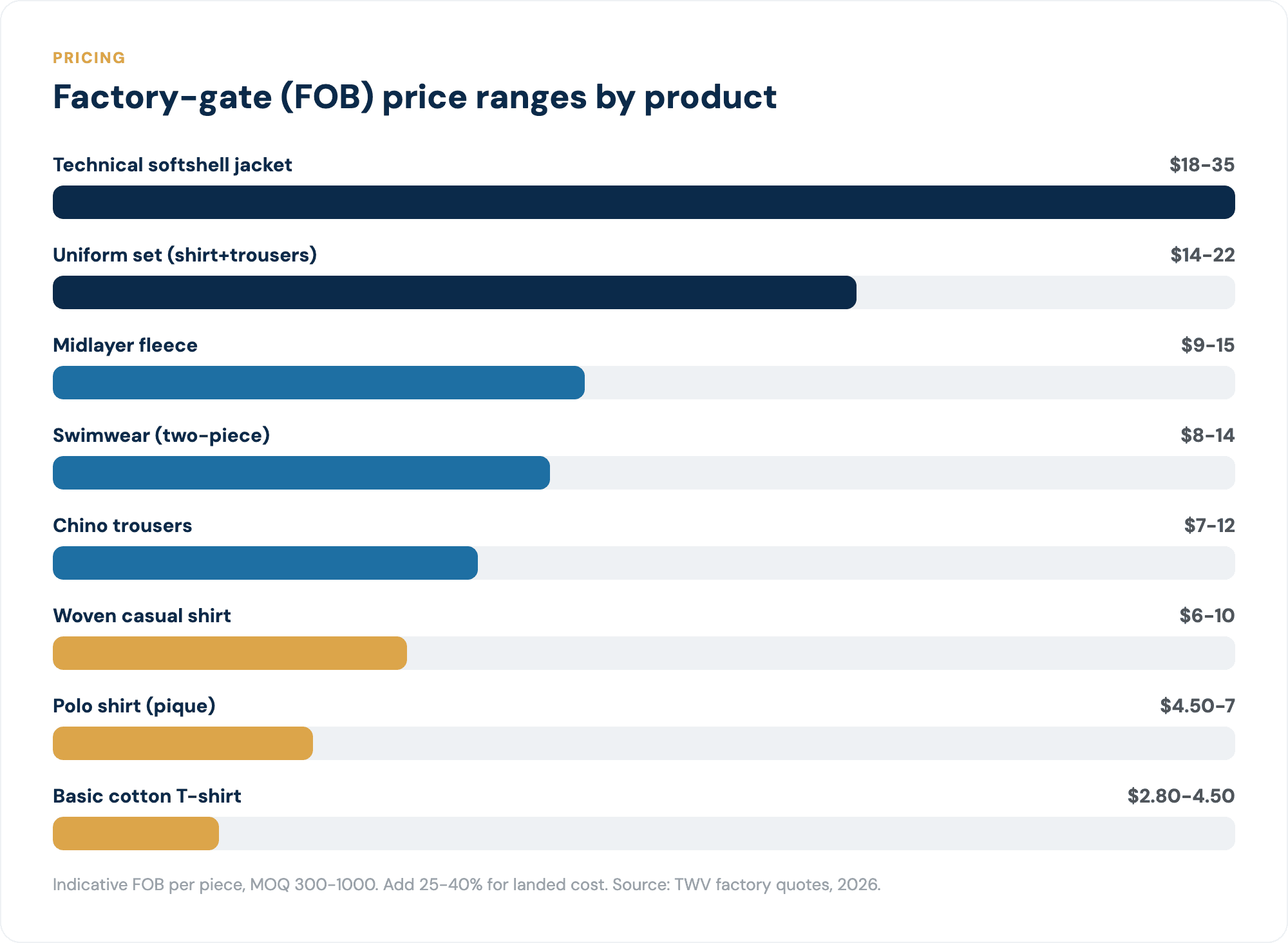
Pricing varies significantly by style complexity, fabric, order volume, and factory tier. These are rough FOB Ho Chi Minh City benchmarks for 2026:
| Product | MOQ | FOB Range |
|---|---|---|
| Basic cotton T-shirt (180gsm) | 300-500 pcs/style/color | $2.80-4.50 |
| Polo shirt (pique knit) | 300-500 pcs | $4.50-7.00 |
| Woven casual shirt | 300-500 pcs | $6.00-10.00 |
| Chino trousers | 300-500 pcs | $7.00-12.00 |
| Midlayer fleece | 300-500 pcs | $9.00-15.00 |
| Technical softshell jacket | 500-1000 pcs | $18.00-35.00 |
| Uniform set (shirt + trousers) | 500+ sets | $14.00-22.00 |
| Swimwear (two-piece) | 300-500 pcs | $8.00-14.00 |
These FOB figures do not include: shipping, insurance, import duties, customs brokerage, or inland freight. Add 25-40% for landed cost calculation depending on destination.
For US buyers, Section 301 tariffs do not currently apply to Vietnamese-origin apparel. For EU buyers, EVFTA preferential rates for qualifying garments reduce duties to 0-5% depending on HS code.
MOQ Structures and How to Negotiate Them
Vietnamese apparel factories set MOQs for two reasons: production efficiency and fabric procurement. Most factories run continuous production with 8-10 hours of machine time per style per shift. Below a certain unit count, setup time (cutting, threading, first-article inspection) exceeds the production time for the order, making it unprofitable.
Standard MOQs:
- Cut-and-sew: 300-500 pcs per style per colorway for most woven and knit products. Some factories will do 200 pcs per style with a premium (typically 5-15% on FOB price)
- Screen printing: 200-300 pcs per design per placement
- Embroidery: 100-200 pcs per design (lower MOQ because embroidery is slower and can amortize setup cost over fewer units)
- Custom fabric development: If you require custom fabric (specific weave, special finish), fabric mills have their own MOQs, typically 300-500m of fabric. This affects your minimum garment order significantly
To negotiate lower MOQs without destroying your unit economics:
- Consolidate colorways. Order the same style in three colors at 150 pcs each (450 total) rather than asking for 150 pcs in one color. The factory runs 450 pcs of the same cut; you get effective 150-unit minimums per color
- Commit to repeat orders. A factory will often accept a lower MOQ on the first order if you provide a credible forecast for follow-on orders. Put it in writing with a soft commitment letter
- Accept a longer lead time slot. Factories fill low-priority (small) orders between large runs. If you can accept a 10-12 week lead time instead of 6-8, some factories will accommodate 200-250 pcs per style
- Pay a premium and accept it as real cost. For test orders, the right question is not “can I get 100 pcs?” but “what is the all-in unit cost at 100 pcs and can my retail margin absorb it?”
A detailed guide on MOQ negotiation with Vietnamese factories is at tradewithviet.com/blog/moq-negotiation-vietnam.
Compliance Requirements for Apparel Buyers
US market:
- CPSC Flammability Standards (16 CFR Part 1610 for general wearing apparel; 16 CFR Part 1615/1616 for children’s sleepwear)
- CPSIA testing for children’s garments: lead content, phthalates, drawstring requirements
- FTC Care Labeling Rule: fiber content and country of origin on all labels
- California Prop 65: requires warning labels for products with chemicals above threshold levels
EU market:
- REACH: restricts certain chemicals in textiles (azo dyes, flame retardants, certain finishes)
- OEKO-TEX[3] Standard 100 certification is the practical compliance tool for most EU buyers, ask for it
- EU Textiles Regulation (labeling): fiber composition and country of origin in all official EU languages
- Ecodesign for Sustainable Products Regulation (ESPR): phasing in requirements for textile durability, repairability, and recycled content from 2025 onward
For both markets: your factory must be able to provide third-party test reports from accredited labs (SGS, Bureau Veritas, Intertek, QIMA) covering the relevant standards for your product category. Build this into your sample approval process, request test reports as a condition of commercial order placement.
Building a Supplier Relationship for Long-Term Production
The factories with the best production quality, best communication, and most flexible MOQ policies are almost always fully allocated 3-6 months in advance for peak season (US: Q4 holiday; EU: spring/summer). Late-approaching buyers get whatever capacity is left.
Build a factory relationship during their off-peak season (November-January for northern hemisphere apparel). Place a moderate first order at a realistic commercial timeline. Demonstrate that you can deliver a complete tech pack, approve samples on schedule, and pay on time. These are not small things, many small buyers create operational chaos for factories and get deprioritized.
Factories that work well with Trade With Viet buyers are in VietConnect’s verified directory at tradewithviet.com/suppliers/apparel. For introductions to specific factories matched to your product category and volume, book a sourcing consultation at tradewithviet.com/contact.
Sources
Source from Vietnam with an operating partner
Trade With Viet supports international buyers across 30+ countries with verified suppliers, compliance review, and first-order support, not just introductions.