7 min read

In this guide
When to Commission a Factory Audit
Not every purchase order requires a full factory audit. The cost runs $400-1,200 per audit day (one-day audits for most manufacturing facilities, two-day for complex operations or combined social and technical audits). The decision criteria:
Commission a full pre-order factory audit when:
- First order value exceeds $50,000
- Product category is compliance-sensitive: food, children’s products, cosmetics, medical devices, electrical goods, or any item with direct consumer safety implications
- You have no direct reference from a buyer you trust who has recently visited the factory
- The supplier has provided documentation you cannot fully verify remotely (certifications, export history, capacity claims)
- Your end customer (retailer, brand partner) requires audited supplier certification
A supplier assessment (document review only) is sufficient when:
- Order value is under $20,000 and product is low-risk (non-regulated, no compliance requirements)
- The supplier is already in VietConnect’s verified directory and you have reviewed their verification file
- You are placing a repeat order with a supplier you have previously audited
A pre-shipment inspection (PSI) replaces a full audit when:
- You need to verify production output quality, not facility capability
- The supplier has been previously audited and the audit passed
- Your specific quality risk is on-spec conformance, not production system integrity
VietConnect’s verification program at tradewithviet.com/trust completes steps equivalent to a Tier 1 supplier assessment (document review + video walkthrough + reference check) for all directory-listed suppliers. For buyers who require a full in-person audit, we coordinate with Bureau Veritas, SGS, Intertek, and QIMA in Vietnam.
The Four Types of Factory Audit and What Each Covers
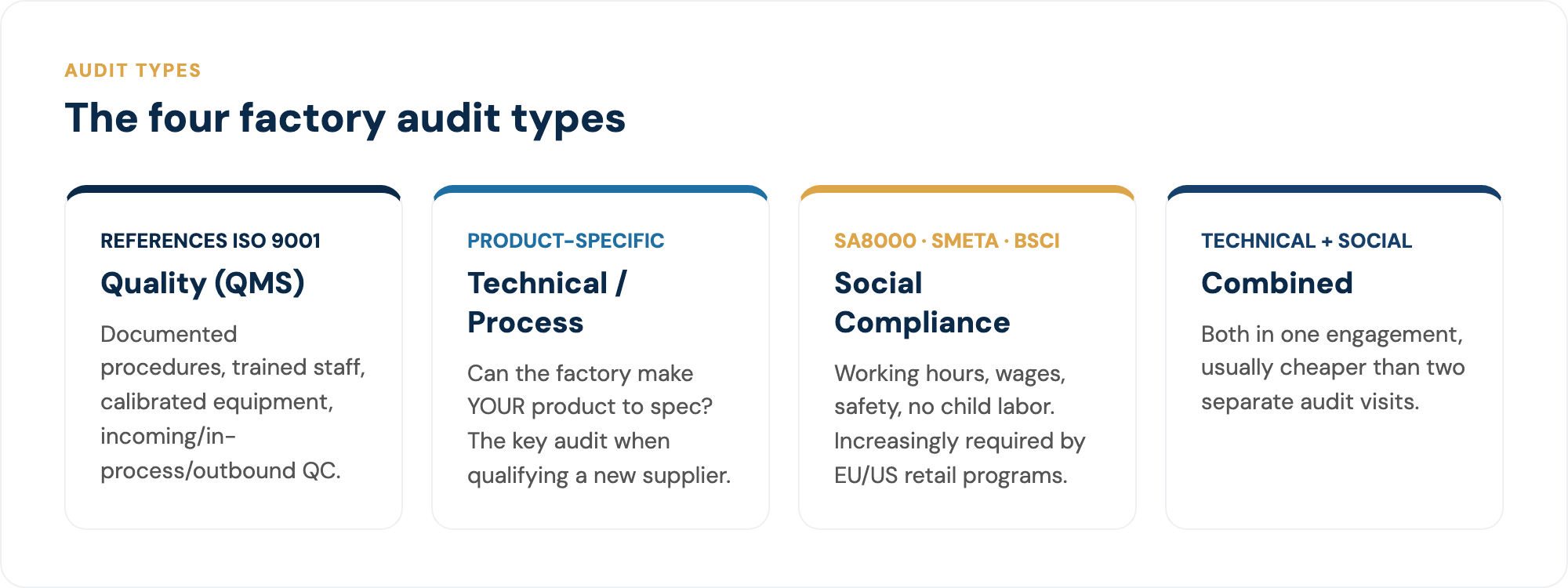
Quality Management Audit (QMS): Assesses the factory’s quality system, whether they have documented procedures, trained staff, calibrated equipment, incoming material inspection, in-process QC, and outbound inspection. Typically references ISO 9001[1]. Result: confirmation that the factory’s quality system is capable of meeting your requirements consistently.
Technical/Process Audit: Product-category-specific. An auditor with relevant technical expertise (garment construction, electronics assembly, food processing, etc.) evaluates whether the factory’s equipment, processes, and technical capabilities can produce your specific product to specification. This is the audit type most relevant to buyers qualifying a new factory for a specific product.
Social Compliance Audit (SA): Evaluates labor practices against standards such as SA8000[2], SMETA[3] (Sedex Members Ethical Trade Audit), or BSCI. Covers working hours, wages, freedom of association, child labor prohibition, health and safety conditions, and grievance mechanisms. Increasingly required by EU and US retailer supply chain programs.
Combined Audit: Technical + social compliance in one engagement. Most large audit firms offer combined audits at a lower total cost than separate audits. For buyers whose retailer customers require social compliance certification, combined audits are the standard approach.
To qualify a new factory, commission a Technical/Process audit (can it make YOUR product to spec) plus a Social Compliance audit if your buyers require it. A combined audit usually costs less than two separate visits.
What the Audit Must Verify: The Critical Checklist
A professional factory audit in Vietnam covers many items, but these are the categories that most often surface issues:
Legal and registration status:
- Business registration (matches what you have on file)
- Export license validity for your product category
- Factory operating permits (fire safety, environmental, required by Vietnamese law; absence indicates regulatory non-compliance risk)
Production capacity verification:
- Actual number of operational production lines and workers (not what was claimed in the supplier profile)
- Production machinery condition and calibration records
- Current factory loading, how much of capacity is currently committed vs available for your order
- Lead time verification: “We can produce 10,000 units in 30 days” should be cross-checked against available shift capacity
Quality management system:
- Incoming inspection records for raw materials (do they actually check what comes in?)
- In-process inspection records
- First-article inspection procedures (is the first production unit approved against a reference standard before the run continues?)
- Defect tracking, does the factory record defect rates? What is the current rate? A factory that cannot produce a defect rate report has no quality management system in practice
- Non-conformance procedures, what happens when a defect is found?
Labor practices (for social compliance):
- Attendance and payroll records (verify that actual wages match legal minimum wage requirements; overtime hours comply with Vietnam Labor Law limits, maximum 48 regular hours/week, 200-300 hours overtime/year)
- Worker age verification (child labor prohibition; Vietnam minimum working age is 15 for non-hazardous work, 18 for hazardous categories)
- Employment contracts, are workers on formal contracts?
- Health and safety: fire exits, extinguishers, safety equipment availability, first aid kits, emergency procedures
- Dormitory and canteen conditions if workers are on-site residential
Subcontracting disclosure:
- Does the factory subcontract any part of the production? To whom?
- Is the subcontractor also audited/certified?
- Unauthorized subcontracting is one of the most common compliance violations found in Vietnam factory audits. A factory that commits to producing your order in-house and then subcontracts without disclosure has breached your supply agreement
Environmental compliance:
- Wastewater treatment for factories with chemical processes (dyeing, tanning, surface treatment)
- Waste disposal procedures
- Hazardous chemical storage and handling (relevant for battery manufacturers, electronics, chemical compounds)
How to Interpret Audit Findings
Audit reports use severity classifications, typically:
- Critical / Zero-Tolerance: Child labor, forced labor, active safety hazard (blocked fire exits, no fire suppression, chemical exposure without PPE), falsification of records. These are deal-breakers. Do not place the order until the finding is remediated and re-verified.
- Major: Significant deficiency in a required system or practice. Examples: no formal QC procedure, systematic wage underpayment below minimum, expired fire safety certificate. Major findings should be remediated within 30-60 days. Request a corrective action plan (CAP) with timeline and re-audit.
- Minor: Procedural gaps, incomplete documentation, minor safety items. These should be corrected but do not by themselves block an order. Document them and verify correction at the next audit.
The most important thing to assess is not the count of minor findings (every factory has some) but the factory management’s response to findings. A management team that immediately acknowledges findings, explains root cause, and produces a CAP is a quality culture. A management team that disputes every finding, blames the auditor, or ignores the corrective action process is a risk that documents do not resolve.
Using Third-Party Audit Firms in Vietnam
Vietnam has strong coverage from major third-party audit and inspection firms:
- Bureau Veritas Vietnam: Full audit, inspection, and testing services. Strong across apparel, food, industrial, and electronics. Offices in HCMC and Hanoi
- SGS Vietnam: Broad coverage including social compliance, product testing labs, and HACCP audits for food processors
- Intertek Vietnam: Consumer goods focus; strong for CPSC, CE, and electrical safety compliance auditing
- QIMA (formerly AsiaInspection): Online platform for booking audits and inspections at transparent pricing; strong coverage across Vietnam manufacturing provinces
Cost benchmarks for 2026:
- Supplier assessment (document review, no site visit): $150-250
- One-day factory audit (QMS or technical): $450-750
- One-day social compliance audit (SMETA 2-pillar or 4-pillar): $500-800
- Combined audit (QMS + social, 1.5-2 days): $700-1,200
- Pre-shipment inspection (one man-day): $250-400
Budget these costs into your first-order financial model. For a $100,000 order, a $600 audit is 0.6% of order value. The cost of a defective container that passes without inspection is often 15-30% of order value in correction, re-shipping, and dispute resolution.
What VietConnect’s Supplier Verification Covers
VietConnect’s verification process for directory-listed suppliers covers: business registration check, export history review, quality certification document verification, and a reference check with at least one prior buyer. This is equivalent to a Tier 1 supplier assessment, sufficient for order qualification below $50,000 in non-regulated categories.
For buyers requiring full factory audits, VietConnect coordinates with qualified audit firms and provides buyers with direct introductions, including briefings on factory-specific areas of interest based on what we know about each supplier from our ongoing relationship.
Review the verification process and view verified suppliers at tradewithviet.com/trust. For audit coordination as part of a sourcing engagement, book a consultation at tradewithviet.com/contact.
Sources
Source from Vietnam with an operating partner
Trade With Viet supports international buyers across 30+ countries with verified suppliers, compliance review, and first-order support, not just introductions.