
8 min read
This guide is part of our how to source from Vietnam playbook, the full step-by-step map for importers.

In this guide
- Vietnam’s Medical Device and Personal Care Manufacturing Base
- Medical Device Classification: Know Your Class Before Selecting a Supplier
- FDA Requirements for US-Bound Medical Devices
- EU MDR and CE Marking: The 2024-2026 Reality
- ISO 13485: Verifying That the Certificate Is Real
- Personal Care Products: Cosmetics Regulation Compliance
- Building a First Supplier Relationship in Medical/Personal Care
Vietnam’s Medical Device and Personal Care Manufacturing Base
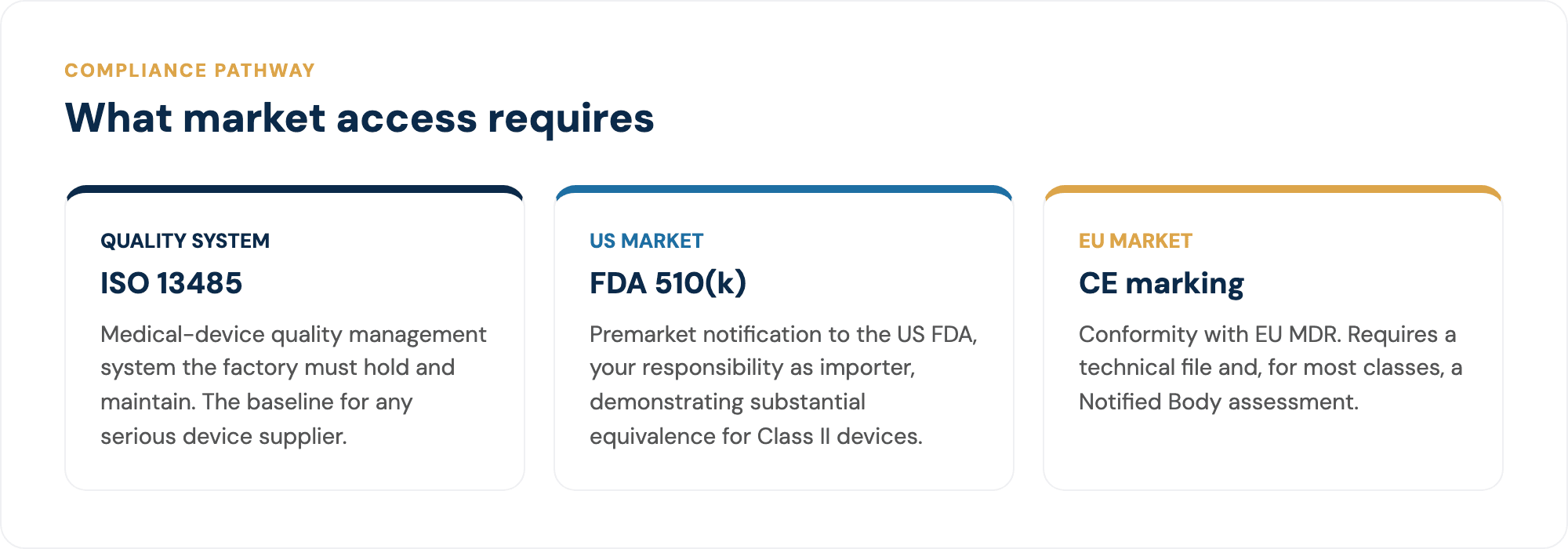
US market access for a Class II device needs an FDA submission and an ISO 13485[2] quality system. That regulatory responsibility sits with you as the importer, not the factory.
Vietnam’s medical device manufacturing sector is a smaller but growing category compared to its dominant export industries. It expanded significantly during 2020-2022 in response to global PPE demand and has continued developing post-pandemic, particularly in:
- Disposable medical consumables: Surgical gloves, masks, gowns, syringes, drapes, sutures
- Diagnostic devices and equipment: In-vitro diagnostic (IVD) test kits, blood glucose monitors, blood pressure devices
- Orthopedic and rehabilitation aids: Braces, supports, mobility aids
- Personal protective equipment: Industrial and medical-grade masks, face shields, protective clothing
- Cosmetics and personal care: Skincare products, hair care, body care formulated in Vietnam; some OEM manufacturing for international brands
- Herbal and natural health products: Vietnam has a strong traditional medicine base; some manufacturers bridge into export-grade herbal supplements
The personal care sector is more developed than medical devices in terms of export volume and regulatory readiness. Vietnam’s cosmetics manufacturing has grown alongside EVFTA[1] market access, with several factories achieving EU Cosmetics Regulation compliance and ISO 22716 GMP certification.
VietConnect lists 54 verified medical device and personal care suppliers at tradewithviet.com/suppliers/medical-devices.
Medical Device Classification: Know Your Class Before Selecting a Supplier
 [4], CE marking[5].” loading=”lazy”>
Medical device classification determines the regulatory pathway in each market. Vietnam itself follows a classification system broadly aligned with the Global Harmonization Task Force (GHTF):
- Class A (lowest risk): Bandages, tongue depressors, examination gloves, wheelchairs
- Class B: Hypodermic needles, suction equipment, blood pressure monitors
- Class C: Lung ventilators, bone fixation plates, dialysis machines
- Class D (highest risk): Active implants, heart valves
For US market entry, the FDA equivalent:
- Class I: Most exempt from premarket notification (510k). Examples: elastic bandages, handheld surgical instruments, latex examination gloves
- Class II: Requires 510k clearance[4]. Examples: powered wheelchairs, blood glucose monitors, surgical drapes
- Class III: Requires Premarket Approval (PMA). Examples: implanted pacemakers, replacement heart valves
The critical implication for Vietnam sourcing: Vietnam has a limited number of Class II-capable factories with the quality systems, design controls, and regulatory documentation required to support a 510k submission. For Class I devices, the Vietnamese manufacturing base is adequate. For Class II, buyer due diligence on quality system capability is essential. Class III medical device manufacturing in Vietnam is not at export-ready scale for most categories.
For EU buyers, the Medical Device Regulation (EU MDR 2017/745) is the applicable framework, with requirements that are in some ways stricter than FDA. CE marking for medical devices requires involvement of a Notified Body for Class IIa, IIb, and III devices.
FDA Requirements for US-Bound Medical Devices
Establishment Registration: All foreign establishments that manufacture, prepare, propagate, compound, or process medical devices for import into the US must register with FDA annually. Registration is done through FDA’s FURLS (FDA Unified Registration and Listing System). Ask your Vietnamese supplier for their FDA establishment registration number and verify at fda.gov/medical-devices/device-registration-and-listing.
Device Listing: Each device commercially distributed in the US must be listed with FDA. This is the manufacturer’s responsibility but the importer should verify that the specific device you are purchasing is listed.
Quality System Regulation (21 CFR Part 820) / FDA Quality Management System Regulation (QMSR): From February 2026, FDA’s QMSR aligns with ISO 13485:2016[7]. Vietnamese manufacturers who hold current ISO 13485 certification from an accredited certification body are substantially compliant. Verify the certificate scope covers the specific device category you are purchasing.
Premarket Notification (510k) or PMA: For Class II devices, a cleared 510k must exist before the device can be legally marketed in the US. You can search FDA’s 510k database at 510k.accessdata.fda.gov. If the device you want to source does not have a cleared 510k, the path to US market requires an FDA submission, which is your regulatory responsibility as the US importer/device introducer, not the Vietnamese factory’s.
Unique Device Identification (UDI): Most Class II and all Class III medical devices sold in the US must be labeled with a UDI and have the device information submitted to FDA’s GUDID database. This labeling requirement cascades to the Vietnamese manufacturer: device labels must be designed and printed to UDI specification.
EU MDR and CE Marking: The 2024-2026 Reality
The EU Medical Device Regulation (MDR 2017/745) is the law governing medical devices in the EU market. Transition from the previous MDD Directive has been extended multiple times; as of 2026, the transition for legacy CE marked devices continues under managed timelines.
For new products without legacy MDD certification:
- Class I devices (non-sterile, non-measuring): Self-certification by the manufacturer, no Notified Body required. The manufacturer drafts a Declaration of Conformity and applies the CE mark
- Class I sterile/measuring, Class IIa, IIb, Class III: Requires assessment by an EU Notified Body (DEKRA, TÜV SÜD, BSI, etc.). Vietnamese manufacturers seeking CE marking for these classes must engage a Notified Body directly
The Notified Body bottleneck is real: there are currently approximately 40 to 50 active Notified Bodies for MDR globally[6], and lead times for conformity assessment range from 12-36 months for complex devices. If you need a Class IIa device CE marked under MDR with a Vietnamese manufacturer, plan the regulatory timeline before selecting the supplier.
For IVDR (In Vitro Diagnostic Regulation 2017/746): similar framework with own class structure. Transition timelines are extended through 2028 for some device classes.
ISO 13485: Verifying That the Certificate Is Real
ISO 13485 is the quality management system standard for medical device manufacturers. It is the prerequisite certification for FDA registration compliance under QMSR and for CE marking under EU MDR.
How to verify:
- Ask for the ISO 13485 certificate
- Identify the accreditation body that accredited the certification body (for example, BSI’s ISO 13485 certificates are accredited by UKAS; TÜV certificates are accredited by DAkkS)
- Verify the accreditation body is a member of the IAF (International Accreditation Forum), iaf.nu/members/
- Check the certificate number against the certification body’s public registry
- Confirm the scope of certification covers your specific product category and manufacturing process
A certificate that covers “surgical gloves” does not cover “blood glucose monitoring systems.” Scope matters.
Also verify the certificate is not suspended. ISO certification bodies publish suspension and withdrawal notices. Check before relying on a certificate.
Personal Care Products: Cosmetics Regulation Compliance
Vietnam manufactures cosmetics and personal care products for OEM export. The regulatory requirements differ substantially from medical devices.
EU Cosmetics Regulation (EC 1223/2009):
- Every cosmetic product sold in the EU must have a Responsible Person (RP) established in the EU. The RP is legally responsible for compliance and product safety
- A Product Information File (PIF) must be maintained for each product, including safety assessment, manufacturing method, proof of effect claims, and GMP data
- Some ingredients are prohibited or restricted; REACH[3] chemical restrictions apply
- Nanomaterials require notification
- Claims must be substantiated
FDA (US), Cosmetics:
- The Modernization of Cosmetics Regulation Act (MoCRA) signed in 2022 introduced facility registration and product listing requirements for cosmetic manufacturers and importers, phased in through 2024-2025
- Fragrance allergen labeling is under development
- GMP guidelines for cosmetics (21 CFR Part 700 and FDA’s voluntary guidelines) are not mandatory but regulatory expectation is increasing
ISO 22716 GMP for Cosmetics: The international standard for Good Manufacturing Practices in cosmetics. Vietnamese cosmetics exporters serving EU or premium US markets should hold ISO 22716 certification. Verify as you would any other certificate.
Key compliance risk for cosmetics: ingredient provenance. An ingredient banned in the EU (certain preservatives, hair dye components, specific UV filters) may be legally used in Vietnamese domestic production. If your Vietnamese OEM manufacturer is also producing domestic-market products, confirm that the formulation for your export product is separately managed and does not include restricted ingredients.
Building a First Supplier Relationship in Medical/Personal Care
The due diligence timeline for medical device and personal care sourcing is longer than for manufactured goods. In our sourcing experience, budget roughly 8 to 12 weeks for supplier qualification, regulatory document review, sample testing, and regulatory counsel review before placing a first production order.
Recommended sequence:
- Identify the device classification and applicable regulatory pathway for your target market (US FDA class, EU MDR class) before selecting a supplier
- Shortlist suppliers whose documented certifications match the required class and category
- Request and verify ISO 13485 certificate (for devices) or ISO 22716 certificate (for cosmetics)
- Confirm FDA establishment registration (for US-bound devices)
- Request product samples and commission independent laboratory testing for relevant standards
- Engage a regulatory consultant (US FDA-registered agent or EU Authorized Representative as applicable) before first import
- Place a commercial order only after regulatory pathway is confirmed
VietConnect’s verified medical device and personal care supplier directory at tradewithviet.com/suppliers/medical-devices includes certification status for listed suppliers. For category-specific supplier introductions and regulatory pathway guidance, book a sourcing consultation at tradewithviet.com/contact.
Sources
- European Commission: EU-Vietnam Free Trade Agreement
- ISO: ISO 13485 Medical devices QMS
- European Chemicals Agency: Understanding REACH
- U.S. FDA: Premarket Notification 510(k)
- European Commission: CE marking
- European Commission: Notified Bodies for Medical Devices
- U.S. FDA: Quality Management System Regulation (QMSR)
Source from Vietnam with an operating partner
Trade With Viet supports international buyers across 30+ countries with verified suppliers, compliance review, and first-order support, not just introductions.