
8 min read
This guide is part of our how to source from Vietnam playbook, the full step-by-step map for importers.

In this guide
- Why Vietnamese Factories Set MOQs: The Real Reason
- The Consolidation Method: Lowest-Risk MOQ Reduction
- The Forecast Commitment Method: Buying Future Flexibility
- The Premium Payment Method: Pay for the Exception
- Category-Specific MOQ Benchmarks and What Is Negotiable
- What Factories Need From You to Say Yes to a Lower MOQ
- When to Walk Away From a Low MOQ Conversation
Why Vietnamese Factories Set MOQs: The Real Reason
Lower an MOQ by reducing the factory’s setup risk, not by asking them to simply do less: consolidate SKUs that share fabric and color, prepay tooling, or commit to a forecast.
MOQ is not arbitrary. It is an operational break-even calculation. Factories price their production against a fixed cost block, setup time, machine calibration, first-article inspection, and material waste, that exists regardless of order size. Below a certain unit count, that fixed cost makes the order unprofitable or margin-negative.
The structure of that cost block varies by category:
- Apparel: Setup (cut layout, thread changes, needle changes) typically takes 2-4 hours per style. At 300 units, setup is 10-15% of total production time, acceptable. At 100 units, setup is 25-40% of total production time, factories either price it punitively or decline
- Furniture: Tooling for CNC cutting, jig setup for assembly fixtures, and stain/finish mixing represent fixed costs. Below 20-30 units on custom designs, these costs become a large fraction of total order value
- Food and beverage: Minimum production runs are set by minimum batch sizes on processing equipment (blending tanks, filling lines, pasteurizers). A filling line might have a minimum run of 500 kg; ordering 50 kg is not operationally possible
- Electronics/components: Tooling amortization, especially for injection-molded parts, dominates. The factory needs a minimum quantity to recover tooling cost at an acceptable unit price
Understanding the specific cost driver behind an MOQ gives you leverage. If you can reduce the factory’s fixed cost burden, by consolidating SKUs, prepaying for tooling, or accepting a longer production window, you can often negotiate the effective MOQ down.
The Consolidation Method: Lowest-Risk MOQ Reduction
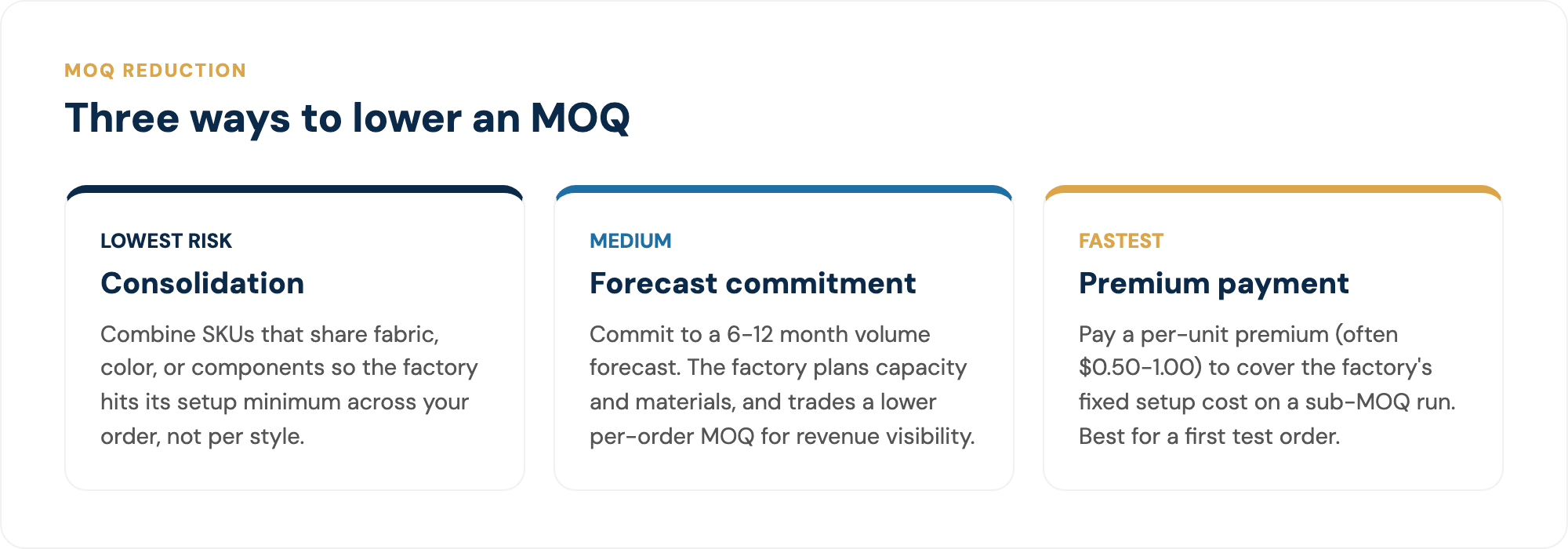
The highest-probability MOQ negotiation for apparel and similar categories is consolidation: ordering multiple styles or colorways on the same base construction to reach total volume.
Example: A buyer wants 150 units of a polo shirt in white. Factory MOQ is 300 units per style per color. Instead of asking for an exception, the buyer orders:
- 150 units white
- 150 units navy
Total: 300 units. Same cut, same pattern, same material, just different colorway. The factory’s setup cost is absorbed across 300 units either way. The buyer gets effective 150-unit colorway minimums.
Extend this to style consolidation: two styles in the same fabric, same construction, same size run. A buyer ordering 150 units of a T-shirt and 150 units of a long-sleeve in the same 180gsm cotton at the same factory often qualifies for 300-unit pricing even though each individual SKU is below threshold. Ask explicitly: “If I consolidate these two styles on the same fabric, can I combine units toward your MOQ?”
This works in furniture too. A buyer wanting 15 units of a dining table design can often reach an MOQ by adding 15 matching chairs, same wood species, same finish, same production run.
The Forecast Commitment Method: Buying Future Flexibility
Factories care more about revenue predictability than any individual order size. A buyer who commits credibly to a repeat purchase schedule can negotiate lower first-order MOQs in exchange for that visibility.
How to make this work:
- Put it in writing. A soft commitment letter (not a purchase order, but a stated intent) with quantities and timing is more credible than a verbal promise. Something like: “Subject to satisfactory first-order quality, we intend to place [X units per quarter] over the next 12 months.” Factories know it is non-binding, but it signals planning maturity
- Reference your business. Share your website, a recent catalog, or other evidence of an active retail or B2B business. A factory will extend more flexibility to a buyer with a demonstrated customer base than to an individual with no business trail
- Start with a test order framing. Explicitly calling it a “test order” frames lower quantity as a qualification step, not a permanent ask. “We want to run 200 units as a quality test before placing our full seasonal order of 1,200 units” is a credible conversation. “We only need 200 units ever” is not
- Be specific about the follow-on volume. Vague promises (“we’ll order more”) are ignored. Specific commitments (“if quality passes, we’ll place 600 units in October”) are taken seriously
The Premium Payment Method: Pay for the Exception
If you genuinely need a below-MOQ quantity and the consolidation method is not applicable, the most straightforward approach is to pay a small lot premium and treat it as a real cost of the first order.
Most factories will do below-MOQ quantities at a unit price premium of 10-25% over their standard FOB. Some call it a “sample surcharge” or “small lot fee.” At 200 units with a 15% premium on a $6 FOB shirt, that is $0.90/unit, $180 total. On a first-order test, $180 is not the decision variable.
When to use this approach: when the ROI on the test order justifies it, when you have a specific retail channel waiting for the product, or when sample-level quality approval is required before you can commit to a full production run.
When not to use it: when your long-term unit economics require the standard FOB price. If you need $6 landed factory cost and the small lot premium puts you at $7.50, plan for a minimum 300-unit order from the start.
Category-Specific MOQ Benchmarks and What Is Negotiable
Apparel (cut-and-sew):
- Standard: 300-500 pcs per style per color
- Negotiable to: 150-200 pcs with consolidation or premium; 100 pcs for embroidery-heavy pieces
- Hard floor: most factories will not run below 100 pcs per production cut
Furniture (standard designs from factory catalog):
- Standard: 20-30 units per SKU
- Negotiable to: 10-15 units if combined with other SKUs in same finish and material
- For custom designs: tooling cost is separate (VND 5-20 million / $200-800); order size is negotiated after tooling is approved
Furniture (custom/OEM designs):
- MOQ is set by tooling amortization. Calculate: tooling cost / acceptable tooling cost per unit = MOQ. A $600 jig cost amortized at $3/unit = 200-unit MOQ minimum to absorb tooling
Processed food (standard products):
- Standard: 500-2,000 units for packaged/private-label products
- Bulk commodities: negotiable based on container economics (a 20ft container of coffee = approximately 14-18 metric tons; this is effectively the FOB minimum that makes freight sense)
- For custom formulations or private-label recipes: minimum batch size is determined by processing equipment and is not negotiable
Industrial components:
- Tooling is always the constraint. Ask for tooling cost upfront. Budget for it as a sunk cost on the first order
- Once tooling exists, repeat order MOQs are usually much lower than initial minimum
What Factories Need From You to Say Yes to a Lower MOQ
The barrier is almost never the conversation. It is the buyer’s credibility.
Before you ask for a MOQ exception, deliver:
A complete, unambiguous tech pack. A buyer who submits a complete tech pack with material specifications, tolerance ranges, label artwork, and size grading tables signals operational competence. It reduces the factory’s risk that the order will require multiple correction rounds. Incomplete tech packs are the single biggest predictor of first-order failure, and factories know it
Payment history or a financial reference. New buyers asking for favors carry more risk than known buyers. If you have a track record with other Vietnamese factories, mention it with a reference. If you are new to Vietnam but have a supplier in another country, offer that reference
A realistic delivery schedule. Buyers who need product “as soon as possible” and are flexible on nothing are operationally difficult. Buyers who can say “we need delivery by September 15 and can accept production starting August 1” give the factory planning room, which is worth something in scheduling your order
No mid-process specification changes. Nothing destroys factory trust faster than a buyer who changes specifications after sampling is underway. The commitment you demonstrate in your tech pack, sample approval, and order placement process will determine how flexible the factory is on your next negotiation
For help identifying factories that are the right fit for your volume and category, VietConnect lists 549+ verified Vietnamese manufacturers across all major categories. For a sourcing consultation that includes factory introductions and first-order support: tradewithviet.com/contact.
When to Walk Away From a Low MOQ Conversation
Not every MOQ negotiation is worth having. If a factory’s standard MOQ is 10x your target quantity, there is a category mismatch, this factory services a buyer tier your order does not fit. Pursuing it costs time and often produces compromises that hurt you at production stage.
The better path: find factories whose standard MOQ is closer to your order size. A factory whose sweet spot is 200-unit runs is a different business than one whose minimum is 3,000. Both exist in Vietnam. The VietConnect directory filters by factory size and minimum order range, which helps match buyer volume to supplier type before first contact.
For a sourcing consultation and factory introductions matched to your specific volume and category: tradewithviet.com/contact.
Source from Vietnam with an operating partner
Trade With Viet supports international buyers across 30+ countries with verified suppliers, compliance review, and first-order support, not just introductions.