
8 min read

In this guide
- Why Vietnam Export Documentation Is More Complex Than Most Buyers Expect
- The Core Export Documentation Set
- Certificate of Origin Forms by Trade Agreement
- Rules of Origin: The Document Behind the Document
- Practical Checklist: What to Confirm Before Each Shipment
- HS Code Accuracy: The Foundation of Document Compliance
Why Vietnam Export Documentation Is More Complex Than Most Buyers Expect
Your preferential duty saving lives or dies on the Certificate of Origin. Confirm the correct CO form and rule-of-origin before production, not at the destination port.
Vietnam’s export documentation system reflects its position as a signatory to multiple overlapping free trade agreements. The country is party to ASEAN FTAs (with China, Korea, Japan, India, Australia-NZ), CPTPP[2] (Canada, Australia, Japan, Mexico, New Zealand, and others), and EVFTA[1] (European Union). Each FTA uses different CO forms, different rules of origin criteria, and different verification protocols at the destination customs authority.
For buyers from countries outside any FTA with Vietnam (US buyers in most categories, for example), documentation is simpler but still requires a non-preferential CO and full commercial documentation set. The complexity scales with the trade agreement you are trying to use.
Understanding the documentation chain upfront prevents two common and expensive outcomes: shipment delays at destination port caused by missing or incorrect documents, and forfeited duty savings because the wrong CO form was presented or the RVC (Regional Value Content) threshold was not documented.
The Core Export Documentation Set
Every Vietnam export shipment requires these baseline documents:
Commercial Invoice: Issued by the Vietnamese exporter. Must include: seller and buyer name and address, port of loading and discharge, HS code (Vietnamese export HS code), goods description, quantity, unit price, total value, and Incoterms[3] (FOB, CIF, etc.). The invoice value is the basis for customs valuation at destination.
Packing List: Itemized by carton, showing gross weight, net weight, dimensions, and contents per carton. Required for customs clearance and inland freight. Must match commercial invoice exactly on quantities and descriptions.
Bill of Lading (BL) or Airway Bill (AWB): Issued by the shipping carrier. The BL serves as both a receipt of goods and (for negotiable BLs) a document of title. The notify party and consignee fields must match exactly what your destination customs broker has on file.
Export Declaration (Tờ khai hải quan xuất khẩu): Filed by the Vietnamese exporter with the General Department of Vietnam Customs. This is the customs export registration, the document that confirms the goods legally left Vietnam under the declared HS code and value. Buyers should request a copy as proof of legal export.
Certificate of Origin (CO): Certifies Vietnam origin of the goods. Form and issuing body depends on destination and claimed trade agreement (see next section).
Optional but often required:
- Certificate of Quality (CQ) / Certificate of Conformity (CoC): Issued by authorized Vietnamese inspection agencies (VINACONTROL, QUATEST, SGS Vietnam) confirming the goods meet specified quality standards. Required by some buyers’ contracts, some destination customs authorities, and many letter-of-credit terms
- Phytosanitary Certificate (for agricultural products): Issued by the Plant Protection Department under MARD. Required for plant-based products in most destination markets
- Health Certificate (for food of animal origin): Issued by MARD (for seafood and meat) or DPM (for plant-based food). Required by US FDA, EU, and most APAC markets for food shipments
- Certificate of Free Sale (CFS): Issued by relevant Vietnamese ministry confirming the product is freely sold in Vietnam. Required by some destination markets for cosmetics, medical devices, and food supplements
Certificate of Origin Forms by Trade Agreement
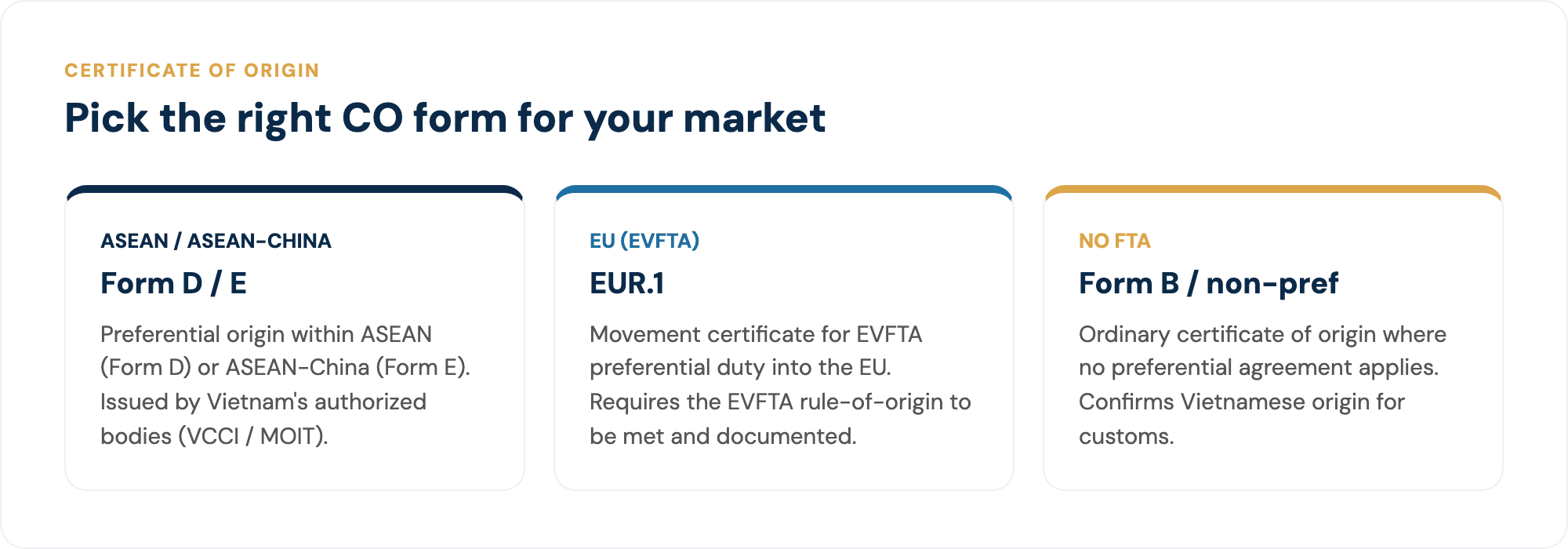
Form B (Non-Preferential): The standard CO for shipments where no FTA preferential rate is being claimed. Used for US-bound shipments in most categories, shipments to countries without FTA coverage, and shipments where ROO requirements are not met. Issued by VIETRADE or authorized Chambers of Commerce. Cost: approximately VND 100,000-200,000 ($4-8 USD) per CO in service fees, above the official issuance fee of around VND 60,000. Processing time: 1-3 working days
Form D (ASEAN): For trade between ASEAN member states under the ATIGA (ASEAN Trade in Goods Agreement). Used for shipments to Thailand, Malaysia, Indonesia, Philippines, Singapore, Brunei, Cambodia, Laos, Myanmar. ATIGA preferential rates for most goods are 0-5%. Issued by VIETRADE. RVC threshold: 40% or Change in Tariff Classification (CTC)
Form E (ASEAN-China FTA): For shipments to mainland China claiming ACFTA preferential rates. Significant duty reductions on manufactured goods. Issued by VIETRADE. RVC threshold: 40%
Form AK (ASEAN-Korea FTA): For shipments to South Korea under AKFTA. Issued by VIETRADE or VCCI
Form AJ (ASEAN-Japan FTA) / Form VJ (Vietnam-Japan Economic Partnership): For Japan. Vietnam also has a bilateral VJEPA with Japan. Check which agreement gives better rates for your HS code
Form AI (ASEAN-India FTA): For India. AIFTA rates apply to specific tariff lines; not all products qualify
Form AANZ (ASEAN-Australia-New Zealand FTA): For Australia and New Zealand. AANZFTA preferential rates are available on a tariff schedule published by DFAT and NZ Customs. Issued by VIETRADE
EUR.1 Movement Certificate (EVFTA): For shipments to EU member states claiming EVFTA preferential duty rates. Issued by VIETRADE or a VIETRADE-authorized body. This is the most document-intensive CO: the exporter must be able to demonstrate that the goods meet EVFTA rules of origin (typically substantial transformation or RVC thresholds of 40-60% depending on category). Processing time: 3-5 working days. EU customs may request back-up documentation. Alternatively, suppliers who are “Registered Exporters” (REX) under the EU system can self-certify origin on the invoice
CPTPP CO (Form CPTPP): For CPTPP member countries (Canada, Mexico, Peru, Chile, Australia, New Zealand, Japan, Singapore, Brunei, Malaysia). CPTPP uses a self-certification system, the exporter can certify origin directly on the invoice, bill of lading, or a separate origin declaration. No separate CO form required if the exporter is authorized to self-certify. However, the exporter must have documented proof of ROO compliance on file
Rules of Origin: The Document Behind the Document
A Certificate of Origin is only valid if the goods actually meet the rules of origin for the agreement being claimed. The RO is where compliance failures happen, and where destination customs authorities conduct post-clearance audits.
Wholly Obtained (WO): Applies to primary products, agricultural goods grown, harvested, or caught in Vietnam, minerals extracted in Vietnam. No imported inputs. Straightforward for coffee, seafood, rice, pepper.
Regional Value Content (RVC): Applies to manufactured goods. The percentage of the product’s value that originates in Vietnam (or the FTA partner zone). Threshold varies: ATIGA uses 40%, EVFTA uses 30-50% depending on category. RVC = (FOB Price – Value of Non-Originating Materials) / FOB Price x 100.
Change in Tariff Classification (CTC): The finished product has a different HS code chapter or heading than the non-originating inputs used to make it. This test is used in CPTPP for many manufactured categories.
Your Vietnamese supplier needs to calculate and document the applicable RVC or CTC test for each product they export under a preferential CO. Many factories do this routinely. Some do not, particularly smaller factories or those new to FTA utilization. Ask for their ROO calculation worksheet for your specific product before assuming the CO they provide is valid.
Practical Checklist: What to Confirm Before Each Shipment
Before your shipment departs Vietnam, confirm the following with your supplier and freight forwarder:
- [ ] Commercial invoice and packing list match in item count, weight, and description
- [ ] HS code on invoice matches the code declared on the export declaration
- [ ] CO form type matches the FTA being claimed for your destination market
- [ ] CO is issued by an authorized body (VIETRADE, VCCI, or Chamber of Commerce with VIETRADE delegation)
- [ ] For EVFTA: EUR.1 certificate is signed and stamped; or REX self-certification is on the invoice from an authorized REX exporter
- [ ] For food shipments: phytosanitary or health certificate is included as required by destination
- [ ] Bill of lading consignee and notify party details are correct (a discrepancy here delays customs release)
- [ ] If LC (letter of credit) payment terms: all document requirements specified in the LC are met before ship date
HS Code Accuracy: The Foundation of Document Compliance
The HS code you declare determines: the applicable duty rate, the CO form and RVC test that applies, whether an import license or permit is required at destination, and whether anti-dumping or countervailing duties apply.
Vietnamese exporters sometimes use approximate HS codes, particularly smaller factories without dedicated trade compliance staff. Buyers should independently verify the correct 8-digit HS code for their product at the destination country’s tariff schedule:
- US: HTS (Harmonized Tariff Schedule) at hts.usitc.gov
- EU: TARIC at ec.europa.eu/taxation_customs/dds2/taric/
- UK: UK Global Tariff at gov.uk/trade-tariff
- Australia: Australian Customs Tariff at abf.gov.au
Use the HS code lookup tool at tradewithviet.com/tools/hs-code to identify the correct code for your product and check applicable Vietnam-origin duty rates by market.
A one-digit HS code error can cost you a preferential duty rate worth 5-15% of shipment value. For a $100,000 shipment, that is $5,000-15,000 in avoidable duty. Verify before the shipment is declared.
For buyers working with Vietnam for the first time, Trade With Viet’s sourcing consultation includes a documentation briefing covering the CO requirements for your specific product and destination. Book at tradewithviet.com/contact.
Sources
Source from Vietnam with an operating partner
Trade With Viet supports international buyers across 30+ countries with verified suppliers, compliance review, and first-order support, not just introductions.