
7 min read
In this guide
- What factory capacity actually means (and why stated numbers mislead)
- The 5 capacity signals you must verify
- How to verify capacity remotely, without flying to Vietnam
- Stated claim vs red flag: a verification checklist
- Frequently Asked Questions
- Next Steps
1. What Factory Capacity Actually Means (and Why Stated Numbers Mislead)
Verify real capacity before a bulk PO: ask for machine count, monthly output, and current order book, then cross-check against an audit rather than the factory’s word.
When a Vietnam garment factory tells you it can produce 100,000 pieces a month, that figure is almost always the theoretical maximum: every line running, every machine staffed, a simple product, and no other clients. You will never get that number. The capacity that matters to you is the realistic monthly output for your product type, at your quality level, in the slot the factory has open when you need it.
Three different numbers hide inside the word capacity. Nameplate capacity is the factory’s full installed output if nothing goes wrong. Effective capacity accounts for product complexity, changeovers, and normal efficiency losses, usually 60 to 75% of nameplate. Available capacity is what is left after existing orders are booked, and during peak season from August to November it can drop below 20%.
The most common sourcing failure is not a factory that lies about its size. It is a factory that quotes a lead time it cannot hold because its lines are already committed to other buyers. Verifying capacity is really about confirming available capacity in your production window, not admiring the size of the building.
2. The 5 Capacity Signals You Must Verify
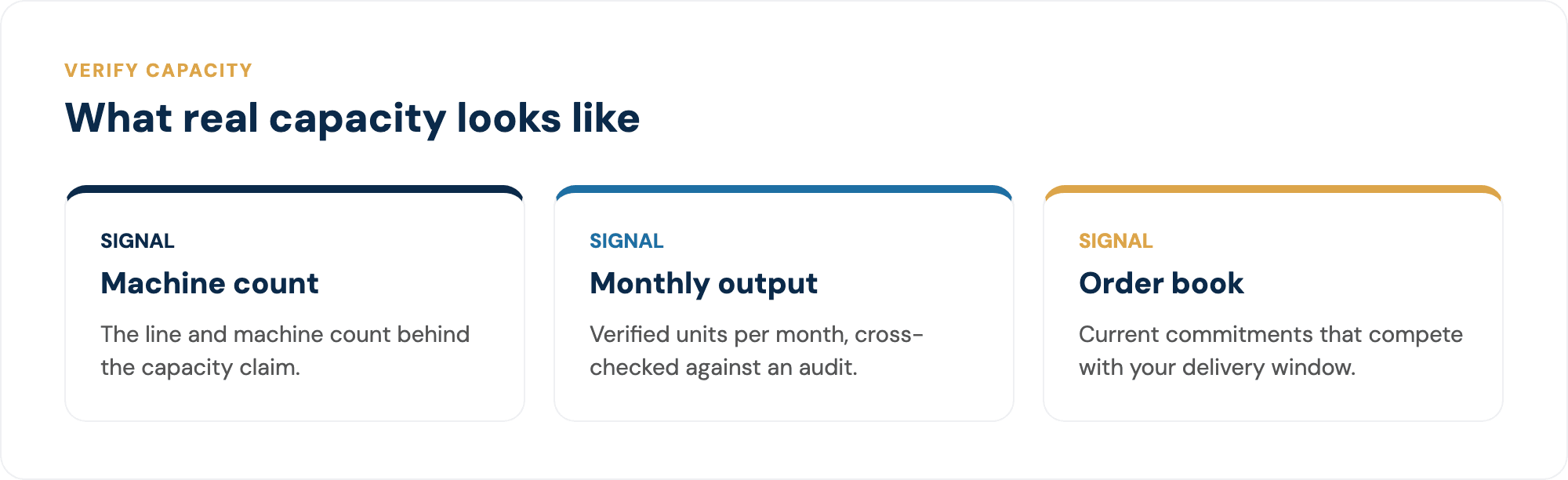
Vietnam’s garment clusters in Ho Chi Minh City, Binh Duong, Dong Nai, and Hai Phong range from 50-worker CMT units to 5,000-worker industrial parks. Size alone tells you nothing. These five signals do.
1. Sewing lines and machine count. Ask for the number of sewing lines and machines per line. A standard line runs 25 to 40 machines and produces one style at a time. A factory with 8 lines can run 8 styles in parallel. Then ask about specialized machines for your product: flatlock and coverstitch for knitwear, bartack and buttonhole for shirts, bonding or welding for technical outerwear. A factory without the right machines will subcontract your order, and you lose control of quality.
2. Monthly output for your product type. A factory that makes 80,000 basic T-shirts a month might make only 15,000 structured blazers in the same space, because tailoring takes far more machine minutes per piece. Ask for output in pieces per month for a SKU of similar complexity to yours, not a generic number.
3. Current load and open slots. This is the signal most buyers skip. Ask directly: what is your current utilization, and when is your next open production slot? A reputable factory will tell you it is running at 70 or 85% and can start your order in a specific week. A vague answer, or an instant yes to any timeline, is a warning sign.
4. Headcount and skill mix. Confirm the number of sewing operators, line supervisors, and dedicated QC staff. A healthy ratio is roughly one QC inspector per 30 to 40 operators. Ask about worker turnover too: factories with annual turnover above 30% struggle to hold quality on complex styles.
5. Subcontracting policy. Ask plainly whether they subcontract, and to whom. Subcontracting is not automatically bad, but an undisclosed subcontractor is a compliance and quality risk, and it can void your audit coverage. Get the policy in writing in your purchase agreement.
Internal reference: once you confirm capacity, model your true cost with the Landed Cost Calculator before you commit to a bulk PO.
3. How to Verify Capacity Remotely, Without Flying to Vietnam
You do not need to be in Binh Duong to verify capacity. Most of the work is done through documents, video, and a paid third party.
Request four documents. Ask for the business registration certificate (to confirm legal entity and registered workforce), a current machine list, a recent two-week production schedule, and a recent payroll headcount summary. A factory that hesitates to share a redacted production schedule is usually hiding how booked, or how empty, it is.
Run a live video factory tour. Schedule a video call during working hours and ask the supplier to walk the sewing floor. Count the active lines. Look for idle machines (under-utilization) or floors packed with another client’s product (over-booking). Ask them to show the machine types for your product and the QC station. A 20-minute live tour reveals more than any capacity spreadsheet.
Commission a third-party capacity audit. Firms such as QIMA, SGS, and Intertek run on-site capacity and compliance audits in Vietnam for roughly $300 to $600 per visit. For any first order above $30,000, this is the cheapest insurance you can buy. The report covers machine count, headcount, output estimates, and social compliance in one visit.
Place a sample or trial order first. A 200 to 500 piece trial run tests real output speed, quality consistency, and communication before you commit five or six figures. According to VITAS, Vietnam’s apparel sector serves buyers across the US, EU, and Japan, and the established exporters expect a trial step from serious new accounts.
4. Stated Claim vs Red Flag: A Verification Checklist
| What the factory says | Red flag to watch for | What to request instead |
|---|---|---|
| “We can make 100,000 pcs/month” | Quotes nameplate, not available capacity | Output for your SKU + open slot date |
| “Yes, we can hit any deadline” | Instant yes, no schedule shown | Current utilization % + production calendar |
| “We have many machines” | No specialized machines for your product | Machine list by type, video of the line |
| “We handle everything in-house” | Cannot name QC ratio or headcount | Operator, supervisor, QC headcount |
| “No need to audit, trust us” | Resists third-party visit | QIMA / SGS capacity audit before bulk |
| “We never subcontract” | Order size exceeds visible line count | Written subcontracting clause in the PO |
Verdict: Treat any single capacity number with suspicion. Real verification is a triangulation: documents that show registered scale, a live video tour that shows current load, and a third-party audit that confirms both. If a factory cannot show you its production schedule or resists an audit on a first bulk order, walk away. The cost of a stalled order dwarfs the cost of a $500 audit.
5. Frequently Asked Questions
How much spare capacity should I leave as a buffer?
Plan for the factory to run at 80% of its quoted output for your style, not 100%. Build at least a 15 to 20% time buffer into your lead time. Vietnam factories absorb fabric delays and minor reworks inside that margin, and orders that assume perfect throughput are the ones that ship late.
What is a realistic monthly output for a mid-size Vietnam garment factory?
A mid-size factory of roughly 300 to 600 workers and 8 to 12 lines typically produces 60,000 to 120,000 basic knit pieces per month, or 20,000 to 40,000 structured woven garments. Output drops sharply with complexity, so always ask for a figure tied to a product similar to yours.
Can a factory still take my order if it is already at 80% utilization?
Often yes, but confirm the start date in writing. At 80% utilization the factory has limited open slots, so your order may begin later than you expect. Ask for the specific production week and put it in the purchase order, not just the email thread.
How do I verify capacity if I cannot visit Vietnam in person?
Combine three remote steps: request the business license, machine list, and a recent production schedule; run a live video tour of the sewing floor during working hours; and commission a third-party capacity audit from QIMA, SGS, or Intertek for $300 to $600. Together these give you most of what an in-person visit would.
Is it a problem if the factory subcontracts part of my order?
Only if it is undisclosed. Subcontracting is common in Vietnam during peak season, but an unknown subcontractor can break your quality and audit coverage. Require the factory to disclose any subcontractor and name it in the purchase agreement before production starts.
Want suppliers whose capacity is already verified?
Browse pre-vetted Vietnam apparel and textile factories with documented line counts, headcount, certifications, and audit records.
Source from Vietnam with an operating partner
Trade With Viet supports international buyers across 30+ countries with verified suppliers, compliance review, and first-order support, not just introductions.