
7 min read
This guide is part of our how to source from Vietnam playbook, the full step-by-step map for importers.

In this guide
- Why buyers move to Vietnam, and what the numbers actually show
- The real supplier landscape and how to qualify it
- The four costs buyers underestimate
- Vietnam vs China: a 2026 head-to-head
- Frequently Asked Questions
- Next Steps
1. Why Buyers Move to Vietnam, and What the Numbers Actually Show
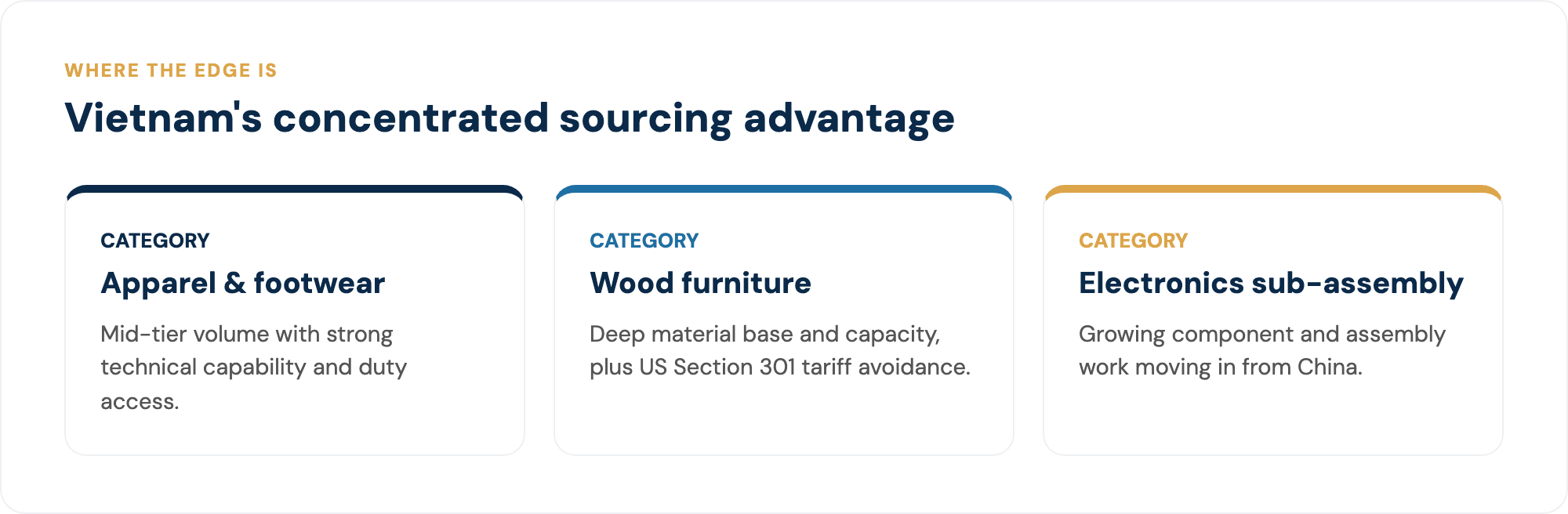
Vietnam’s advantage is concentrated: mid-tier apparel, wood furniture, processed food, and electronics sub-assembly, plus CPTPP and EVFTA duty access. Match your category to where the edge actually is.
Vietnam exported roughly $405 billion in goods in 2024, according to the General Statistics Office of Vietnam, led by electronics, apparel, footwear, and furniture, and now ranks among the top 20 global exporters[5]. The buyer-side driver is diversification: since the 2018 Section 301 tariffs on Chinese-origin goods, US and EU importers have been qualifying alternative origins, and Vietnam’s trade agreements (CPTPP, EVFTA, RCEP) give it duty advantages China cannot replicate.
Here is where most sourcing plans go wrong. “Vietnam is cheaper than China” is not a reliable thesis. Northern labor rates around Hanoi, Bac Ninh, and Hai Phong have risen 6 to 8% a year since 2020, and the cost advantage today is concentrated in specific categories: mid-tier apparel, wood furniture, processed food, and certain electronics sub-assemblies. For high-precision metal fabrication or complex consumer electronics, Vietnam’s supplier ecosystem is still maturing, and a buyer who assumes a flat country-wide discount will mis-price the deal.
The buyers who get this right start with a category-level cost model, not a country-level assumption. Use the Landed Cost Calculator to build a Vietnam-specific baseline before you contact a single factory.
2. The Real Supplier Landscape and How to Qualify It
Vietnam has roughly 9,000 export-ready manufacturers, but that number hides extreme quality variation. The top tier, factories with current certification, international buyer references, and audited lines, is only about 10 to 15% of the total. The rest range from capable but undocumented to outright spec-risk. Production also clusters by category: garments, footwear, and processed food around Ho Chi Minh City, Binh Duong, and Dong Nai; electronics, furniture, and hardware around Hanoi, Bac Ninh, and Hai Phong; seafood and textiles along the central coast near Da Nang; aquaculture and fruit processing in the Mekong Delta.
Most buyers default to Alibaba-style directories where the data is self-reported and unverified. A listing that reads “ISO 9001[4]” may hold a certificate that expired two years ago or covers a different product line than the one you are buying. Qualifying a supplier remotely is possible, but it takes a structured process: matching the tax code (Mã số thuế) across the quote, invoice, and certificate, checking both the business registry and the tax authority, and verifying the accreditor rather than the certificate. We walk through that full process in how to verify a Vietnamese supplier without flying there. Trade With Viet’s directory of 549+ verified suppliers removes the first-filter problem, with each entry confirmed for registration, active export history, and at least one reference check.
3. The Four Costs Buyers Underestimate
The price on the quote is the smallest number in the deal. Four costs do more damage to first-time Vietnam sourcing budgets than the unit price ever does.
Lead time. A first $100,000 apparel order with a new factory runs about 14 to 20 weeks from first contact to goods in your warehouse: 3 to 4 weeks to qualify and sample, 2 to 4 weeks for sample approval, 45 to 60 days of production, a week of inspection and documents, then 20 to 35 days of ocean freight. Buyers who plan for 8 to 10 weeks get caught short. Build inventory plans around a 16-week minimum on first orders.
The Section 301 trap on Chinese inputs. Moving production to Vietnam does not automatically move you out of US tariff exposure. If your Vietnamese factory uses Chinese-origin fabric, components, or sub-assemblies above a meaningful value share, the finished goods can still trigger additional US duties under the rules of origin. Ask, in writing, where the major inputs come from, and confirm the answer against the bill of materials before you assume a tariff saving.
Production diverges from the sample. In our experience, production quality drifts from approved-sample quality on roughly 30 to 40% of first runs with a new factory. The reason is structural: samples are made by senior workers on dedicated equipment, while the production line is neither. This is exactly why skipping the $600 pre-shipment inspection to save money is the most expensive saving in sourcing.
FOB is not landed cost. Vietnamese factories quote FOB, which means you own the risk and the rest of the cost from the moment goods hit the vessel. Freight, insurance, duties, brokerage, inland freight, and warehousing typically add 25 to 45% on top of the FOB price depending on category and lane. Model the landed number before you commit to a price point.
4. Vietnam vs China: A 2026 Head-to-Head
| Factor | Vietnam | China |
|---|---|---|
| Unit cost | Lower on mid-tier apparel, wood furniture, processed food | Lower on high-precision metal, complex electronics, deep component supply |
| Typical MOQ | Smaller (apparel 300 to 500 pcs/style) | Larger on most categories |
| FTA / tariff access | CPTPP, EVFTA, RCEP; no US FTA | Section 301 tariffs into the US |
| First-order lead time | 14 to 20 weeks | 12 to 18 weeks (deeper ecosystem) |
| Chinese-input tariff risk | Real if inputs are Chinese-origin | Not applicable |
| Supplier ecosystem maturity | Strong in target categories, still maturing in high-precision | Deep and broad across categories |
Verdict: Vietnam wins when your product sits in its strong categories, your order size suits smaller MOQs, and you sell into a CPTPP or EU market where the tariff math favors it. China still wins on high-precision work, deep component sourcing, and the largest runs. For most buyers the real answer is both countries, split by category, not one replacing the other.
5. Frequently Asked Questions
Is it cheaper to source from Vietnam than China?
Not across the board. Vietnam is usually cheaper on mid-tier apparel, wood furniture, and processed food, and on smaller order sizes. China often remains cheaper on high-precision metal work, complex electronics, and very large runs where its deeper component supply chain lowers cost. Price the specific category, not the country.
Do I owe US tariffs if my Vietnamese factory uses Chinese materials?
You can. Final assembly in Vietnam does not automatically clear Section 301 exposure. If Chinese-origin inputs make up a significant value share of the finished goods, US rules of origin can still apply additional duties. Confirm input origin against the bill of materials before you bank on a tariff saving.
How long does a first order from Vietnam take?
Plan for 14 to 20 weeks from first contact to warehouse on a first order, covering qualification, sampling, 45 to 60 days of production, inspection, documents, and 20 to 35 days of ocean freight. Repeat orders with an established supplier compress, but 10 to 12 weeks remains a realistic floor.
How do I find verified Vietnamese suppliers?
Do not start with a search engine or an open directory, where data is self-reported. Start with a category-specific shortlist from a verified source, then qualify each supplier with a structured process: tax-code matching, registry and tax-authority checks, and reference calls. Trade With Viet maintains 549+ verified suppliers across six categories.
Get a category-specific Vietnam supplier shortlist
Trade With Viet supports international buyers across the full sourcing cycle, from supplier identification to first-order support, with 549+ verified suppliers across six categories and 10+ years in the Vietnam supply chain.
Sources
Source from Vietnam with an operating partner
Trade With Viet supports international buyers across 30+ countries with verified suppliers, compliance review, and first-order support, not just introductions.