
7 min read
This guide is part of our how to source from Vietnam playbook, the full step-by-step map for importers.

In this guide
1. Why Most Vietnam Supplier Fraud Is an Identity Problem
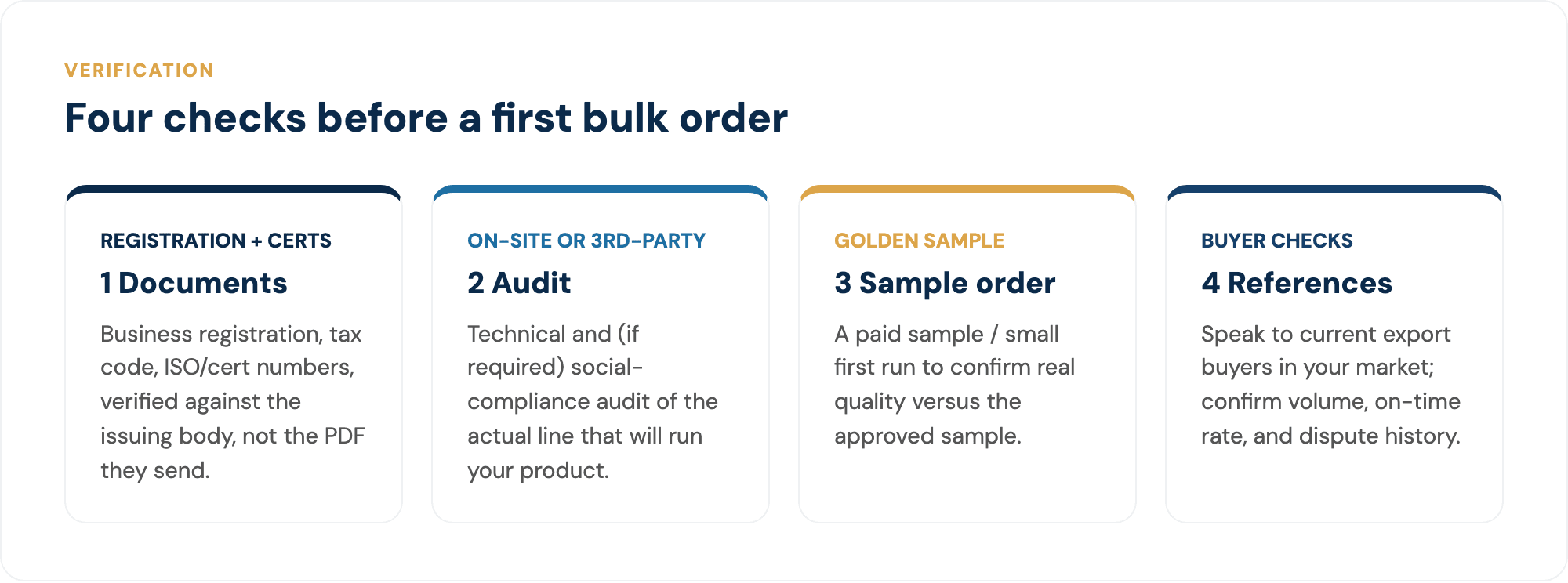
Never take a certificate at face value. Verify ISO and business-registration numbers against the issuing body, and require a third-party audit before placing a first bulk order.
Vietnam shipped roughly $355 billion in exports in 2023, according to the General Statistics Office of Vietnam, spread across more than 900,000 registered enterprises. For an international buyer, the hard part is not finding a factory. It is confirming that the entity quoting you is the one that will manufacture, invoice, and answer for the goods.
In our work qualifying 549+ suppliers across six categories, the most expensive mistake is rarely a factory that does not exist. It is a broker chain hiding in plain sight. The tax code (Mã số thuế, MST) on the first quote, the MST on the proforma invoice, and the MST on the ISO certificate are sometimes three different companies. Each link adds a markup and removes a layer of accountability, and when a shipment ships short or late, no one in the chain owns the problem.
So treat verification less as proving a factory is real and more as proving the chain is short and the entity is consistent. Every step below is built around that one idea. Remote checks do not replace a first-production audit on any order above $50,000. They are the filter that removes brokers, dormant shells, and capability mismatches before you spend a dollar on samples or a flight.
2. The Free Checks That Catch Most Problems in an Afternoon
Run the business registry, then the tax authority. Buyers skip the second. Ask for the MST before anything else; a factory that will not share it is one to walk away from. Search it on Vietnam’s National Business Registration Portal and confirm the entity name, the registered address, an active status reading “Đang hoạt động,” and an establishment date that fits the years of experience they claim. Then do the step almost no one does: cross-check the same MST on the General Department of Taxation lookup at tracuunnt.gdt.gov.vn. A company can show as registered on the business portal while its tax status is suspended. When the two databases disagree, the tax side is the one that signals trouble.
Pull export records, then match them to the entity. Ask for a redacted customs export declaration (tờ khai hải quan) for a recent shipment, or search the company on a trade-data service such as ImportYeti or Panjiva. Do not stop at confirming exports exist. Confirm the shipper of record matches the MST you just verified. A genuine manufacturer appears as the exporter; a trader will often list the factory as shipper while routing the payment relationship elsewhere. One more tell from practice: a company shipping to 30 countries in small, scattered lots is usually an aggregator reselling other people’s production, not a focused factory.
3. The Paid and Human Checks That Tell You the Most
Verify the accreditor, not the certificate. Anyone can produce a certificate with a convincing number. The tell of a worthless one is the body that issued it. Certification mills sell ISO 9001[1] certificates that no International Accreditation Forum signatory stands behind. Confirm the issuing body is an IAF-recognized accreditor, and confirm the certificate scope actually covers your product rather than an adjacent category. A valid number against the wrong scope is the most common dodge we see.
Ask references for a peer, not a fan. Every factory hands you its happiest customer, so the praise is not the signal. The signal is whether they can produce a reference in your own country or trade bloc, for a buyer of your size, and whether the defect-rate answer is an actual number instead of a shrug. Put the same five questions to three references and watch for specific versus vague. Two vague answers on defect rate is a factory pattern, not a personality clash.
The factory video tour is overrated. Use it for one job. A live walkthrough proves a floor exists. It does not prove the floor is theirs, that it has open capacity for your order rather than capacity already booked, or that the line you were shown runs your product. Treat it as a binary filter that catches trading companies with no floor at all, and nothing more. Real capacity is an audit question. After it passes, place a sample order and compare the QC documentation against your tech pack point by point, because a factory that argues about specifications at sample stage will argue harder during production, with less room to fix things. Use the Landed Cost Calculator to confirm the sample’s quoted terms still hold once freight and duties are added.
4. Remote Verification vs On-Site Audit: When to Use Each
| Factor | Remote verification | On-site audit |
|---|---|---|
| Cost | Under $200 | $600 to $1,500 per factory |
| Time to complete | 5 to 10 business days | 2 to 4 weeks to schedule |
| Catches | Broker chains, shells, mismatched entities, expired or out-of-scope certs | Real line capacity, labor conditions, machine condition |
| Misses | Actual available capacity, working conditions | Nothing material if done well |
| Best for | Screening a shortlist before RFQ | Final sign-off before a bulk order |
| Recommended order threshold | Every supplier, any order size | Orders above $50,000 |
Verdict: Run remote verification on every candidate, because it is cheap and fast enough to apply across a whole shortlist, and it catches the entity and broker problems an audit is not designed to look for. Reserve the on-site audit for the finalist on any order above $50,000, where confirming real line capacity and labor conditions earns the trip. The two are sequential filters, not substitutes.
5. Frequently Asked Questions
How do I check if a Vietnamese supplier is legally registered?
Ask for the tax code (Mã số thuế) and search it on the National Business Registration Portal at dangkykinhdoanh.gov.vn, confirming the entity name, address, and an active “Đang hoạt động” status. Then cross-check the same code on the tax authority lookup at tracuunnt.gdt.gov.vn, because a company can read as registered while its tax status is suspended.
Can I see a Vietnam factory’s real export history?
Yes. Request a redacted customs export declaration, or search the company on ImportYeti or Panjiva. The key is to match the shipper of record to the tax code you verified. Consistent shipments over 12 to 24 months with HS codes matching your product point to a real manufacturer; scattered small lots to dozens of countries usually point to a reseller.
How long does remote supplier verification take in Vietnam?
Plan for 5 to 10 business days. The registry, tax, and certificate checks take a few hours. The elapsed time is mostly waiting on other people: three buyer references and a live factory walkthrough have to fit other calendars, and that scheduling is the real bottleneck.
Is remote verification enough, or do I still need a factory audit?
Remote verification is enough to screen a shortlist and to qualify suppliers for orders under roughly $50,000. Above that, add a first-production on-site audit. Remote checks confirm the entity is real, consistent, and capable on paper. An audit confirms real available capacity and working conditions, which no desk review can see.
Skip the first three verification steps
VietConnect has confirmed legal registration, active export history, and at least one valid quality certification for 549+ Vietnamese suppliers across six categories, so you start from a clean shortlist.
Sources
Source from Vietnam with an operating partner
Trade With Viet supports international buyers across 30+ countries with verified suppliers, compliance review, and first-order support, not just introductions.