
8 min read

In this guide
Why the “Vietnam Is Cheaper” Claim Needs a Category Qualifier
The comparison that matters to buyers is not factory gate price. It is total landed cost: everything from raw material to your warehouse shelf, including duties, freight, compliance documentation, and the cost of defects and rejects.
In 2018, when Section 301[1] tariffs added 25% to Chinese-origin goods in key categories, the math shifted dramatically for US buyers. Vietnam suddenly had a 20-30% duty advantage on hundreds of HS codes. That gap has held through 2025-2026, though ongoing Section 301 reviews mean buyers in tariff-sensitive categories should monitor CBP ruling updates.
For EU buyers, the EVFTA[2] (EU-Vietnam Free Trade Agreement) has progressively reduced tariffs on Vietnamese-origin goods toward zero across most manufacturing categories. By 2026, EVFTA preferential rates apply to approximately 99% of Vietnamese export goods to the EU. This is a structural cost advantage China cannot match in EU-bound trade.
The nuance: Vietnam’s factory gate prices are not always lower than China’s. They are comparable or slightly higher in some categories. The total landed cost advantage comes from the duty differential and, increasingly, from EVFTA-driven freight route optimization.
Compare total landed cost, not factory price. Vietnam’s edge for US and EU buyers comes mostly from the duty differential (Section 301 and EVFTA), so the winner changes by HS code and destination, not by country alone.
Use the landed cost calculator at tradewithviet.com/tools/landed-cost to run the numbers for your specific HS code and destination.
Labor Cost: Vietnam vs China in 2026
Vietnam’s monthly minimum wage[3] (as of January 1, 2026, under Decree 293/2025) ranges from VND 3.7 million (~$146 USD) in rural Region 4 to VND 5.31 million (~$210 USD) in Region 1[4] (Ho Chi Minh City and Hanoi). Effective factory wages including allowances and overtime run 1.5-2x the minimum, approximately $250-380/month for production workers in manufacturing hubs.
China’s comparable figure (Guangdong province, the primary competitor for export manufacturing): minimum wage RMB 2,520/month (~$350 USD) as of 2026[5]; effective factory wages with benefits typically $450-600/month for production workers.
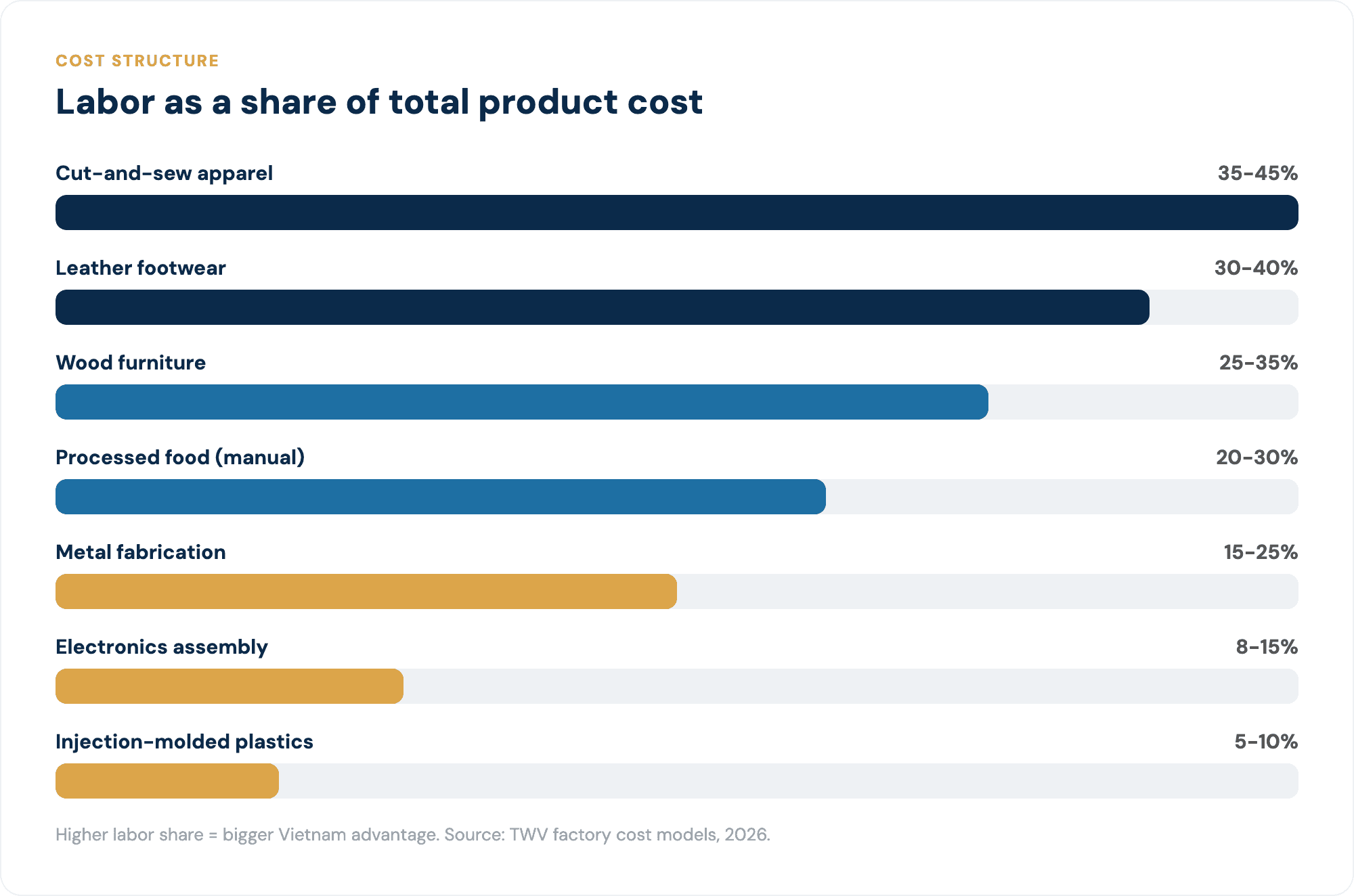
The labor cost differential: Vietnam production workers cost roughly 40-55% of equivalent Guangdong workers at the floor rate. But labor is not the dominant cost in most manufactured goods. The relevant metric is labor cost as a percentage of total manufactured cost by category:
| Category | Labor % of total cost (approx.) |
|---|---|
| Cut-and-sew apparel | 35-45% |
| Wood furniture | 25-35% |
| Leather footwear | 30-40% |
| Electronics assembly | 8-15% |
| Injection-molded plastics | 5-10% |
| Processed food (manual) | 20-30% |
| Metal fabrication | 15-25% |
For categories where labor is 35-45% of total cost, a 45% labor rate advantage translates to a 16-20% total cost reduction before adjusting for materials, overhead, and freight. That is material and it shows up in final landed cost.
For electronics, where labor is 8-15% of total cost, the same labor rate advantage produces only a 4-7% total cost reduction. That advantage is frequently offset by Vietnam’s thinner component supply ecosystem, which forces manufacturers to import from China and re-export, sometimes erasing the duty advantage if rules of origin (ROO) thresholds are not met.
Materials and Supply Chain Depth
This is where Vietnam’s gap with China is most significant. China’s manufacturing supply chain is vertically integrated to a degree no other country has replicated. Guangdong alone houses suppliers for essentially every manufacturing input across most consumer goods categories.
Vietnam’s supply chains are category-specific and geographically clustered:
- Apparel and textiles: Vietnam imports approximately 55-60% of its fabric from China, South Korea, and Taiwan. This is the single largest supply chain vulnerability for apparel buyers. Vietnamese-origin fabric (qualifying for EVFTA/CPTPP preferential origin rules) is available but more limited in variety and volume. The domestic textile sector is growing, particularly in synthetic fabrics, but cannot yet match the breadth of China’s fabric market
- Wood furniture: Vietnam has a well-developed domestic timber supply chain (plantation-grown acacia and rubberwood) supplemented by legal timber imports. Component hardware (hinges, slides, fasteners) is predominantly imported from China but at low cost impact given the proportion of total product cost
- Electronics: Vietnam assembles, but key components, semiconductors, displays, passive components, are overwhelmingly imported. Samsung, LG, and Intel have built large assembly operations in Vietnam, but the upstream supply chain remains thin
- Food processing: Vietnam’s domestic agricultural supply chain is genuinely strong. Coffee, seafood, rice, tropical fruit, and pepper are produced and processed domestically with minimal import dependency
The supply chain depth gap means lead times and minimum orders in Vietnam are sometimes less flexible than China for non-core categories. A manufacturer adding a new material specification may face a 4-6 week delay sourcing it versus 1-2 weeks in the Guangdong ecosystem.
Freight and Logistics Cost Comparison
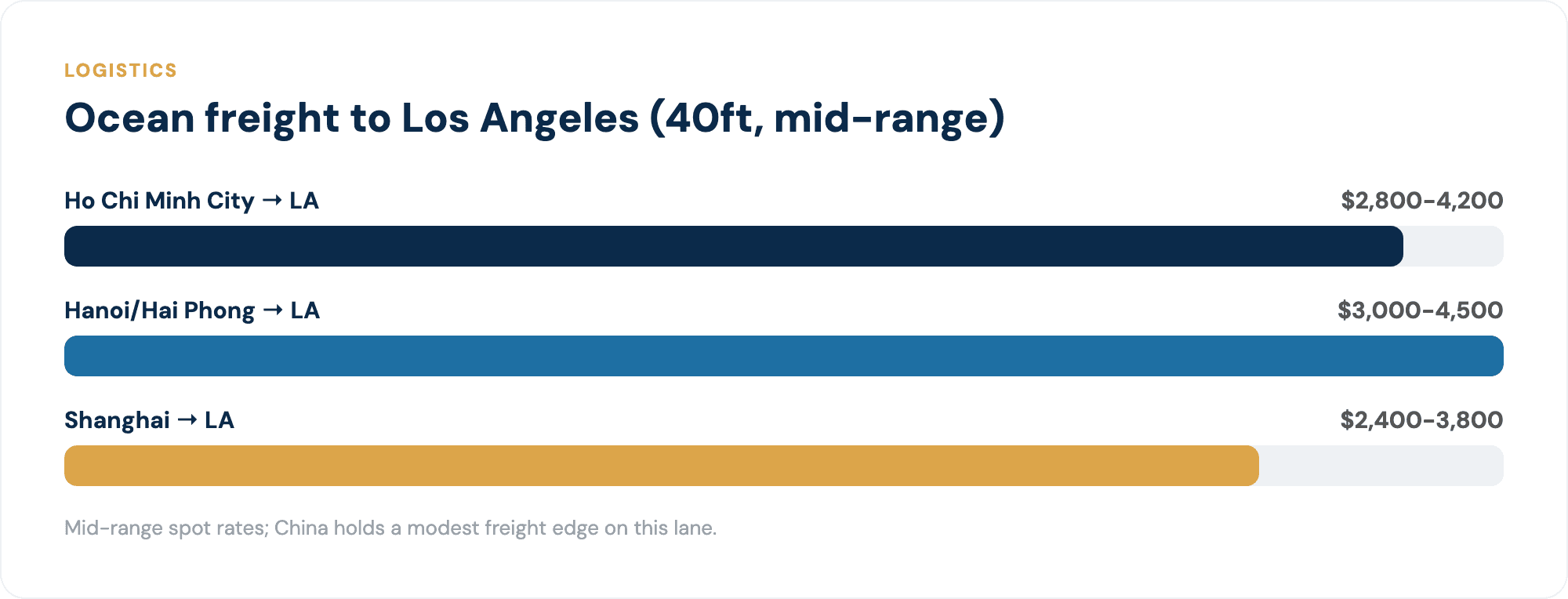
Ocean freight from Vietnam to key markets (2026 rates, per 40ft container, approximate):
| Route | Transit Time | Rate Range |
|---|---|---|
| Ho Chi Minh City to Los Angeles | 18-22 days | $2,800-4,200 |
| Ho Chi Minh City to Rotterdam | 26-30 days | $3,200-4,800 |
| Hanoi/Haiphong to Los Angeles | 20-25 days | $3,000-4,500 |
| Ho Chi Minh City to Sydney | 12-15 days | $1,800-2,800 |
Comparable China (Shanghai) routes:
| Route | Transit Time | Rate Range |
|---|---|---|
| Shanghai to Los Angeles | 14-18 days | $2,400-3,800 |
| Shanghai to Rotterdam | 26-30 days | $2,800-4,200 |
| Shanghai to Sydney | 14-18 days | $1,600-2,400 |
Vietnam freight costs are typically 10-20% higher than comparable China routes and transit times are 3-7 days longer for US-bound cargo. This partially offsets the labor cost advantage. For time-sensitive replenishment orders, the transit differential matters more than for initial seasonal buys.
Air freight from Vietnam is available from Tan Son Nhat (Ho Chi Minh City), Noi Bai (Hanoi), and Da Nang. Rates are broadly comparable to China.
Compliance and Documentation Cost
Both origins require comprehensive export documentation. Vietnam adds one element that China does not: CO/CQ (Certificate of Origin / Certificate of Quality) processing through the Vietnam Trade Promotion Agency or accredited issuing bodies. Service providers typically charge $30-80 per shipment over 2-5 working days. It is minor cost but adds to lead time.
For EVFTA preferential duty claims, buyers must hold valid EUR.1 movement certificates or supplier declarations of origin. These require that products meet Vietnam content rules of origin requirements, typically 40-50% value added in Vietnam depending on category. Documenting this takes more supplier cooperation than buyers sometimes expect.
For US Section 301 tariff avoidance, Customs and Border Protection is actively reviewing “China Plus One” strategies that may involve minimal processing in Vietnam. If your Vietnamese supplier’s bill of materials is predominantly Chinese-origin, consult a trade attorney before assuming origin qualification.
Category-by-Category Verdict: Vietnam vs China
Apparel and footwear: Vietnam wins on total landed cost for US and EU buyers in most mid-market categories. Labor advantage is high, EVFTA and CPTPP duty benefits are substantial. Main risk: fabric supply chain complexity and ROO compliance.
Wood furniture: Vietnam wins clearly. Domestic timber supply, competitive labor, strong production capacity. FSC-certified supply chain available for compliance-sensitive buyers.
Processed food and beverage: Vietnam wins for categories where its agricultural base is strong (coffee, seafood, rice, pepper). Less competitive for processed goods relying on imported ingredients.
Apparel accessories and leather goods: Vietnam competitive; depends on specific product and leather sourcing.
Consumer electronics assembly: China wins on supply chain depth and total cost for complex products. Vietnam competitive for simple assembly with major branded components (e.g., Samsung-tier production).
Industrial components (precision machining, stamping, castings): China wins in most cases. Vietnam’s industrial manufacturing sector is growing but not yet at China’s cost and capability levels for tight-tolerance parts.
Medical devices and personal care: Varies by product class. Vietnam is competitive for Class I medical devices and personal care packaging. Complex devices remain better suited to established China supply chains.
Running Your Own Numbers
The Vietnam vs China cost question is ultimately a spreadsheet question, not a general one. The variables are: your HS code (duty rates), your destination market (trade agreement applicability), your product’s labor intensity, your freight volume (LCL vs FCL break-even), and your compliance documentation requirements.
The landed cost calculator at tradewithviet.com/tools/landed-cost lets you input your product details and get a Vietnam-specific landed cost estimate with duty calculations for US, EU, UK, and APAC markets.
For a sourcing consultation that includes a formal Vietnam vs China cost model for your specific category, book at tradewithviet.com/contact. Trade With Viet has built cost models for buyers across 30+ countries sourcing across all major Vietnam export categories.
Sources
Source from Vietnam with an operating partner
Trade With Viet supports international buyers across 30+ countries with verified suppliers, compliance review, and first-order support, not just introductions.