
8 min read
In this guide
- Vietnam’s Furniture Industry: Scale and Category Breakdown
- Wood Species and Material Supply Chain
- Lacey Act Compliance: What US Buyers Must Document
- EU Deforestation Regulation (EUDR): 2025 Phase-In
- Factory Types and How to Match Them to Your Sourcing Need
- Pricing Benchmarks: Vietnam Furniture FOB
- EVFTA Furniture Tariffs and ROO Requirements
- Building a Sustainable Furniture Sourcing Program
Vietnam’s Furniture Industry: Scale and Category Breakdown
Natural-forest hardwood triggers the US Lacey Act[3] and EU EUDR[2]. Get documented legal-harvest proof for the exact wood species, or your shipment can be detained.
Vietnam’s furniture cluster is primarily concentrated in the southeast, Binh Duong province (sometimes called the “furniture capital of Vietnam”) and surrounding areas in Ho Chi Minh City, Dong Nai, and Long An. A secondary cluster in the north around Ha Tay (now part of Hanoi) and Bac Ninh produces more traditional and craft-oriented furniture.
The industry is export-driven by design. Approximately 80-85% of Vietnamese furniture output is for export, primarily to:
- United States: the single largest market, approximately $9 to 10 billion annually
- EU: a smaller but growing market, led by Germany, Netherlands, France
- Japan, South Korea, Australia: substantial and growing
The product category breakdown of Vietnamese furniture exports:
- Wooden furniture (indoor): Dining sets, bedroom furniture, occasional tables, shelving, cabinets, this is the core strength
- Outdoor and garden furniture: Teak, acacia, eucalyptus, strong production base; teak furniture from Vietnam commands premium pricing and quality
- Upholstered furniture: Sofas and seating, growing but more limited supply chain depth than wood-dominant categories
- Home accessories and decor: Bamboo and rattan goods, lacquerware, ceramics (from Bat Trang village cluster near Hanoi), artificial flowers
- Mattresses and bedding: Production capacity exists, primarily serving ASEAN regional markets
VietConnect lists 87 verified home and furniture manufacturers. Browse at tradewithviet.com/suppliers/home-furniture.
Wood Species and Material Supply Chain
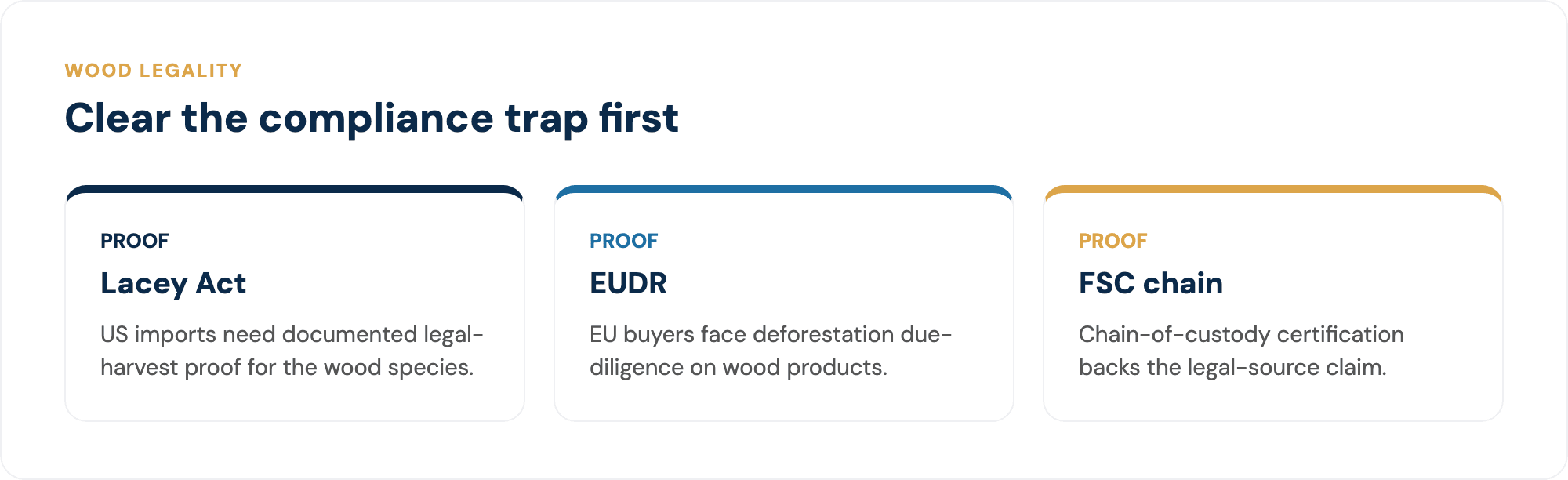
Understanding the timber supply chain is essential for buyers who need to comply with Lacey Act (US), EUDR (EU), or Timber Trade Policy requirements. Vietnam uses several primary wood species in furniture production:
Acacia: The dominant plantation species. Grown domestically across central and northern highlands. Fast-growing (7-10 year rotation), FSC[4] certification is widely available from Vietnamese plantation sources. Acacia is used for medium-density, mid-market furniture, dining tables, chairs, outdoor furniture, cutting boards. It is light-colored, reasonably hard, and works well with finishes. Most cost-competitive wood species for export furniture.
Rubberwood: Plantation-grown from rubber tree (Hevea brasiliensis) after the latex-producing life cycle ends. Abundant in southeast Vietnam (Binh Duong, Binh Phuoc). Lighter in color than acacia, good machining properties. Used in bedroom furniture, kitchen cabinets, and home accessories.
Teak: Premium species. Vietnam has plantation teak, primarily in the central and northern highlands. Plantation teak is legal and Lacey Act compliant with proper documentation. Natural forest teak is a different matter, the Lacey Act and EUDR require proof of legal harvest. Ask for plantation teak specifically and request Forest Management certificates.
Pine (imported): Vietnam imports radiata pine from New Zealand, Australia, and Chile for flatpack furniture production. Certification documentation (PEFC or FSC) from the source country is required for Lacey Act compliance.
MDF and plywood (partially imported from China): A significant portion of panel products used in Vietnamese furniture manufacturing is imported. Chinese-origin MDF and plywood, particularly products containing formaldehyde-based adhesives, require testing against California Air Resources Board (CARB) Phase 2 standards for US market entry, and EU E1/F4 star standards for EU.
Lacey Act Compliance: What US Buyers Must Document
The Lacey Act prohibits importing wood products harvested or traded in violation of US or foreign law. For US furniture buyers sourcing from Vietnam, compliance requires:
- A Plant and Plant Product Declaration (PPQ Form 505) filed with US Customs for all wood product shipments
- Documentation confirming legal harvest of the wood species used, this means your Vietnamese supplier must provide country of harvest, species name, volume, and legal harvest documentation for each timber input
- CITES compliance for any protected species (CITES Appendix II species like Dalbergia/rosewood require CITES export permits; avoid this by specifying non-CITES species)
Vietnamese furniture manufacturers who export at volume to the US generally have Lacey Act documentation systems in place. But verify, ask for their standard Lacey Act documentation package for a sample product and review it before placing a production order.
Key risk areas: suppliers using recycled or mixed-source timber, suppliers sourcing from Myanmar or Cambodia (high illegal logging risk, documented cases of mislabeled timber in Vietnamese supply chains), and suppliers unable to identify the country of harvest for imported timber inputs.
EU Deforestation Regulation (EUDR): 2025 Phase-In
The EUDR requires that wood products sold in the EU are not sourced from land deforested after December 31, 2020. For furniture buyers, this means:
- Due diligence on all wood inputs, including plywood components and timber sourced from third countries
- Geolocation data for forest plots of origin (latitude/longitude to plot level)
- Evidence of compliance with forest management laws in the country of harvest
- A due diligence statement submitted to the EU TRACES NT system before import
Vietnam-origin plantation timber (acacia, rubberwood) from certified sources with plot-level documentation is EUDR-compliant. The complication: some Vietnamese furniture factories source timber inputs from brokers or secondary suppliers who cannot provide plot-level geolocation data.
For EU buyers placing furniture orders from mid-2025 onward: require EUDR due diligence documentation from your Vietnamese supplier before commercial order placement. Factories that cannot provide it for their primary timber inputs are not compliant for EU market supply.
Factory Types and How to Match Them to Your Sourcing Need
Vietnamese furniture factories fall into three operational types:
OEM/ODM factories (large, export-focused): Typically 500-3,000 workers. Fully equipped woodworking lines with CNC, edge banding, spray booths, and QC facilities. Serve major US and EU retailers directly. MOQ typically 40-100 containers per year of business. These factories have dedicated export compliance teams, Lacey Act documentation systems, and EVFTA[1] origin management. Not accessible to small buyers.
Mid-tier contract manufacturers: 100-500 workers. Capable of custom and catalog production. MOQ 1-3 containers per order per SKU. These are the target factories for most independent importers, specialty retailers, and mid-volume e-commerce brands. Many have FSC chain of custody certification. They can produce to a tech pack but may not have in-house design capability.
Craft and artisan workshops: Under 100 workers. Specialist in traditional joinery, lacquerware, rattan, or hand-carved pieces. Low MOQ (10-30 units per design). Longer production times. Less predictable on consistency. Right for buyers who specifically need handcraft quality; not suitable for production-consistency-dependent retail programs.
The 87 verified suppliers in VietConnect’s home and furniture directory include all three types with factory size and minimum order data to help buyers match their sourcing volume.
Pricing Benchmarks: Vietnam Furniture FOB
Approximate FOB Ho Chi Minh City ranges for 2026:
| Product | MOQ | FOB Range |
|---|---|---|
| Acacia dining table (4-seater) | 20-30 units | $85-160 per set |
| Acacia garden chair | 20-30 units | $18-35 |
| Teak outdoor lounger | 15-25 units | $120-220 |
| Rubberwood bookshelf (5-tier) | 15-25 units | $45-90 |
| Rattan armchair | 30-50 units | $55-120 |
| Ceramic decorative vase (medium) | 100 units | $8-25 |
| Lacquer tray set | 50-100 sets | $12-30 per set |
Add 15-20% for FSC chain-of-custody premium where applicable.
Container utilization is a critical cost variable for furniture. A 40-foot high-cube container holds approximately 65-75 CBM (cubic meters). For low-density upholstered furniture or large outdoor pieces, buyers frequently achieve only 40-50 CBM utilization per container, effectively paying a significant freight premium per CBM. Design your SKU mix to optimize container fill, or negotiate FOB consolidation (multiple suppliers, one container) through your freight forwarder.
EVFTA Furniture Tariffs and ROO Requirements
Under EVFTA, furniture (HS Chapter 94) benefits from 0% tariff for EU buyers. Before EVFTA, the standard EU MFN rate on wooden furniture was 2.7-5.6%. The 0% rate is applied to goods with sufficient Vietnam origin under EVFTA ROO.
For furniture, EVFTA applies a Combined Rule: either RVC 45% (Regional Value Content of at least 45% Vietnam/EU origin) or CTC at the 4-digit heading level (wood or components must be classified under a different 4-digit HS heading than the finished furniture). In practice, for furniture made from Vietnamese plantation timber, the CTC test is usually satisfied automatically.
Verify with your supplier that they can provide EUR.1 certificates or are registered as REX exporters for EVFTA self-certification. If claiming EVFTA rates, retain all origin documentation for at least 5 years, EU customs has a 3-year post-import verification window.
Building a Sustainable Furniture Sourcing Program
The buyers who extract the most from Vietnam furniture sourcing do three things consistently:
They visit factories before committing to large volumes. A factory video walkthrough shows production process, but a physical visit reveals finishing quality, QC workflow, and storage conditions in ways video cannot. For furniture buyers placing annual orders above $500,000, one annual factory visit is standard practice.
They invest in sample approval process. Furniture tolerances in dimensions, finish color matching, and joinery quality require careful sample approval. A golden sample (approved reference unit) should be retained and photographed in detail. Production lots are inspected against the golden sample.
They manage lead time actively. Vietnam furniture peak order season is March-August for Q4 US holiday. Factories that aren’t booked by June for Q4 delivery are usually over-capacity or second-tier. Plan your production calendar 6 months ahead.
For sourcing introductions to verified furniture manufacturers matched to your category and volume, visit tradewithviet.com/suppliers/home-furniture or book a consultation at tradewithviet.com/contact.
Sources
Source from Vietnam with an operating partner
Trade With Viet supports international buyers across 30+ countries with verified suppliers, compliance review, and first-order support, not just introductions.