
8 min read

In this guide
- Why FOB Price Is Not Your Real Cost
- Export-Side Charges (Vietnam Origin)
- Ocean Freight: What You’re Actually Paying For
- Marine Insurance
- Destination Port and Customs Charges
- Inland Freight and Last-Mile Delivery
- Warehousing and Carrying Cost (First 30 Days)
- Building Your Landed Cost Model: A Worked Example
Why FOB Price Is Not Your Real Cost
FOB is not your real cost. In our cost modeling, total landed cost typically runs 125 to 180% of FOB once freight, duty, insurance, and destination fees are added. Model it per HS code and destination.
FOB (Free On Board) is the price point at which the Vietnamese factory’s responsibility ends and yours begins: when the goods are loaded on the vessel at the port of export[3]. Everything after that point, freight, insurance, port fees, destination customs, inland transportation, warehousing, is your cost to manage and absorb.
Buyers who present FOB pricing to their CFO without adding the full landed cost stack consistently encounter budget overruns and margin erosion on first imports. The most common mistake is benchmarking against a China landed cost built over years of experience, then applying the same assumptions to Vietnam, where freight routes, documentation costs, and duty structures differ.
The landed cost formula:
Landed Cost = FOB Price + Export Charges + Ocean/Air Freight + Marine Insurance + Destination Port Charges + Import Duties + Customs Brokerage + Inland Freight + Warehousing (first 30 days)
Each of these line items has sub-components. The sections below break them down.
Use the landed cost calculator at tradewithviet.com/tools/landed-cost to run the numbers for your specific HS code, destination port, and freight mode.
Export-Side Charges (Vietnam Origin)
These fees are incurred in Vietnam before the goods board the vessel. Some are absorbed in the FOB price; some are additional:
Export customs declaration fee: Filed by the Vietnamese exporter with Vietnam Customs General Department. Cost: approximately VND 20,000-50,000 per declaration line. Typically absorbed in FOB price.
Certificate of Origin fee: VND 100,000-200,000 ($4-8 USD) per CO for standard forms. EUR.1 for EVFTA[1] can run VND 200,000-400,000 ($8-16 USD) due to issuing body fees. Typically billed separately or added to the factory invoice.
Port terminal handling charge (THC) at origin: Charged by the port authority or terminal operator at the port of export. For Ho Chi Minh City (Cat Lai terminal, the main container port): approximately $120-180 per 20ft container, $180-250 per 40ft container. For Hai Phong (northern port): similar range. Typically included in freight forwarder’s all-in quote but worth confirming.
Container inspection fee: Vietnam Customs conducts physical inspections of a percentage of export shipments. When selected, the importer/exporter pays a scanning fee and any associated delay costs. Cannot be predicted; budget $50-150 as a contingency per shipment.
Local charges / Origin inland haulage: Trucking from factory to port. Rates depend on distance and container size. From Binh Duong to Cat Lai: $80-140 per 40ft container. From Bac Ninh to Hai Phong: $120-200 per 40ft container.
Ocean Freight: What You’re Actually Paying For
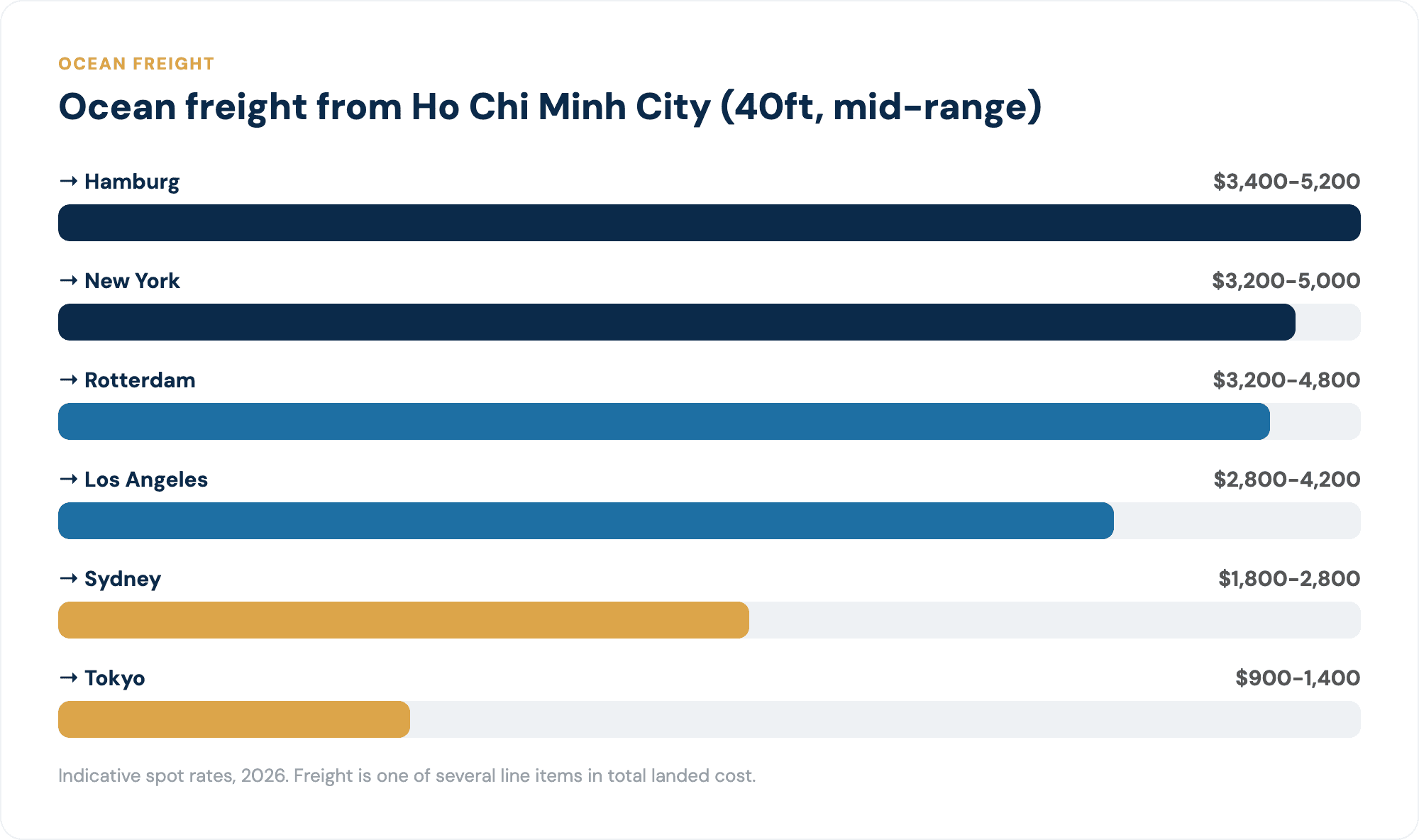
Ocean freight is quoted per container (FCL, full container load) or per CBM/weight (LCL, less than container load). For first shipments and smaller orders, LCL is common. For mature sourcing programs, FCL almost always has better unit economics above approximately 8-10 CBM.
FCL rates (2026 approximates, per 40ft high-cube container):
| Route | Range |
|---|---|
| Ho Chi Minh City to Los Angeles | $2,800-4,200 |
| Ho Chi Minh City to New York | $3,200-5,000 |
| Ho Chi Minh City to Rotterdam | $3,200-4,800 |
| Ho Chi Minh City to Hamburg | $3,400-5,200 |
| Ho Chi Minh City to Sydney | $1,800-2,800 |
| Ho Chi Minh City to Tokyo | $900-1,400 |
| Hai Phong to Los Angeles | $3,000-4,500 |
These are base freight rates. Add:
- Bunker Adjustment Factor (BAF) / Fuel Surcharge: Variable; currently $150-400 per container depending on route and carrier
- Peak Season Surcharge (PSS): Applied during high-demand periods (August-October for Q4 holiday season); $200-600 per container
- Low Sulphur Fuel Surcharge (LSS): Applied on routes through ECA (Emission Control Areas); EU-bound routes particularly affected
- Port Congestion Surcharge: Applied when destination ports have significant backlogs; variable, historically $0-500 per container
Total freight-side surcharges often add $300-800 to the base rate, particularly during peak season. Quote requests should specify “all-in” to get a total number.
LCL rates: Typically quoted per CBM or per revenue ton (weight/volume, whichever is greater). Vietnam to US West Coast: approximately $80-150 per CBM LCL. Minimum LCL charges apply regardless of actual volume, typically 1 CBM minimum.
Marine Insurance
Marine cargo insurance covers loss or damage from port of loading to destination warehouse. Standard coverage: All Risks policy, 110% of CIF value (standard in trade finance).
Approximate cost: 0.3-0.6% of insured value for general cargo on standard routes. Higher for high-value electronics or specialized cargo. For a $50,000 CIF shipment: $150-300 in insurance premium.
Do not waive marine insurance on any ocean freight shipment. A container lost overboard, a vessel fire, or theft at destination port can destroy the entire order value. The premium is genuinely de minimis against that risk.
Destination Port and Customs Charges
Destination terminal handling charge (DTHC): Charged by the destination terminal. US West Coast (Los Angeles/Long Beach): approximately $350-450 per 40ft container. US East Coast: similar range. Rotterdam: EUR 200-300. Sydney: AUD 400-600.
Customs entry / broker fee: Your customs broker charges for preparing and filing the customs entry declaration. US: $150-400 per entry (varies by broker and complexity). EU: EUR 100-300. Australia: AUD 200-450.
Import duties: The single largest variable in landed cost. Completely dependent on HS code and origin-destination trade relationship:
- US: No FTA with Vietnam. Standard MFN rates apply. Section 301[2] tariffs (25% on many goods if Chinese components exceed de minimis thresholds). Check hts.usitc.gov for your HS code rate
- EU: EVFTA 0-5% for qualifying Vietnam-origin goods (vs MFN rates of 6-12% for many categories). EUR.1 required
- UK: UK Global Tariff; post-Brexit rates diverge from EU. Check gov.uk/trade-tariff
- Australia: AANZFTA preferential rates; most goods at 0-5% with Form AANZ CO
- Japan: VJEPA or AJEPA preferential rates; varies by HS code
Harbor maintenance fee (US): 0.125% of cargo value[5] assessed on ocean imports entering US ports. Often missed by first-time importers.
Merchandise processing fee (US MPF): Ad valorem rate of 0.3464% of declared value[6], minimum $31.67, maximum $614.35 per entry. Applies to commercial imports.
Customs bond (US): Required for all US commercial imports. Single-entry bond: $50-100 per shipment. Continuous bond (for regular importers): approximately $500-600 per year. If you import more than 3-4 containers per year, a continuous bond is cheaper.
Inland Freight and Last-Mile Delivery
After customs release, cargo moves from port to warehouse via truck or rail. This cost is completely dependent on your warehouse location relative to the arrival port.
Example costs for a 40ft container (2026):
- Los Angeles port to Los Angeles warehouse: $350-600
- Los Angeles port to Chicago: $2,200-3,500
- Rotterdam to customer warehouse (100km): EUR 400-700
For LCL shipments, add deconsolidation/unstuffing fees at the destination CFS (Container Freight Station): $100-250 typically.
Warehousing and Carrying Cost (First 30 Days)
Destination port warehousing for the first 3-5 days is typically included in the ocean freight quote (demurrage-free period). After free time expires, port storage rates escalate rapidly: $50-150 per container per day at major US ports during congestion.
After customs release and delivery to your warehouse, carrying cost of the inventory (cost of capital tied up in goods in transit + 30 days at destination) should be factored for working capital planning, particularly for seasonal goods. Rule of thumb: 0.5-1% of inventory value per month.
Building Your Landed Cost Model: A Worked Example
Take a $50,000 FOB order of 300 dining table sets (400 CBM, 3 x 40ft containers) shipped from Ho Chi Minh City to Los Angeles, for a US buyer without FTA preferential rates:
| Cost Item | Amount |
|---|---|
| FOB factory price | $50,000 |
| Origin CO fee | $40 |
| Origin inland haulage (3 containers) | $420 |
| Ocean freight (3 x 40ft, base + surcharges) | $13,500 |
| Marine insurance (0.4% x CIF) | $260 |
| Destination THC (3 containers) | $1,200 |
| US customs entry + broker fee | $350 |
| Import duty (US MFN rate for HS 9403.30 = 0%[4]) | $0 |
| US Harbor Maintenance Fee (0.125%) | $80 |
| US MPF (0.3464%, max $614 per entry) | $614 |
| Inland freight (LA port to warehouse) | $1,500 |
| Total Landed Cost | $67,964 |
| Landed Cost as % of FOB | 136% |
This example assumes 0% duty on wooden furniture (HS 9403.30 is indeed 0% MFN for the US). Categories with 15-25% MFN duty rates produce significantly higher landed cost multiples, total landed cost can reach 160-180% of FOB for high-duty categories.
The landed cost calculator at tradewithviet.com/tools/landed-cost walks through this calculation for your specific product, HS code, and destination market. Trade With Viet sourcing consultations include a landed cost model as standard deliverable for new category engagements. Book at tradewithviet.com/contact.
Sources
- European Commission: EU-Vietnam Free Trade Agreement
- Office of the U.S. Trade Representative: Section 301, China
- ICC Academy: Incoterms 2020 FOB
- Flexport: HS 9403.30 wooden office furniture (MFN duty)
- U.S. CFR 19 §24.24: Harbor Maintenance Fee
- U.S. Customs and Border Protection: Merchandise Processing Fee
Source from Vietnam with an operating partner
Trade With Viet supports international buyers across 30+ countries with verified suppliers, compliance review, and first-order support, not just introductions.