8 min read
In this guide
- What Supply Chain Resilience Actually Means in a Vietnam Context
- The Three-Supplier Model: Redundancy Without Complexity
- Geographic Diversification Within Vietnam
- Compliance Infrastructure: Building for Scale
- Pricing Architecture: Locking In Cost Advantage
- Relationship Management: The Operational Currency
- Trade With Viet as an Ongoing Operating Partner
What Supply Chain Resilience Actually Means in a Vietnam Context
The term gets used broadly, but resilience in the Vietnam sourcing context specifically means:
- No single point of failure at factory level: If your one apparel manufacturer in Binh Duong has a fire, floods (common in the Mekong Delta and some southern provinces), a labor dispute, or loses a key buyer that reshuffles their capacity, your production does not stop
- Compliance continuity: Your supply chain can meet the documentation, audit, and certification requirements of your destination market without a six-month remediation project when a new regulation phases in
- Cost predictability: You have multi-year pricing visibility on your major SKUs, reducing the margin volatility that comes from annual renegotiation from a position of dependency
- Supplier relationship depth: When a problem occurs (and it will), you have a relationship with factory management that produces honest communication and collaborative problem-solving, not denial and delay
These are operational outcomes. They are built through deliberate sourcing architecture, not through price negotiation alone.
The Three-Supplier Model: Redundancy Without Complexity
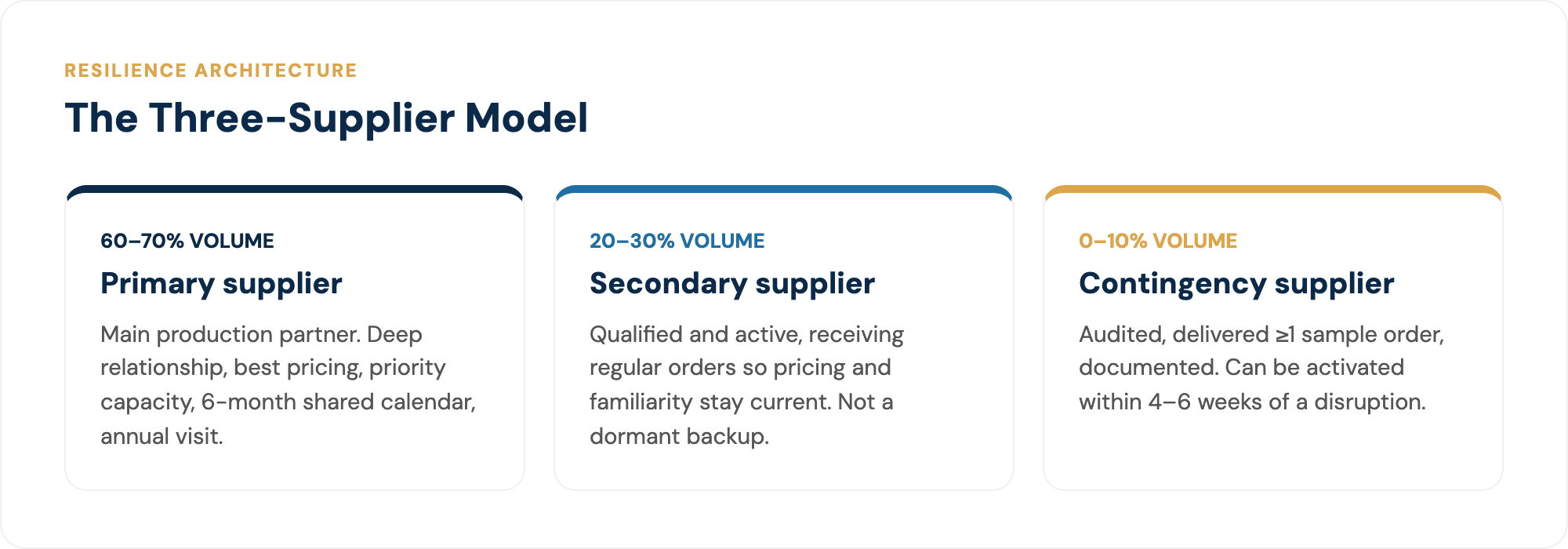
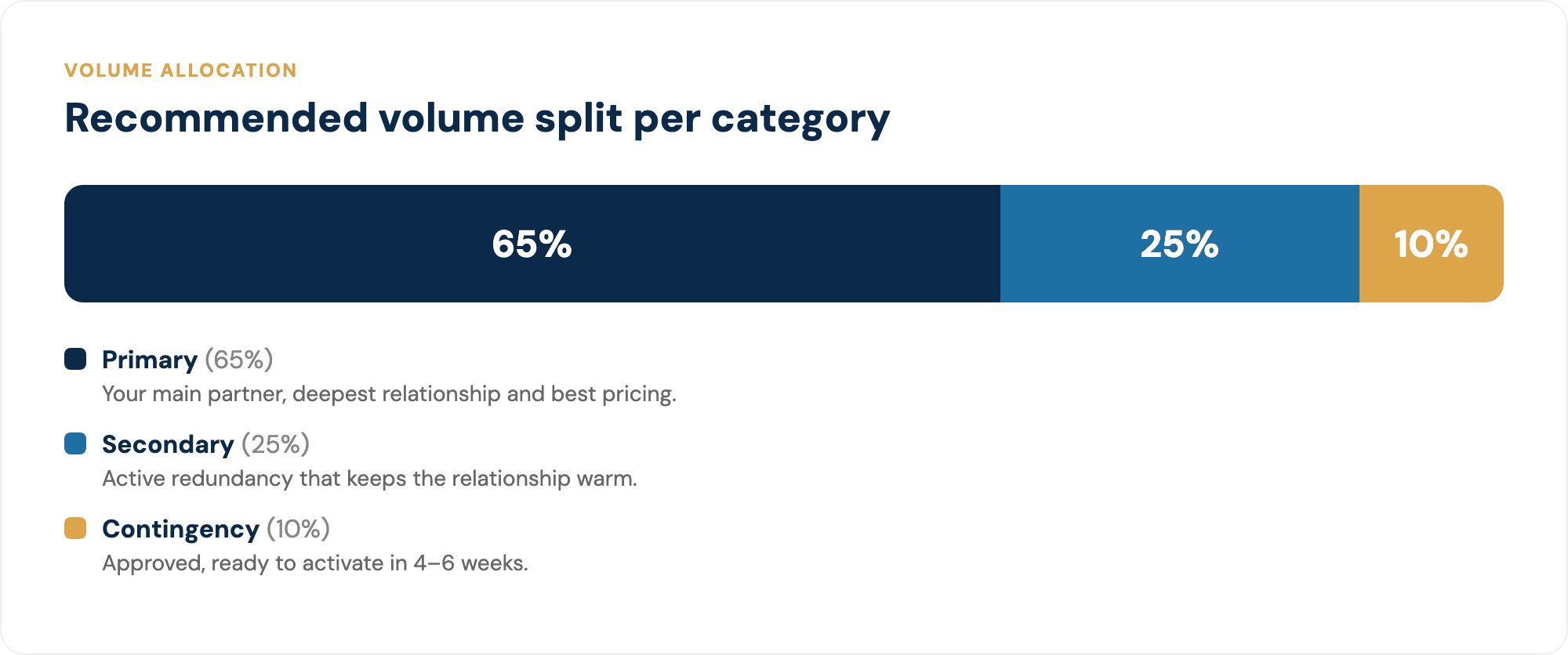
The standard resilience architecture for mid-scale importers (annual Vietnam procurement $500K-$5M) is a three-supplier model per product category:
Primary supplier (60-70% of volume): Your main production partner. Deep relationship, best pricing, priority capacity allocation. Shared production calendar 6 months in advance. Annual in-person visit.
Secondary supplier (20-30% of volume): Qualified, active, and receiving regular orders. Not a “backup we’ll call in an emergency”, an emergency backup who never receives orders will not be reliable when called. Regular volume keeps the relationship active, pricing current, and the factory’s familiarity with your specifications maintained.
Tertiary/contingency supplier (0-10%, or approved-but-inactive): A factory that has been audited, received and delivered at least one sample order, and is documented in your supplier qualification file. May not be currently active. Can be activated within 4-6 weeks of a disruption event.
The math for most product categories: qualifying three suppliers costs 2-3x the qualification cost of one supplier (audits, samples, documentation). But the cost of a primary supplier failure, missed season, emergency air freight, customer penalties, typically exceeds $200,000-500,000 for mid-size importers. Three-supplier qualification is insurance with a defined and reasonable premium.
Qualify three suppliers per category before you need them. The 2-3x upfront qualification cost is small next to the $200,000-500,000 a single primary-supplier failure typically costs a mid-size importer.
Geographic Diversification Within Vietnam
Vietnam is not a single supply chain geography. The country spans 1,650km north to south. Northern factories and southern factories are affected by different weather events, labor markets, and infrastructure constraints. Buyers who concentrate all suppliers in one region have regional risk even with multiple factories.
Risk diversification by geography:
- Typhoon and flood risk: Central Vietnam (Da Nang to Hue corridor) is highest risk for typhoons (September-November). Southern Vietnam flood risk concentrated in Mekong Delta. Northern Vietnam is less typhoon-prone but experiences periodic cold snaps that affect textile production
- Labor market risk: Northern Vietnam (Hanoi, Bac Ninh) and southern Vietnam (HCMC, Binh Duong) have separate labor pools and wage dynamics. A wage dispute or strike affecting Binh Duong’s garment sector does not affect Hanoi’s production
- Infrastructure: Hai Phong port serves northern factories; Ho Chi Minh City’s Cat Lai serves southern. Port congestion events are local. Having suppliers in both regions means access to both port systems
For buyers with annual Vietnam procurement above $1M in a single category, having at least one qualified supplier in each of north and south Vietnam provides meaningful geographic resilience.
Compliance Infrastructure: Building for Scale
The compliance requirements your Vietnam supply chain faces today will be stricter in three years. EU CSRD[1] supply chain reporting, US forced labor screening under UFLPA[2], EUDR[3] documentation requirements, and expanding product safety frameworks will all require more structured supplier data than most import programs currently maintain.
Building compliance infrastructure proactively, rather than retroactively when a new regulation forces it, saves significant cost and avoids the supply chain interruptions that accompany emergency compliance projects.
What to build now:
Supplier compliance register: A master file for each supplier containing: business registration, tax ID, ISO certificates with expiry dates, audit reports with finding summaries, corrective action status, FDA registration numbers (where applicable), and contact information for the factory’s compliance or QC manager. Updated annually minimum.
Audit calendar: Schedule audits on a 12-24 month cycle for active suppliers, not on-demand only. Factories that know an annual audit is coming maintain compliance continuously rather than scrambling before buyer visits.
COO documentation system: For each product you source, document the origin calculation (RVC or CTC) and CO form required for each destination market. When regulations change, new FTA, EVFTA rule refinement, CPTPP addition of a new member, you can update the calculation without starting from scratch.
Restricted substance list (RSL): Maintain an RSL aligned with your most demanding destination market (typically EU REACH[4] for most consumer goods, California Prop 65[5] for US). Require factories to sign acknowledgment that they do not use restricted substances in your production. This shifts legal exposure appropriately.
What scale triggers additional requirements:
- Annual import above $5M: CTPAT certification (US) or AEO (EU) becomes cost-justified; these authorized trader programs reduce customs inspection rates and accelerate clearance
- Direct retail supply in EU: CSRD supply chain disclosure requirements apply to large EU companies, which will pass disclosure obligations to their suppliers. If your Vietnamese products end up in large EU retailer supply chains, ESG data (emissions, labor practices, water use) will be required
- US imports in UFLPA risk categories: Electronics, polysilicon, cotton, and tomatoes from supply chains with any PRC nexus face heightened scrutiny under the Uyghur Forced Labor Prevention Act. Ensure your Vietnamese supply chain has no Chinese-origin components in these categories without clear documentation
Pricing Architecture: Locking In Cost Advantage
The buyers who extract the most consistent value from Vietnam sourcing are those who move from transactional pricing to structured pricing agreements. This does not require long-term purchase commitments, it requires a pricing framework that both parties understand and can plan against.
Annual pricing review vs. per-order negotiation: With established suppliers, negotiate prices once per year against a formal RFQ covering your full anticipated volume across SKUs. This gives the factory revenue visibility to plan capacity and material procurement. In exchange, you get volume-level pricing even on individual orders that might not hit the volume threshold if ordered independently.
Material cost pass-through mechanisms: For products where raw material cost is significant (fabric, timber, steel), agree in advance on the mechanism for adjusting prices when material costs move more than X% from the baseline. A pre-agreed adjustment formula prevents adversarial renegotiation every time cotton prices spike.
Tooling ownership: For custom designs with factory-made tooling (molds, jigs, fixtures), own your tooling. Pay the tooling cost upfront as a sunk cost, but document that the tooling is your property and cannot be used for other buyers. This protects your design exclusivity and gives you the practical ability to move production to a secondary supplier without incurring re-tooling cost.
Relationship Management: The Operational Currency
In Vietnam’s manufacturing sector, relationship quality with factory management is a functional input to supply chain performance. Factories prioritize buyers who are easy to work with, communicate clearly, and pay on time. When capacity constraints force factories to choose which orders to delay, relationships determine prioritization.
Practical relationship investment:
- Regular communication outside of order crises: Quarterly check-in calls or messages with your primary contact at each factory, not just when there is a problem to solve
- Annual visits: For any supplier relationship representing $500K+ in annual procurement, a plant visit builds relationship capital that translates into operational flexibility
- References and introductions: Introducing a factory to another qualified buyer (when appropriate) builds reciprocal goodwill. Vietnam’s manufacturing community is smaller and more interconnected than buyers from outside the country typically realize
- Payment history: Pay on time, every time. A buyer who consistently pays on invoice date gets treated differently than one who routinely holds payment for 60-90 days beyond terms. This is not just courtesy. It is a signal of buyer quality that affects every subsequent negotiation
Trade With Viet as an Ongoing Operating Partner
The buyers in VietConnect’s network who have built the most durable Vietnam supply chains share one characteristic: they treated the first year as system-building, not just transaction-executing. They qualified suppliers with audits, not just price quotes. They built compliance files before they needed them. They invested in secondary supplier relationships before they needed the backup.
Trade With Viet has served international buyers across 30+ countries over 10+ years. Our role is operating partner, not broker: we are involved in supplier qualification, first-order support, compliance review, and ongoing relationship management, not just in introductions.
For a strategic supply chain consultation covering supplier architecture, compliance readiness, and category-specific recommendations: book at tradewithviet.com/contact.
VietConnect’s verified supplier directory at tradewithviet.com/suppliers covers 549+ manufacturers across apparel (142), food and beverage (98), home and furniture (87), industrial (76), medical devices and personal care (97). Category pages include filter by certification, minimum order, and factory location.
Sources
Source from Vietnam with an operating partner
Trade With Viet supports international buyers across 30+ countries with verified suppliers, compliance review, and first-order support, not just introductions.