
9 min read
In this guide
Why Buyers Are Moving Orders to Vietnam
The shift started accelerating after 2018, when the US applied Section 301[3] tariffs of 25 percent on Chinese-origin furniture. Buyers sourcing upholstered seating, case goods, and outdoor furniture from China saw landed costs jump almost immediately. Vietnam, already a capable manufacturing hub, absorbed a large share of those diverted orders.
Two trade agreements made that decision easier to hold long term. Under CPTPP[2], Vietnam-origin goods enter Canada, Australia, Japan, and several other member markets at preferential or zero tariff rates, which matters for brands selling into multiple geographies from a single factory. Under EVFTA[1], furniture with sufficient Vietnam-origin content enters the EU at reduced duty rates, a meaningful saving on items that otherwise face the standard EU wood furniture tariff schedule.
Vietnam’s furniture export sector is concentrated in a belt stretching from Binh Duong province north through Ho Chi Minh City and out to Dong Nai. The factories in this corridor are not cottage producers. Many run 500 to 2,000 workers, hold ISO 9001[6] quality certifications, and ship direct-to-container with ERP-linked production tracking. Annual wood-furniture export value from this cluster has been above $10 billion for several consecutive years, which tells you something real about throughput capacity.
What Vietnam Furniture Factories Actually Do Well
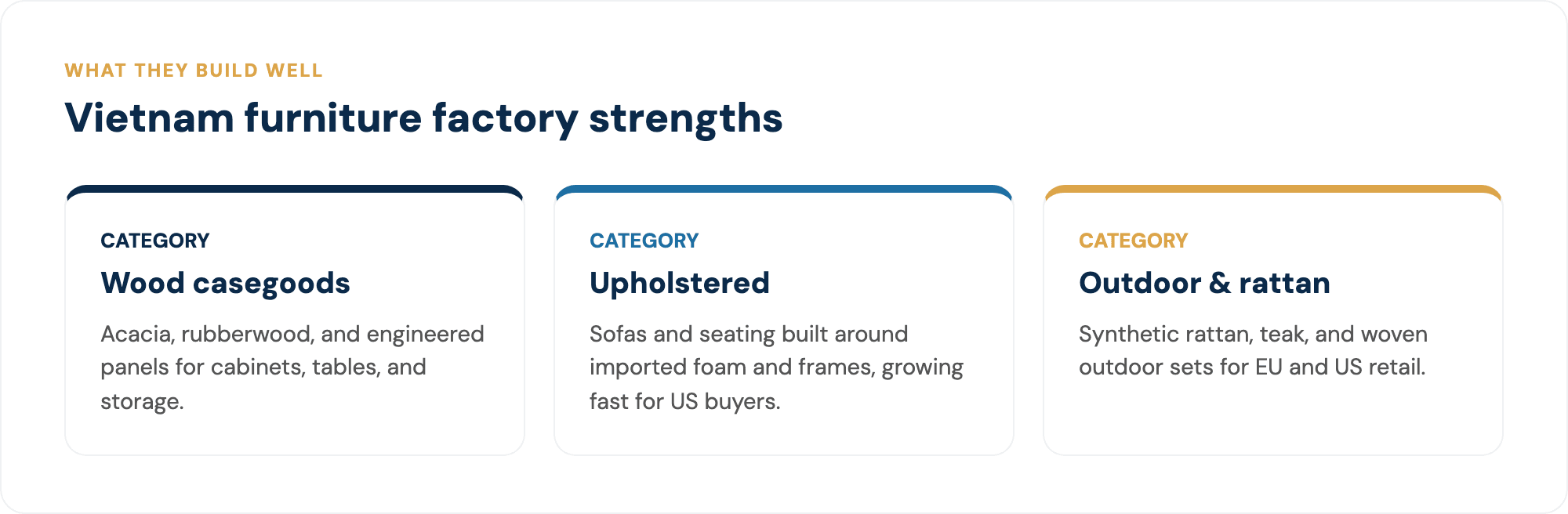
Understanding where Vietnamese factories have genuine depth helps buyers match orders to the right capability tier.
Solid wood and engineered wood case goods are the clearest strength. Vietnam has strong access to rubber wood (a sustainable plantation crop), acacia, and imported teak, oak, and walnut. Factories in Binh Duong run CNC milling, finger-jointing, and dovetail assembly lines that are comparable to mid-tier European operations. For bedroom sets, dining room furniture, and shelving, this category is mature and price-competitive.
Upholstered furniture has grown significantly. HCMC and surrounding provinces have a cluster of fabric-and-foam suppliers that supports domestic upholstery production. Lead times on upholstered items (sofas, dining chairs, ottomans) are longer than case goods because fabric sourcing adds a variable, but buyers placing 6-month forward orders find the category workable.
Outdoor and rattan furniture represents a distinct niche. Vietnam is one of the few countries with both the rattan raw material supply chain and the craft labor base to produce high-quality hand-woven outdoor pieces at commercial scale. Buyers sourcing this category from China have seen inconsistent quality; Vietnam factories focused on this niche often outperform on durability and finish.
| Category | Material Depth | Typical MOQ (containers) | Lead Time | Compliance Note |
|---|---|---|---|---|
| Solid wood case goods | High (rubber wood, acacia, hardwood imports) | 1 FCL | 60-90 days | Lacey Act[5] documentation required |
| Engineered wood / MDF | High | 1 FCL | 45-75 days | Lower legality risk; verify board sourcing |
| Upholstered seating | Medium-High | 1-2 FCL | 75-105 days | Fabric origin affects EVFTA rules of origin |
| Outdoor / rattan | High for rattan niche | 0.5-1 FCL | 60-90 days | Rattan species may require CITES check |
| Bedroom / dining sets | High | 1 FCL | 60-90 days | Lacey Act + EUDR[4] if EU-destined |
One field note from qualifying factories in Binh Duong: the difference between a factory quoting $180 and one quoting $230 for the same solid-wood dining chair is usually not margin, it is timber sourcing. The lower-cost quote often means mixed or undocumented wood lots. That matters, as the next section explains.
The Wood-Legality Trap Every Buyer Must Clear
This is the single most common area where first-time Vietnam furniture buyers run into problems, and the consequences are not small.
The US Lacey Act requires that any wood or wood product imported into the United States be accompanied by documentation showing the species, country of harvest, and that the timber was legally harvested under the laws of the country of origin. The importer of record bears this burden, not the factory. If US Customs flags a shipment and the importer cannot produce an adequate paper trail, the goods can be seized and the importer faces civil or criminal penalties.
The EU Timber Regulation has been superseded by EUDR, which entered into force in 2023 and requires importers placing furniture products on the EU market to conduct due diligence demonstrating that the wood in the product did not originate from deforested or forest-degraded land after December 31, 2020. EUDR applies to solid wood, plywood, and engineered wood panels. It requires GPS-level geolocation data on forest plots, not just a species declaration.
FSC[7] certification is the clearest way to satisfy both sets of requirements. A factory holding an FSC Chain of Custody certificate can trace timber from certified forest management through its production process to the finished product. The FSC certificate number, scope, and expiry appear on a certificate search tool at fsc.org, so buyers can verify claims independently rather than taking factory assurances at face value.
In our experience qualifying furniture factories across Vietnam, roughly 40 to 50 percent of factories working in solid wood hold active FSC Chain of Custody certification. Of those, a smaller share maintain the documentation discipline needed to produce a complete Lacey Act declaration at the SKU level. The tell is whether the factory can hand you a harvest-country breakdown by species on a per-order basis, within 48 hours. If they need two weeks to compile that, their CoC system is not actually functional.
FSC certification on the factory does not automatically mean every timber lot they received that month came from certified sources. A factory can hold FSC CoC and still run non-FSC material through the same line if their internal segregation is weak. Ask for the “percentage claim” or “credit claim” methodology and audit a recent delivery receipt.
Buyers sourcing rattan furniture face an additional check. Some rattan species fall under CITES Appendix II, which means the exporting country must issue a CITES export permit. Vietnam’s CITES Management Authority issues these permits; buyers should confirm the factory’s CITES permit history before the first order ships.
How to Start Sourcing Furniture from Vietnam
The practical steps for a first-time buyer are less complicated than the compliance layer makes them sound, provided the qualification process is done in the right order.
Step 1: Define your category and compliance requirements first. Before contacting any factory, know your destination market (US, EU, or both), your timber species preference, and whether your product requires FSC documentation for your retail channel. Some US retailers require FSC on all wood goods; if yours does, that requirement cuts your factory pool immediately and saves you from qualifying factories that cannot serve you.
Step 2: Qualify factories on compliance before quoting. The pattern we see most often is buyers reversing this order, getting a low quote, falling in love with the price, and then discovering three months before shipment that the factory cannot produce Lacey Act documentation. Request the FSC CoC certificate number in the first email. Verify it at fsc.org. Ask for a sample harvest-country declaration for an existing order. Factories that can produce these documents quickly are used to working with compliance-oriented buyers.
Step 3: Request samples before committing to a production run. Standard practice in this market is to pay sample cost (usually $150 to $400 per piece for solid wood items) plus air freight. Expect 3 to 5 weeks for a production-spec sample from a qualified factory. Do not accept photos as a substitute. The sample review should include finish adhesion, joint integrity, drawer tolerance, and weight relative to spec.
Step 4: Negotiate deposit terms and production milestones. The norm in Vietnam’s furniture export market is 30 percent deposit on order confirmation, 70 percent against the bill of lading before shipment. Some factories with longer customer relationships will move to 30/40/30 structures (deposit, mid-production, pre-ship). Avoid 50/50 structures on first orders; they reduce the factory’s incentive to hit delivery milestones.
Step 5: Use a third-party pre-shipment inspection. Vietnam-based inspection firms (SGS, Bureau Veritas, and several independent QC houses in HCMC) offer factory inspections for $250 to $400 per man-day. On a full-container order, this is a straightforward insurance cost. Inspectors check production conformance to approved samples, packaging integrity, and carton labeling accuracy.
For buyers who want a vetted starting list rather than cold-contacting factories, the VietConnect supplier directory lists furniture manufacturers verified through our 7-signal scoring process, including compliance certification status. To run preliminary landed-cost estimates before committing to a sourcing lane, the VietConnect landed-cost tool calculates duty, freight, and port charges by HS code and destination market.
Frequently Asked Questions
Q: Do all Vietnam furniture exports avoid US Section 301 tariffs?
Vietnam-origin furniture is not subject to Section 301 tariffs, which currently apply to Chinese-origin goods at rates up to 25 percent on most furniture HS codes. The key qualifier is “Vietnam-origin”: goods must meet substantial transformation rules and cannot simply be Chinese-made furniture transshipped through Vietnam. US Customs has increased scrutiny on origin claims since 2020, so factory documentation on material sourcing matters.
Q: What does an acceptable Lacey Act declaration actually include?
A Lacey Act declaration (Form PPQ 505) requires the scientific name of each timber species, country of harvest, quantity and unit of measure, and the value of the plant component. On a complex item like a wood-and-upholstery sofa with a frame, the declaration covers the wood species in the frame. Factories regularly exporting to the US should have this documentation as a standing process, not something they produce on request for one buyer.
Q: How does EUDR affect furniture buyers importing into the EU from Vietnam?
EUDR requires EU-market importers to conduct due diligence showing the wood in their products did not come from deforested or degraded forest land after December 31, 2020. For Vietnam-origin solid wood furniture, this means obtaining GPS coordinates for the harvest area, evidence of legal harvest authorization, and supplier declarations. FSC-certified supply chains simplify this considerably because FSC’s forest management standard prohibits conversion of natural forests, which aligns with EUDR’s core requirement.
Q: What minimum order quantity should a US buyer expect from a qualified factory?
Most solid-wood furniture factories in Vietnam’s main export cluster set minimums at one full 40-foot container per SKU or per order, which translates to roughly 150 to 300 dining chairs or 40 to 80 bed frames depending on size. Some factories, particularly those with existing retailer relationships, will accept mixed-SKU containers at the same overall container minimum. Factories targeting the higher-end market sometimes work with smaller runs, but lead times extend accordingly.
Sources
- European Commission: EU-Vietnam Free Trade Agreement
- Government of Canada: CPTPP
- Office of the U.S. Trade Representative: Section 301, China
- European Commission: Deforestation-free products regulation (EUDR)
- USDA APHIS: Lacey Act
- ISO: ISO 9001 Quality management
- Forest Stewardship Council
- Vietnam Government (baochinhphu): wood furniture export turnover 2024
Source from Vietnam with an operating partner
Trade With Viet supports international buyers across 30+ countries with verified suppliers, compliance review, and first-order support, not just introductions.