
9 min read
In this guide
What EVFTA[1] Is and the Scale of the Duty Cut
EVFTA is a comprehensive bilateral free trade agreement between the EU and Vietnam, ratified by the European Parliament in February 2020 and in force since 1 August 2020. It covers goods, services, investment, and intellectual property, but for importers the headline is tariffs on goods.
At entry into force, the EU eliminated duties on roughly 85% of Vietnamese goods immediately[3], with the remaining lines phased to zero over 7 to 10 years depending on the product sensitivity. Vietnam, for its part, is liberalising EU goods on a parallel but asymmetric schedule, given the development gap between the two economies.
For context: before EVFTA, Vietnamese goods entering the EU paid standard MFN duties, which for categories such as apparel and footwear ran into double digits. The agreement converted those into preferential rates that in most cases trend toward zero. The cumulative duty saving across a full container of textile or furniture products can exceed several thousand euros per shipment, which is the kind of number that makes origin compliance worth managing carefully.
EVFTA sits alongside the CPTPP[2], to which Vietnam is also a party. EU buyers sometimes ask whether CPTPP applies to their shipments. It does not: CPTPP covers a different group of economies and does not include EU member states.
How the Tariff Phase-Out Actually Works
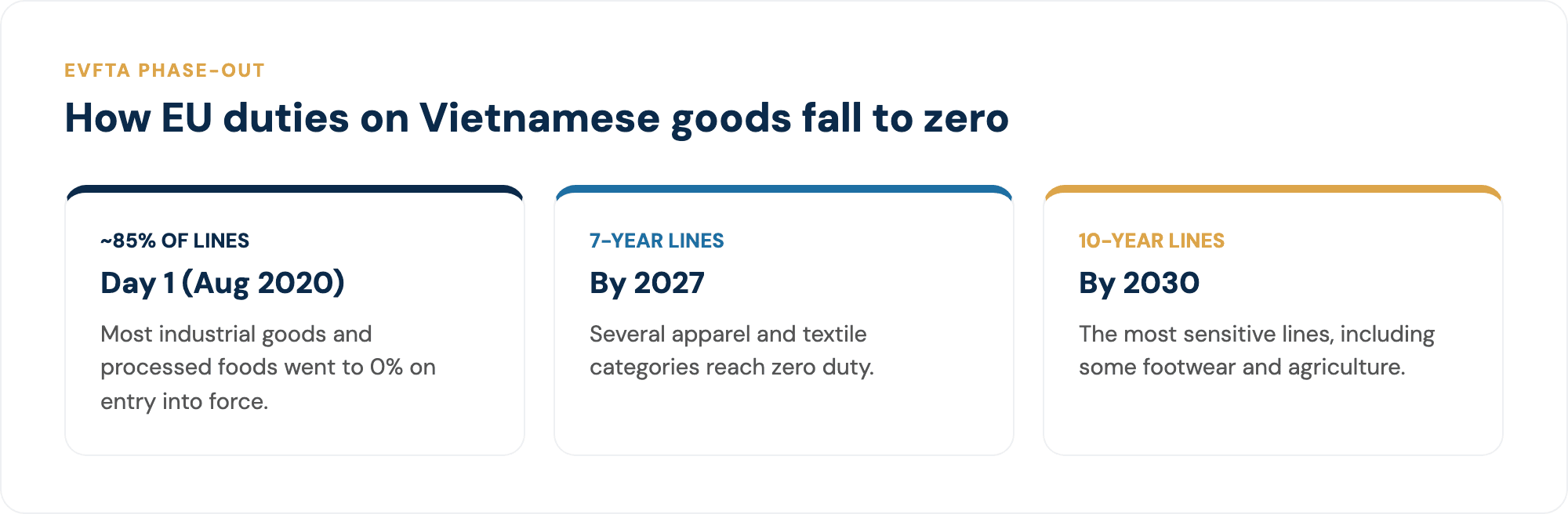
EVFTA structured its liberalisation into staging categories. The practical picture for EU importers:
- Immediate elimination (Day 1, 1 Aug 2020). The largest share of lines went to 0% on entry into force. Many industrial goods, processed foods, and select consumer products fell into this category.
- 3-year phase-out (by 2023). A further tranche of lines reached zero on 1 August 2023.
- 7-year phase-out (by 2027)[4]. Products such as certain apparel and textile categories are on this schedule.
- 10-year phase-out (by 2030)[5]. The most sensitive lines, including some footwear sub-categories and specific agricultural products, reach zero by 2030.
A buyer importing garments in HS Chapter 61 or 62, for example, may still be in a transitional period where the preferential rate is not yet zero but is already meaningfully below the MFN rate. The precise rate for a given HS code on a given date is available in the EU’s TARIC database (Commission Regulation implementing EVFTA preferential tariffs). Our HS code lookup tool at vietconnect.tradewithviet.com/tools/hs-codes can help you identify the correct heading before you engage a supplier.
Illustrative Duty Comparison: MFN vs EVFTA Preferential
The figures below are directional and illustrative. Actual rates vary by precise HS code, staging year, and whether additional EU trade measures (anti-dumping, safeguards) apply. Verify your specific line in TARIC before contracting.
| Product Group | HS Chapter (illustrative) | EU MFN Rate (approx.) | EVFTA Preferential Rate (by 2025, approx.) |
|---|---|---|---|
| Woven garments | Ch. 62 | 12% | 9% (trending to 0% by 2027) |
| Footwear (leather uppers) | Ch. 64 | 17% | 9% (trending to 0% by 2030) |
| Upholstered furniture | Ch. 94 | 5.6% | 0% (immediate) |
| Frozen shrimp (HOSO) | HS 0306 | 12% | 0% (immediate) |
| Woven fabric (cotton) | Ch. 52 | 8% | 0% (immediate) |
| Ceramic tiles | Ch. 69 | 4.7% | 0% (immediate) |
The furniture and seafood lines are where we see EU buyers gaining the most immediately. Apparel and footwear are still phasing, but even the interim preferential rates represent a material reduction versus MFN.
Rules of Origin: Why the Duty Saving Dies Without Valid Proof
This is where most EU importers lose the benefit. In our experience working with buyers across 30+ countries sourcing from Vietnam, the buyers who lose the EVFTA saving lose it on origin paperwork, not on the tariff schedule. They find the right HS code, they confirm the preferential rate exists, then they fail to get origin proof in time or the proof they get does not comply with the agreement’s requirements.
The Origin Criterion
EVFTA’s rules of origin are set out in the agreement’s Protocol on Rules of Origin and its Annexes (available via EUR-Lex). For most manufactured goods, Vietnam must be the country where sufficient processing took place. “Sufficient processing” is defined product by product and can mean:
- A change in tariff heading (CTH) at the four-digit HS level, meaning the inputs arrive under one chapter heading and the finished product ships under a different one.
- A specific percentage of value-added in Vietnam, typically expressed as a maximum non-originating content threshold (for example, non-originating materials must not exceed 50% of the ex-works price).
- Specific processing rules for sensitive sectors such as textiles, where EVFTA generally requires yarn-forward or fabric-forward processing, meaning the fabric used must itself originate in Vietnam or the EU.
The yarn-forward rule in textiles is the most commonly misunderstood requirement. A Vietnamese factory that cuts and sews imported Chinese fabric does not produce an EVFTA-originating garment, regardless of how much Vietnamese labour is in it. The fabric must itself originate in Vietnam (or under the agreement’s cumulation provisions, in certain partner countries). This is the most frequent compliance failure in apparel sourcing.
The Two Valid Proof-of-Origin Documents
EVFTA recognises two instruments as valid proof of preferential origin:
EUR.1 Movement Certificate. A paper certificate issued by Vietnamese customs authorities (the General Department of Vietnam Customs, under the Ministry of Finance) at the point of export. The exporter applies for it, customs verifies origin, and the certificate travels with the shipment. The EU importer presents it at customs in the member state of import to claim the preferential rate.
Origin Declaration (Statement on Origin). A text declaration made by the exporter directly on the commercial invoice, packing list, or delivery note. As of the EVFTA’s entry into force, any Vietnamese exporter can make this declaration for shipments up to EUR 6,000[6]. For shipments above EUR 6,000, the exporter must be a Registered Exporter (REX) under the EU’s REX system, administered in Vietnam by the Ministry of Industry and Trade (MOIT). REX registration is free but requires the exporter to demonstrate knowledge of origin rules and accept that declarations are subject to subsequent verification.
Ask your supplier before production whether they hold REX status or can obtain an EUR.1 certificate. Neither document can be backdated after the goods have shipped. If the shipment arrives at EU customs without a valid EUR.1 or a compliant origin declaration, you pay MFN duty with no recovery option.
How a Buyer Claims the Saving in Practice
The steps below reflect what a well-prepared EU importer does before placing a purchase order, not after the goods arrive.
Step 1: Confirm the HS code and check TARIC. Use the 10-digit Combined Nomenclature code for your EU member state and enter it in the TARIC database (ec.europa.eu/taxation_customs/dds2/taric/) with origin Vietnam to see the live EVFTA preferential rate and the applicable product-specific rule. The landed-cost calculator at vietconnect.tradewithviet.com/tools/landed-cost lets you model total duty and VAT before you commit.
Step 2: Confirm the supplier meets the origin criterion. Send the supplier your HS code and ask directly whether the product qualifies for EVFTA origin. For textiles or complex goods, ask for fabric or material certificates. A supplier who cannot answer is a compliance risk.
Step 3: Confirm the proof-of-origin method before production. For shipments above EUR 6,000, the supplier must hold REX registration or obtain an EUR.1 from Vietnamese customs. EUR.1 processing takes several business days; build it into the export schedule. Ask for the REX number or the EUR.1 application reference before goods leave the factory.
Step 4: Verify the document. On a EUR.1, check Box 8 (country of origin: Vietnam), Box 7 (transport details), and the customs stamp. On an origin declaration, confirm the exporter’s REX number is present; without it, a shipment over EUR 6,000 is non-compliant.
Step 5: Declare at import and retain records for at least three years. EU customs conduct post-clearance audits and can request retrospective verification from Vietnamese authorities under EVFTA’s administrative cooperation provisions.
For buyers using our verified supplier network at vietconnect.tradewithviet.com/suppliers, we track REX status across 549+ verified suppliers as a standard field for pre-shortlist filtering.
Frequently Asked Questions
Q: Does EVFTA apply if I buy through a trading company rather than the manufacturer?
The origin criterion applies to the goods, not the commercial structure. If the goods meet the product-specific rule, the preferential rate is available. The REX registration or EUR.1 must be obtained by the Vietnamese exporter of record, whether that is the factory or a trading company. Confirm who holds that role before production.
Q: What happens if my supplier provides an incorrect origin declaration and I claim EVFTA at import?
EU customs can issue a post-clearance demand for the MFN duty difference plus interest if a verification request to Vietnamese authorities reveals the declaration was unfounded. The EU importer of record bears the liability. Verifying origin documentation before shipment is cheaper than recovering duty after the fact.
Q: Can I claim EVFTA if some components come from China?
It depends on the product-specific rule. If the rule requires only a change in tariff heading and the Chinese inputs fall under a different heading from the finished product, Vietnam origin may still be established. For textiles, the yarn-forward rule generally disqualifies Chinese fabric unless cumulation provisions apply. Check EVFTA Annex II for your specific code.
Q: Is EVFTA the same as the GSP preference Vietnam previously held with the EU?
No. EVFTA replaced the EU’s Generalised Scheme of Preferences (GSP) for Vietnam from 1 August 2020 and generally offers better rates. However, Form A certificates used under GSP are not valid for EVFTA claims. Buyers must use EUR.1 or REX-based origin declarations under the new agreement.
Sources
Source from Vietnam with an operating partner
Trade With Viet supports international buyers across 30+ countries with verified suppliers, compliance review, and first-order support, not just introductions.