
9 min read
In this guide
The Scale and What It Buys You
Vietnam’s roughly $44 billion annual garment and textile export[6] figure is not a marketing number. It reflects decades of investment in cut-make-trim and, increasingly, full-package production across hundreds of factories in provinces like Binh Duong, Long An, and Dong Nai.
To put the capacity in practical terms: the country’s garment sector employs roughly 2.5 million workers[7]. Factories that serve major international brands often run 10 to 20 production lines per facility, with monthly output measured in hundreds of thousands of units per style category. When buyers say they want a vendor with “proven volume,” Vietnam satisfies that requirement at the top end of global options.
The EVFTA[1] (EU-Vietnam Free Trade Agreement) and CPTPP[2] (Comprehensive and Progressive Agreement for Trans-Pacific Partnership) create real tariff advantages for qualifying goods. EU import duties on garments from Vietnam can drop to zero from rates that would otherwise range from 6 to 12 percent under EVFTA. CPTPP opens similar corridors into Canada, Japan, Australia, and other member markets. These are not hypothetical savings; they directly reduce landed cost for buyers sourcing at volume.
For cost benchmarking, Vietnam’s apparel manufacturing minimum wage[5] varies by region and labor zone, but industrial zone rates have risen steadily over the past several years. Factor that into your cost models. The country is no longer the cheapest option in Asia, but the trade-off is skill level and reliability that lower-cost alternatives often cannot match at comparable quality tiers.
Use the landed cost calculator to model actual landed pricing inclusive of duties, freight, and insurance before comparing quotes.
Where Vietnam Is Strongest
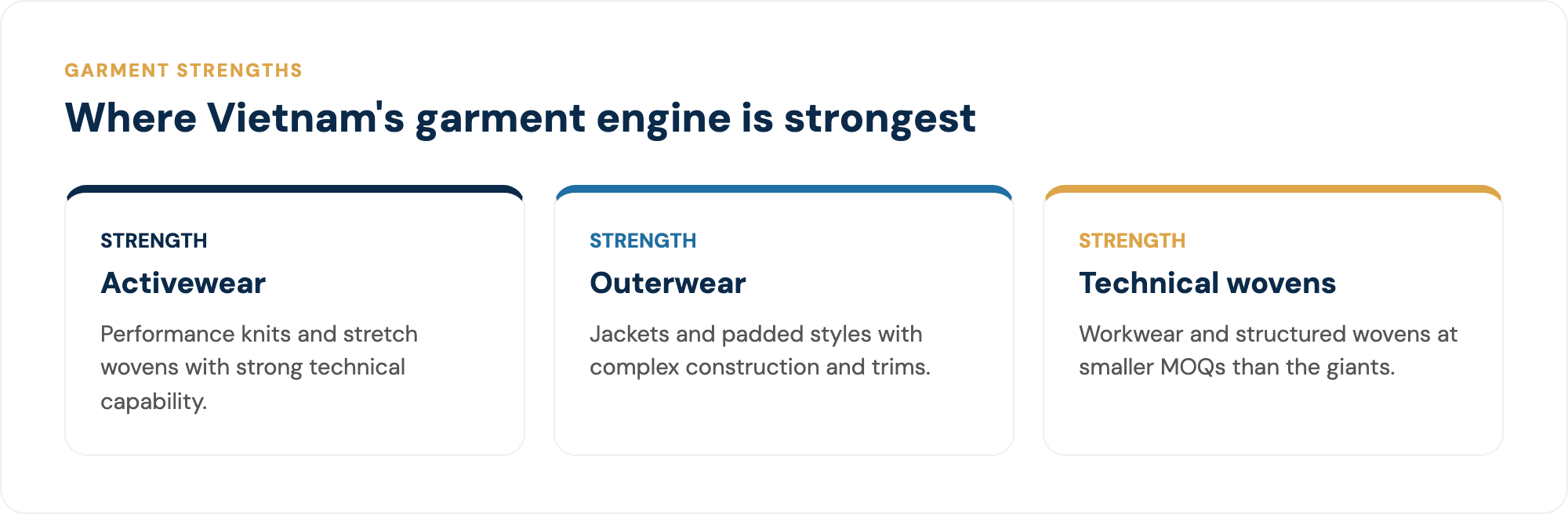
Vietnam’s garment industry is not uniformly strong across all categories. Understanding where it concentrates capacity helps buyers select the right factories rather than the nearest ones.
Activewear and performance fabrics. This is Vietnam’s fastest-growing segment. Factories in the Ho Chi Minh City corridor have built out bonding, sublimation, and technical-seam capabilities specifically to serve Western athletic brands. MOQs for activewear in Vietnam typically start at 300 to 500 units per colorway for established suppliers, compared to 1,000 or more at comparable Chinese facilities running the same output levels.
Outerwear and wovens. The country has deep experience in woven bottoms, casual jackets, and mid-layer outerwear. Pattern-making and sampling cycles at experienced outerwear factories run four to six weeks for development samples, which is competitive with China and faster than Bangladesh for the same complexity.
Knits and basics. Vietnam’s knit sector is mature. T-shirts, polo shirts, and fleece are sourced here by brands at every price point. The advantage over Bangladesh in this category is not cost but turnaround: smaller development orders, faster response on re-cuts, and better English-language communication in factories.
Technical and institutional. Workwear, uniforms, and performance PPE garments have a strong cluster in northern Vietnam around Hanoi and Hai Phong. Buyers sourcing these categories often find fewer qualified vendors in Bangladesh or Cambodia.
In our experience qualifying garment factories across Vietnam, the supplier list on vietconnect.tradewithviet.com/suppliers/textiles surfaces verified manufacturers across these categories with capacity and compliance data pre-checked. The directory covers 549+ verified suppliers across six categories sourced from 30+ countries of buyer origin.
One insider tell worth knowing: when a factory quotes lead time, ask specifically about fabric receipt-to-cut, not order placement-to-ship. The gap between those two numbers reveals whether the factory controls its own fabric pipeline or is waiting on an import agent. Factories that cannot separate those two figures reliably have supply chain visibility gaps that will cost you time on re-orders.
The Fabric and Rules-of-Origin Caveat
This is the constraint that most sourcing guides underplay, and it matters directly to whether EVFTA or CPTPP duty savings apply to your shipments.
Vietnam imports a significant share of its fabric, primarily from China, Taiwan, and South Korea. This is not a hidden fact; it is structural. Vietnam’s domestic textile spinning and weaving sector has grown, but it cannot yet supply the full volume and variety that garment factories need.
The problem for duty-seeking buyers is that both EVFTA and CPTPP impose strict rules of origin that require garments to be made from fabric produced within the FTA zone.
Under EVFTA, the standard is “double transformation,” which in practice means yarn-forward: the fabric must be woven or knitted in Vietnam (or another EU country), and the garment must then be cut and sewn in Vietnam. Fabric imported from China and cut-and-sewn in Vietnam does not qualify for EVFTA preferential tariffs regardless of where the final garment is assembled.
CPTPP imposes a “yarn-forward” rule for most apparel: the fiber must be spun into yarn, the yarn woven or knitted into fabric, and the garment sewn, all within CPTPP member countries. Vietnam is a member; China is not.
A factory quoting you EVFTA or CPTPP duty access without a Form EUR.1 certificate of origin backed by a fabric traceability document is quoting you a benefit you may not be able to claim. Always request the fabric mill certificate and verify the country of origin before building the duty saving into your landed cost model.
There is a practical path through this: Vietnam-origin fabric mills do exist and have expanded capacity. OEKO-TEX[4] certified fabric suppliers in Vietnam can supply knit fabrics meeting both quality and origin requirements for EVFTA purposes. The sourcing task for duty-seeking buyers is to identify factories that have either invested in domestic fabric supply relationships or can document an approved supply chain. This adds steps to factory qualification but is entirely workable at volume.
How to Qualify a Garment Factory
With 549+ verified suppliers in the TWV network across Vietnam, the filtering question is not whether factories exist but which ones are worth your development time.
Capacity verification. In our experience qualifying garment factories, the capacity number on the line sheet is not the one that matters. What matters is confirmed allocated capacity: how many lines, currently producing for which customers, and what percentage of those lines are available for a new program. A factory running at 95% utilization for two anchor customers will not serve a new buyer well regardless of its nominal capacity.
Compliance maturity. For EU and US buyers, minimum requirements typically include BSCI or SMETA[3] social compliance audits, with GOTS or OEKO-TEX certification expected for brands with sustainability commitments. OEKO-TEX Standard 100 certification at the fabric level confirms that tested substances are within regulated limits, which is increasingly a baseline requirement for EU market entry under the European Green Deal’s textile sustainability provisions.
Sample and development speed. Request a proto-sample on a style of comparable complexity to your actual program. Track from fabric order placement to sample delivery. Target: four to six weeks for a development sample. Factories that consistently miss this threshold on protos will miss it on production too.
Communication and account management. This is a practical filter that sourcing checklists omit. Ask who your day-to-day contact is, what their English proficiency is, and how they handle change orders mid-production. A recurring pattern we see: buyers award a first order based on price, then spend the next three months managing communication failures that cost more than the price saving. Factory relationship quality is a sourcing variable, not a soft consideration.
Vietnam vs. Bangladesh: Garment Sourcing Comparison
| Factor | Vietnam | Bangladesh |
|---|---|---|
| Minimum Order Quantity | 300-500 units/colorway (activewear); 500-1,000 (wovens) | 1,000-3,000 units typical for comparable categories |
| Product Strength | Activewear, outerwear, knits, technical wovens, uniforms | Basic knits, T-shirts, denim, casualwear at very high volume |
| Development Lead Time | 4-6 weeks (proto sample) | 5-8 weeks; longer for complex constructions |
| EVFTA Duty Access | Yes, subject to yarn-forward/double-transformation origin rule | No (Bangladesh has LDC GSP access, separate scheme) |
| CPTPP Duty Access | Yes, subject to yarn-forward rule | No |
| Compliance Maturity | Strong; BSCI/SMETA audits common; OEKO-TEX growing | Mature at top-tier factories; variance at smaller units |
| Minimum Wage Context | Higher than Bangladesh; varies by industrial zone | Among the lowest globally; cost advantage for basics at volume |
Verdict: Vietnam has the edge for buyers sourcing activewear, outerwear, technical categories, or programs requiring EVFTA/CPTPP duty access with verified origin. Bangladesh remains more cost-competitive for high-volume basic knit programs where LDC duty access under the EU’s GSP scheme applies and origin rules are not an issue.
Frequently Asked Questions
Q: Does Vietnam’s $44 billion export figure mean any factory there can handle my volume?
Scale at the country level does not guarantee capacity at the factory level. Vietnam’s export base is spread across thousands of facilities, many of them already fully allocated to anchor customers. Buyers need to verify confirmed available capacity, not nominal capacity, before committing development resources. TWV’s verified supplier directory pre-filters for this.
Q: How do I know if my Vietnam-sourced garments qualify for EVFTA zero-duty rates?
The factory must provide a Form EUR.1 or a Registered Exporter (REX) declaration supported by fabric-origin documentation showing the fabric was produced within an EVFTA member country, typically Vietnam itself. If the factory cannot produce this documentation, the garment does not qualify for preferential tariff treatment regardless of where it was assembled.
Q: Is OEKO-TEX certification required to sell apparel into the EU?
OEKO-TEX Standard 100 is not currently a legal requirement for EU market entry, but it is increasingly a buyer-imposed prerequisite, particularly for brands with sustainability commitments. EU textile regulations under the European Green Deal are tightening, and OEKO-TEX certification at the fabric level provides a defensible basis for product safety claims. Treat it as a near-term commercial requirement rather than a regulatory one.
Q: What MOQs should a new buyer expect when sourcing activewear from Vietnam?
For buyers working with established, audit-compliant factories in Vietnam’s activewear cluster, typical minimums run 300 to 500 units per colorway per style, with 12-piece size runs. This is meaningfully lower than comparable Chinese facilities at the same quality tier, which is one reason Vietnam has attracted mid-market activewear brands that cannot absorb 1,000-unit minimums during development phases.
Sources
- European Commission: EU-Vietnam Free Trade Agreement
- Government of Canada: CPTPP
- Sedex: SMETA audit
- OEKO-TEX: Standard 100
- Vietnam Briefing: Vietnam minimum wage (regional rates)
- VietnamPlus: Vietnam textile export turnover hits 44 billion USD in 2024
- IFC: Weaving Respect into Workplace Culture in Vietnam Garment Sector
Source from Vietnam with an operating partner
Trade With Viet supports international buyers across 30+ countries with verified suppliers, compliance review, and first-order support, not just introductions.