
9 min read
This guide is part of our how to source from Vietnam playbook, the full step-by-step map for importers.
In this guide
- Red Flag 1: No Itemized Cost Breakdown
- Red Flag 2: Instant “Yes” to Any Spec or Deadline
- Red Flag 3: No Certificates or Refusal to Share Audit Reports
- Red Flag 4: Deposit Above 50% or Payment to a Mismatched Account
- Red Flag 5: Vague or Unverifiable Company Registration
- How a Clean Quote Looks
- Frequently Asked Questions
Red Flag 1: No Itemized Cost Breakdown
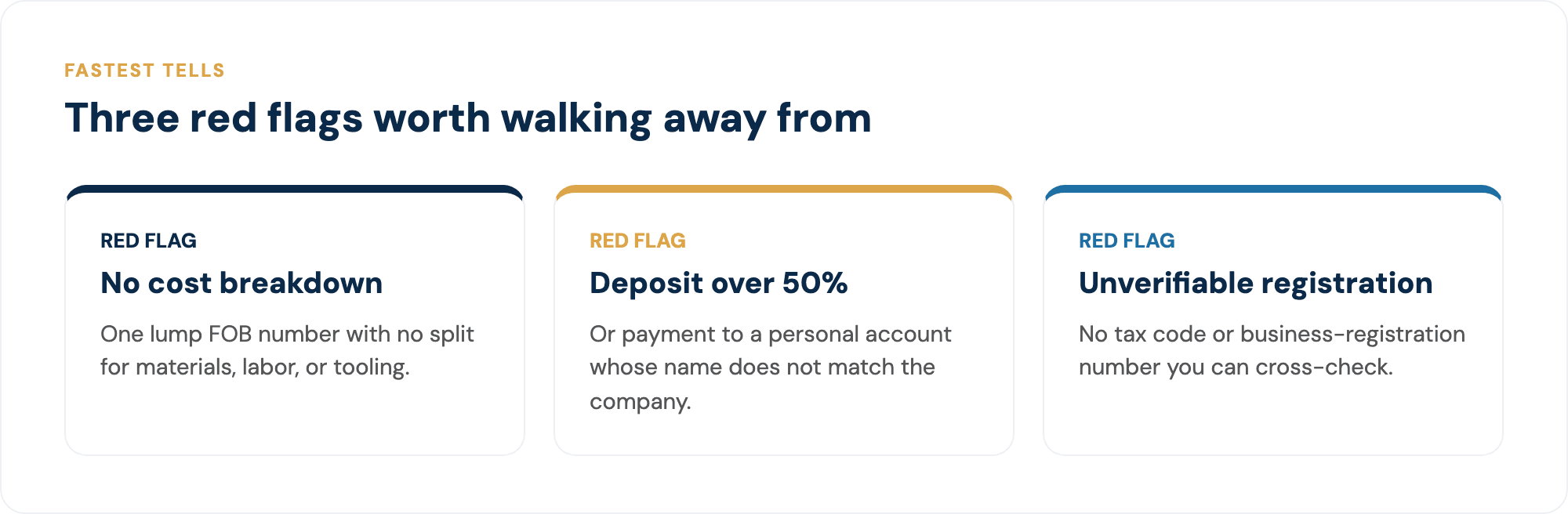
A legitimate factory can break down what each line of your cost is: raw material, labor, overhead, and freight to the named port. A single FOB number with no breakdown means you cannot benchmark against market rates, cannot negotiate on any component, and have no basis for dispute if quality drops on the production run.
The pattern we see repeatedly: a trading company quotes a round number because they are marking up a factory price they cannot expose. The markup is often 15 to 30 percent. When buyers push for a breakdown, these suppliers either go quiet or produce a vague table that still conceals the real factory cost.
What to ask. Request a cost-breakdown sheet covering at minimum: (1) material cost per unit with grade and origin specified, (2) labor cost per unit, (3) factory overhead allocation, (4) FOB margin. If the supplier says they “do not disclose cost structure,” that is a firm signal to verify who you are actually dealing with before proceeding. Cross-reference material cost against publicly available commodity prices for the category. A significant gap means something is buried in the number.
Red Flag 2: Instant “Yes” to Any Spec or Deadline
The most dangerous words in Vietnam sourcing are “no problem.” A factory that accepts every specification change without question, agrees to your tightest deadline without checking production schedules, and never sends a counter-spec is not demonstrating capability. It is demonstrating that it will say whatever it takes to secure your deposit.
Factories that actually produce consistently ask questions. They flag incompatible tolerances, request material samples, push back on lead times that conflict with their order book, or ask for a technical drawing review. That friction is a sign of operational competence.
The risk when a factory says yes to everything: you wire upfront, production starts, and the factory substitutes materials to hit an impossible price, ships late because the lead time was never achievable, or produces to a spec no one clarified.
What to ask. Present one deliberate inconsistency or tight constraint in your RFQ and watch the response. Ask: “Our packaging dimension requires X, but the standard carton for this product is Y. How will you handle that?” A capable factory will give you a specific answer. A red-flag supplier will say “we will handle it.”
For deadline verification, ask them to share their current production schedule for your product category and confirm where your order would slot in.
Red Flag 3: No Certificates or Refusal to Share Audit Reports
Certificates are not paperwork formalities. ISO 9001[1] certification (issued by an accredited certification body under the International Accreditation Forum Multilateral Recognition Arrangement) means the factory has a documented quality management system that has been audited by a third party. SMETA[3] (Sedex Members Ethical Trade Audit) and SA8000[2] (Social Accountability International standard) cover labor and social compliance. A factory with real ISO 9001, SMETA, or SA8000 certifications has gone through external scrutiny on specific dimensions of how it operates.
When a supplier claims certification but cannot produce the actual certificate, or produces one that lists a different legal entity name, that is a material misrepresentation.
Certificate fraud is a known problem in the Vietnam manufacturing sector. The safest verification method is to take the certificate number directly to the issuing certification body’s public registry. ISO 9001 certificates can be verified through the certification body named on the document (Bureau Veritas, SGS, TUV, DNV, etc.). Each body maintains a searchable registry. A certificate that does not appear in the issuer’s database is not valid.
What to ask. Request the full certificate document, not a logo or a reference number. Cross-check: does the certificate name match the legal entity you are contracting with? Is the certificate still within its validity period? Then verify the certificate number directly with the issuing body’s registry. For SMETA reports, the full audit report is held in the Sedex platform and can be shared by the supplier if they have a paid Sedex membership.
Factories with nothing to hide share this documentation within 24 to 48 hours.
Red Flag 4: Deposit Above 50% or Payment to a Mismatched Account
Standard payment terms in Vietnam B2B manufacturing run 30 to 50 percent deposit with the balance against shipping documents or on delivery. Any demand for more than 50 percent upfront, particularly for a first order with a new supplier, sits outside normal commercial practice and shifts all the risk to you before any production has started.
The bank account mismatch is the faster and more reliable tell. The single fastest indicator we use when reviewing payment instructions is whether the beneficiary account name matches the legal registered name of the supplier. If you are contracting with “Thanh Phat Furniture Co., Ltd.” and the wire instructions say the beneficiary is “T. Nguyen” or a completely unrelated company name, that is a strong signal of either fraud or an undisclosed intermediary.
We have seen this pattern repeatedly in first-order situations: a supplier presents credible product photos and pricing, the buyer agrees to terms, and the payment instructions arrive with a personal account or a holding company name. After the wire goes out, communication degrades.
What to verify. Before any wire transfer, confirm the beneficiary name on the banking instructions against the legal entity name on the pro forma invoice and the business registration certificate. These three names must match. For transfers above $10,000, request a bank letter confirming the account belongs to the stated legal entity. This is a standard request in international trade and a legitimate supplier will not refuse it.
If a supplier insists on payment to a personal account for any reason, do not proceed.
Red Flag 5: Vague or Unverifiable Company Registration
Vietnam requires all businesses to hold a Business Registration Certificate issued by the Department of Planning and Investment of the relevant province. This document carries a tax identification number (MST in Vietnamese, a 10 or 13-digit code). Every legitimate manufacturer has one and can share it immediately.
When a supplier cannot produce their MST, produces a certificate with details that do not match their quoted address or product scope, or presents a registration that names a trading company when they claim to be a direct factory, you are dealing with an unverifiable counterparty.
The trading-company-posing-as-factory problem is one of the most common issues TWV buyers encounter across our 549+ verified supplier network. The fastest verification method: search the MST on the General Department of Taxation’s public lookup tool (tracuunnt.gdt.gov.vn). This returns the official registered name, address, and legal representative. If the result does not match what the supplier told you, you have your answer.
A secondary check for factory verification: request the business registration scope (nganh nghe kinh doanh). A real manufacturer will have “production” or “manufacturing” listed in their registered business activities. A trading company will show “wholesale trade” or “import/export.”
What to ask. Request the Business Registration Certificate and note the MST. Run the MST on the GDT lookup. Confirm the registered name, address, and business scope match what the supplier has represented. This takes under five minutes and has saved buyers from significant losses.
How a Clean Quote Looks
A credible quote from a vetted Vietnam manufacturer gives you something to work with, not just a number to accept or reject blind.
| Dimension | Red-Flag Quote | Healthy Quote |
|---|---|---|
| Cost breakdown | Single lump FOB number | Itemized: material, labor, overhead, freight margin |
| Response to spec questions | “No problem, we can do it” | Specific questions back, counter-specs where needed |
| Certificates | Claims certification but cannot produce documents | ISO 9001 certificate with verifiable issuing body + number |
| Deposit terms | 70% or more upfront, or personal account payment | 30-50% to verified legal entity matching contract |
| Company registration | No tax code provided or details do not match | MST verified on GDT lookup, scope includes manufacturing |
| Lead time response | Agrees to any deadline without checking schedule | Confirms current capacity and gives a realistic window |
A factory that passes all five checks has not guaranteed a perfect order, but it has demonstrated the minimum transparency that makes a dispute resolvable. Without verified registration, matched payment details, and traceable certifications, you have limited recourse once money has moved.
The VietConnect verified supplier directory shows which suppliers have passed document verification across these categories. Before you reach the quote stage, you can filter by certification type and confirm manufacturing scope.
Use the landed cost calculator to check whether the FOB price, once duties and freight are added, reaches your target landed cost before you negotiate individual line items.
Frequently Asked Questions
Q: Is it normal for a Vietnam factory to ask for 50% deposit on a first order?
Yes, 30 to 50 percent is standard for new buyer relationships. Above 50 percent warrants a direct question about why. If the supplier cites material pre-purchasing costs, request the material purchase order as documentation. A legitimate factory will provide it.
Q: How do I verify a Vietnam business registration number (MST) without speaking Vietnamese?
Go to tracuunnt.gdt.gov.vn and enter the MST. The result is in Vietnamese but the registered name and address are readable. Use a browser translation plugin if needed. The legal entity name displays in Latin characters and is usually recognizable against what the supplier stated.
Q: What should I do if a supplier lists ISO 9001 on their website but cannot produce the certificate?
Request the certificate number and the issuing certification body name. Then search the body’s online registry directly. Bureau Veritas, SGS, TUV SUD, and DNV all maintain public certificate lookup tools. If the certificate number does not appear, or the entity name does not match, treat the claim as unverified.
Q: Can a trading company still be a reliable supplier if they are not the direct factory?
Yes. The problem is misrepresentation, not the trading-company model itself. Posing as a factory limits your ability to audit production, negotiate on cost, and understand your actual supply chain. Ask directly: “Are you the manufacturer or a trading company?” then verify against the business registration scope.
Sources
Source from Vietnam with an operating partner
Trade With Viet supports international buyers across 30+ countries with verified suppliers, compliance review, and first-order support, not just introductions.