
10 min read
In this guide
From a 14th-Century Village to an Export Cluster
Bat Trang sits on the Red River about 13 kilometers southeast of Hanoi’s center. The village name translates roughly to “white clay field,” and the clay deposits along the river are what drew potters there around the 14th century under the Ly and Tran dynasties. For several hundred years, Bat Trang supplied the Vietnamese imperial court and traded with China and Japan. The pieces were distinctive: thick walls, bold blue-and-white cobalt motifs, heavy foot rings.
What makes Bat Trang commercially significant today is what changed after Doi Moi economic reforms in the late 1980s. State-owned cooperatives gave way to private family workshops, then to larger factory operations. Gas-fired tunnel kilns replaced wood-fired traditional ones, cutting firing times and improving glaze consistency. CNC mold-cutting arrived for high-volume slip-cast production. By the 2000s, the village had begun taking private-label orders from European homeware brands.
The cluster now spans both the original commune and industrial workshop zones along National Highway 5. Rough estimates from Vietnamese trade publications put active producers in the hundreds. Some are three-person family operations making hand-painted decorative pieces. Others run factory floors with 50-plus workers, multiple kilns, and dedicated QC lines for export.
One concrete signal of scale: Bat Trang products appear regularly in the import records of US Customs and Border Protection filings under HS codes 6911 (tableware, porcelain) and 6913 (ornamental ceramics). That paper trail matters when you are building landed-cost models. Use the landed cost calculator to factor in duties under the specific subheadings.
What Bat Trang Factories Make Well
Bat Trang’s core competency is mid-to-premium hand-finished ceramics in relatively modest volumes. That positions it differently from the mass-production ceramic clusters in Chaozhou or Dehua, and that distinction should drive how you spec your order.
Tableware. Plates, bowls, mugs, and serving pieces in stoneware or porcelain. The strongest factories produce consistent wall thickness and clean glaze application. Earthenware is also available but is less common for export because of stricter food-safety requirements at lower firing temperatures. If you are sourcing tableware for retail or food service in the US or EU, request only stoneware or porcelain pieces fired above 1200 degrees Celsius.
Garden planters and pots. Large-format planters are a significant export category. Frost resistance is a frequent buyer question. Most Bat Trang planters are not frost-rated, because the clay body and glazing are optimized for indoor or subtropical use. If your customer base is in northern Europe or the US Midwest, get explicit written confirmation of the firing temperature and clay body composition, and test a sample through a freeze-thaw cycle before placing a full order.
Vases and decorative pieces. This is where hand-painting capability is strongest. The village has maintained a large pool of skilled painters working in traditional cobalt blue styles and in contemporary palette-driven designs. For private-label work requiring specific Pantone color matching, expect a longer sampling cycle, typically three to five rounds, before glaze colors stabilize across production batches.
Custom and private-label homeware. Factories with export experience can work from buyer-supplied 3D files, physical samples, or hand-drawn sketches. Mold-cutting fees range broadly depending on complexity. Confirm ownership of tooling in the contract; some factories retain mold rights by default.
What Bat Trang does less well: ultra-thin bone china at scale, technical ceramics, and products requiring extremely tight dimensional tolerances for mechanical assembly. For those applications, factories in Binh Duong or specialized Chinese clusters are more appropriate.
The Compliance That Decides a Tableware Order
This is where tableware orders get stopped, returned, or worse, recalled at retail. In our experience qualifying Bat Trang tableware factories, the order that gets stopped at customs or pulled from a US retailer’s shelf is almost always the one where the buyer accepted a factory’s own test certificate instead of requiring an accredited third-party report.
The core issue: lead and cadmium leaching.
Ceramic glazes achieve color through metallic oxides. Some colorants, particularly reds, oranges, and yellows, have historically used cadmium sulfoselenide compounds. Blue and green glazes may contain cobalt, manganese, or copper. When these glazes are poorly formulated or under-fired, acidic food and drink can leach lead or cadmium from the glaze surface into the food.
The regulatory thresholds you need to know:
- US FDA limits (from 21 CFR 109.16): flatware must not exceed 3 ppm lead and 0.5 ppm cadmium in acetic acid leach tests. Small hollowware has a 2 ppm lead / 0.5 ppm cadmium limit. Large hollowware is 1 ppm lead.
- California Proposition 65 (Prop 65[3]): requires a warning label if lead exposure from a product exceeds 0.5 micrograms per day or cadmium exceeds 4.1 micrograms per day. Prop 65 enforcement is via private plaintiff action, which means the exposure threshold can create liability well below FDA limits. Any retailer selling in California is exposed, and that includes most US e-commerce sellers.
- EU REACH[2] Regulation (EC No 1907/2006): restricts cadmium in glazes on ceramic ware to 0.1% by weight under Annex XVII, Entry 23. EU Directive 84/500/EEC sets migration limits for lead (0.8 mg/dm2 for flatware) and cadmium (0.07 mg/dm2) that are significantly stricter than US FDA limits.
A factory passing US FDA leach limits may still fail EU Directive 84/500/EEC cadmium migration thresholds. If you are dual-listing products for US and EU retail, test against both standards. Do not assume FDA compliance covers EU requirements.
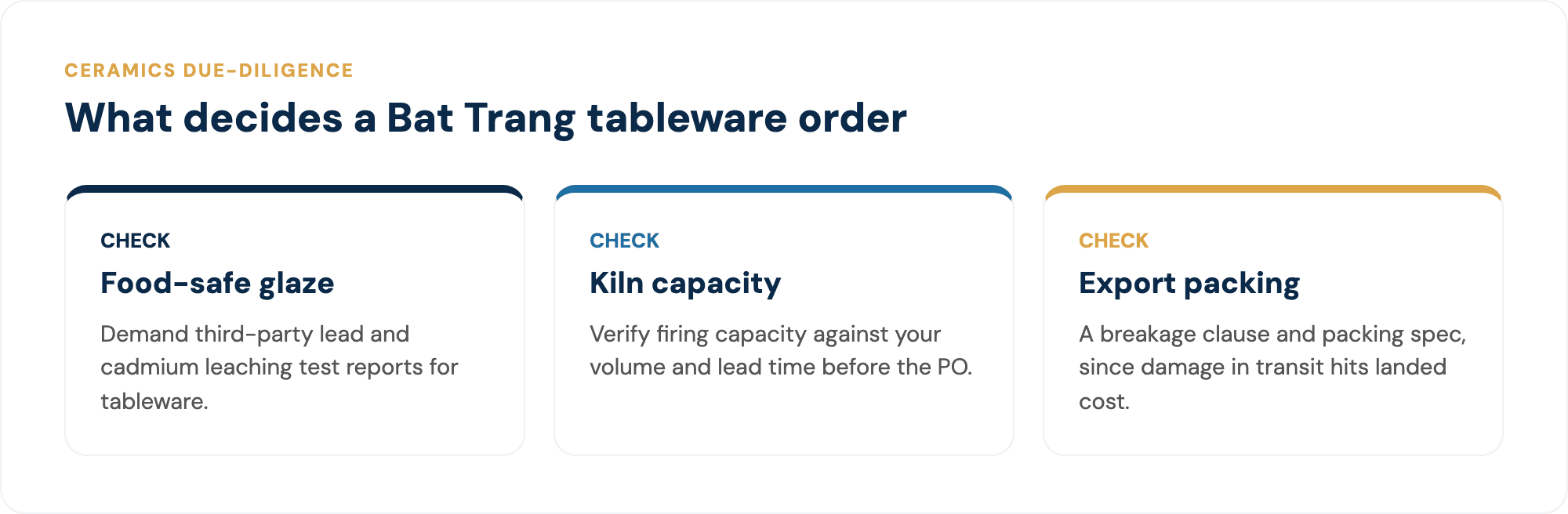
What test report to demand. Request a leaching test report issued by an accredited third-party lab, specifically SGS, Bureau Veritas, Intertek, or TUV Rheinland. The test method must be EN 1388 Parts 1 and 2 (EU) or ASTM C738 and C927 (US FDA). A factory’s in-house certificate is not acceptable for retail buyers. The report should identify the specific SKUs or glaze batches tested; a generic “our products pass” letter covers nothing.
In our experience qualifying suppliers in the consumer-goods category across 30-plus countries, the gap between what a factory claims and what an accredited test shows is widest for colored glazes. Request testing on the darkest-colored pieces in your order, not on the white or unglazed items.
How to Qualify a Ceramics Supplier
Beyond compliance documents, four operational factors determine whether a Bat Trang supplier can actually service your program.
Kiln capacity and scheduling. Unlike garment or electronics factories, ceramics production cannot be easily accelerated by adding shifts. Kiln load and firing cycles are fixed. A factory running two tunnel kilns at full capacity may have a committed lead time of 90-120 days for any new order. Ask for the factory’s current kiln schedule and committed orders before you sign a purchase order. A supplier that cannot show you a capacity utilization document is a risk for late delivery.
MOQ realities. Most export-oriented Bat Trang factories set per-SKU MOQs between 200 and 1,000 pieces. Mold-based slip-cast production has higher minimums because mold amortization needs sufficient volume. Factories capable of lower MOQs (50-100 units) typically specialize in handmade or hand-built pieces, which carry higher unit costs and more dimensional variation. Match your volume requirements to the right factory type before sampling.
Sample firing and glaze consistency. Request a minimum of two production-run samples before approving mass production. The first sample establishes the shape and approximate color. The second sample should come from an actual production batch, not a one-off handmade mockup, to validate glaze application consistency, dimensional tolerances, and color stability across pieces. Glaze color can shift meaningfully between a single-piece sample and a 500-piece kiln load.
Breakage rates and export packing. Ceramics breakage in transit is the largest hidden cost in landed price calculations. Professional export factories pack tableware in double-wall cartons with foam inserts or bubble wrap per piece, with a maximum carton weight around 15-20 kg to prevent bottom-of-stack crushing. Ask for the factory’s standard export packing spec and their historical breakage rate claim. An auditable factory can provide this number. Run your own landed-cost scenario using the landed cost calculator with breakage factored in at 2-5% for air freight and 5-8% for sea freight if you are not yet confident in the supplier’s packing.
Bat Trang vs. Chaozhou: A Sourcing Comparison
Both clusters produce tableware and decorative ceramics for international buyers. The decision depends on your volume, customization needs, and compliance requirements.
| Factor | Bat Trang, Vietnam | Chaozhou, China |
|---|---|---|
| Primary strengths | Hand-finishing, custom/private-label, artisan-style | Mass volume, bone china, tight tolerances |
| Typical per-SKU MOQ | 200-1,000 pieces | 500-5,000 pieces (lower for repeat orders) |
| Lead time (first order) | 60-120 days | 45-90 days |
| Tariff environment (US, 2025) | Section 301[1] tariffs do not apply; normal trade relations | Section 301 tariffs apply to most ceramic categories |
| Glaze compliance documentation | Variable; accredited labs available in Hanoi | Mature testing infrastructure; more standardized |
| Private-label flexibility | High for mid-volume custom work | High for large-volume repeatable programs |
| Prop 65 track record | Growing; fewer established compliance programs | More established programs with major US retailers |
| Language for QC communication | Vietnamese/English; fewer Mandarin-speaking QC firms | Mandarin/English; large pool of third-party QC agents |
The tariff differential is significant in 2025. Section 301 tariffs on Chinese ceramics under HTSUS 6911 and 6912 have ranged from 7.5% to 25% depending on the subheading and exclusion status. Vietnamese production under the same HS codes enters at the standard 3-6% MFN rate. For buyers calculating total landed cost, that gap can offset a higher ex-works price from Vietnam, particularly on mid-volume orders.
Frequently Asked Questions
Q: Do Bat Trang factories hold FDA food-contact compliance documentation by default?
Most do not maintain current third-party test reports unless a buyer requests them, because domestic Vietnamese sales do not require it. Before sampling, confirm the factory is willing to fund a third-party leaching test against ASTM C738/C927 or EN 1388 as a condition of the order. Budget USD 300-600 per SKU group for accredited lab testing. Buyers placing orders for US retail should require Prop 65 compliance confirmation in writing.
Q: What is a realistic minimum order for a private-label tableware program from Bat Trang?
For slip-cast production with custom molds, expect a minimum of 300-500 pieces per SKU across your first production run, plus tooling fees for each new mold. For hand-built or hand-thrown forms, some factories accept 100-200 pieces per SKU, but dimensional variation is higher. A realistic entry-level private-label program for a 4-6 SKU tableware set runs 1,500-3,000 total pieces on a first order.
Q: How do I verify a Bat Trang factory’s export capability before visiting?
Request copies of their export customs declarations (export C/O certificates issued by VCCI, the Vietnam Chamber of Commerce and Industry) from recent shipments, plus at least two buyer references from US or EU clients. A factory with genuine export experience will have these documents. Also check whether they appear in US Customs import records by searching their name on ImportYeti or similar public customs data tools before committing to sampling costs.
Q: What REACH requirement applies specifically to cadmium in ceramic glazes for EU import?
EU REACH Annex XVII, Entry 23 restricts cadmium concentration in glazes and engobes applied to ceramic articles sold in the EU to 0.1% cadmium by weight of the ready-to-use mixture. Additionally, EU Directive 84/500/EEC (as amended by 2005/31/EC) sets cadmium migration limits at 0.07 mg/dm2 for flatware. These are separate requirements: the REACH restriction applies to the glaze formulation itself; the directive migration limit applies to the finished article under standard test conditions. Both apply to imported ceramic tableware entering the EU market.
Sources
Source from Vietnam with an operating partner
Trade With Viet supports international buyers across 30+ countries with verified suppliers, compliance review, and first-order support, not just introductions.