
5 min read
This guide is part of our how to source from Vietnam playbook, the full step-by-step map for importers.
In this guide
- Why the FOB vs CIF question costs buyers real money
- What FOB actually covers (and where it stops)
- What CIF adds and why the number looks higher
- FOB vs CIF: side-by-side for Vietnam buyers
- Frequently Asked Questions
- Next Steps
1. Why the FOB vs CIF Question Costs Buyers Real Money
FOB vs CIF is not just who books the freight. Under CIF the supplier controls the forwarder and can mark up freight and insurance; FOB gives you control and usually a lower landed cost.
Two factories in Ho Chi Minh City quote the same product. One comes back at $4.20 a unit, the other at $5.05. The lower number wins the order. Three months later the “cheaper” supplier has cost more, because the first quote was FOB and the second was CIF, and the buyer compared two numbers that were never the same thing.
FOB and CIF are Incoterms[1]: standardized rules published by the International Chamber of Commerce (ICC, Incoterms 2020) that define exactly where the seller’s responsibility ends and the buyer’s begins. They decide who pays freight, who insures the cargo, and who carries the risk if a container goes overboard. For anyone sourcing from Vietnam, getting this wrong is one of the most common and most expensive first-order mistakes.
2. What FOB Actually Covers (and Where It Stops)
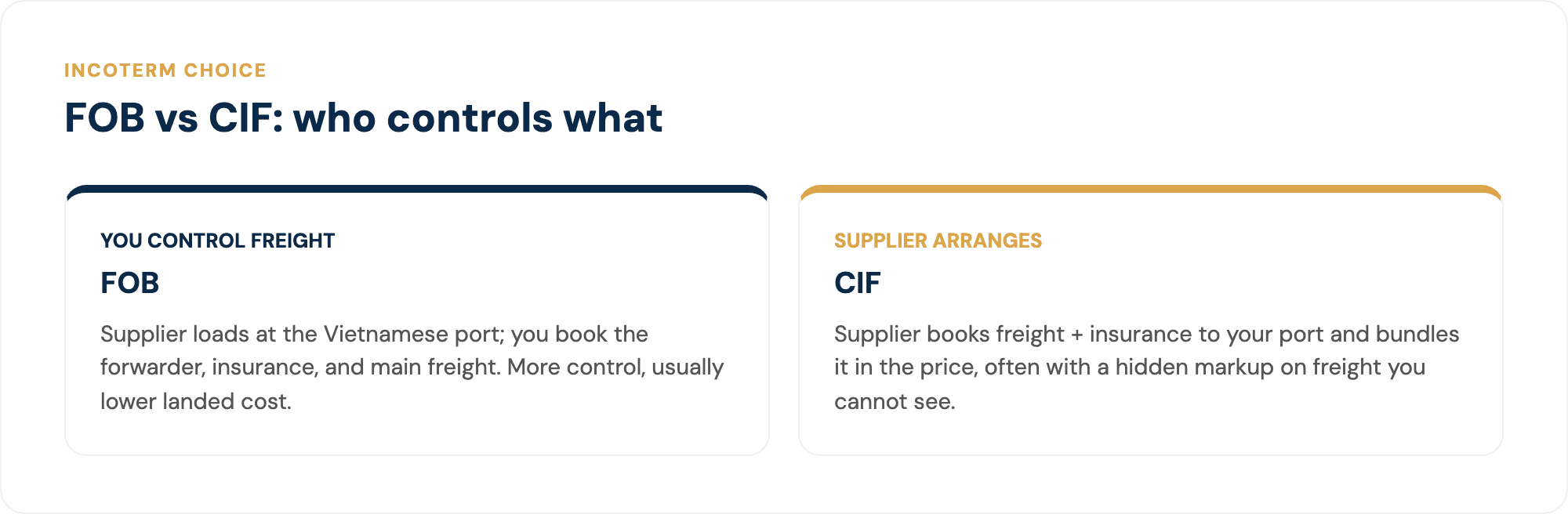
FOB stands for Free On Board. Under FOB, the Vietnam supplier is responsible for getting your goods to the named port of origin (usually Cat Lai, Hai Phong, or Cai Mep) and loading them onto the vessel you or your forwarder have booked. The moment the cargo is on board, responsibility transfers to you.
From that point you pay for, and carry the risk on, ocean freight, marine insurance, import duty in your country, the customs broker, destination port and handling fees, and final delivery to your warehouse. An FOB price is genuinely useful when you control your own logistics, because it strips the supplier’s freight markup out of the quote. But it is only the first slice of the total cost.
3. What CIF Adds and Why the Number Looks Higher
CIF stands for Cost, Insurance, and Freight. Under CIF, the supplier covers the goods, the marine insurance, and the ocean freight all the way to your destination port. The quote is higher because it bundles in the shipping line cost and a basic insurance policy.
For a first-time or low-volume buyer, CIF is often the smarter choice. It removes the need to book freight, the price is predictable, and there are fewer moving parts to manage from the other side of the world. The trade-off is control: the supplier picks the carrier and the routing, sometimes at a markup, and the insurance is usually the minimum cover (110% of invoice value), which may not be enough for high-value goods.
One thing CIF does not cover: import duty, customs clearance at your end, destination handling, and last-mile delivery. Even under CIF, those are still yours.
4. FOB vs CIF: Side-by-Side for Vietnam Buyers
| Factor | FOB (Free On Board) | CIF (Cost, Insurance, Freight) |
|---|---|---|
| Who books ocean freight | You / your forwarder | Supplier |
| Who insures the sea leg | You | Supplier (minimum cover) |
| Risk transfers | At origin port, on board | At origin port, on board |
| Quote looks | Lower | Higher |
| Import duty + customs | You | You |
| Last-mile delivery | You | You |
| Best for | Steady volume, own forwarder | New buyers, low volume, predictability |
| Main risk | You manage all logistics | Less control over carrier + cover |
Verdict: Neither term is “cheaper.” FOB shifts cost and control to you; CIF bundles the sea leg into one predictable number. The only honest comparison is total landed cost: take each quote and add every downstream cost through to your door. On most Vietnam orders that downstream stack is 15 to 30% of the FOB price. Quote on the term that fits your logistics maturity, then decide on landed cost, never on the headline number.
5. Frequently Asked Questions
Is FOB or CIF cheaper when buying from Vietnam?
Neither is inherently cheaper. FOB looks lower because it excludes ocean freight and insurance, which you then pay separately. CIF bundles those in. Compare the full landed cost to your warehouse, and the gap usually narrows or reverses.
Does CIF mean my goods are fully insured?
Only at the minimum level. CIF requires the seller to insure 110% of the invoice value with basic cover. For high-value or fragile goods, arrange your own all-risk policy rather than relying on the supplier’s minimum.
Who pays import duty under FOB or CIF?
You do, under both terms. Neither FOB nor CIF includes import duty, customs clearance, or delivery in your country. If you want the supplier to handle everything to your door, that is a different Incoterm (DDP), which is rare and expensive from Vietnam.
When should a first-time buyer choose FOB?
When you already work with a freight forwarder who can book competitive ocean rates and manage the sea leg. Without that, CIF is simpler and usually safer for a first order, even at a higher headline price.
Compare the real landed cost before you commit.
Model door-to-door cost on any Vietnam quote, then browse pre-vetted suppliers.
Sources
Source from Vietnam with an operating partner
Trade With Viet supports international buyers across 30+ countries with verified suppliers, compliance review, and first-order support, not just introductions.