8 min read

In this guide
- Vietnam’s Food Export Sector: Strengths and Where Buyers Focus
- Destination Market Compliance: What Applies to You
- HACCP and Food Safety Certifications: What to Require and How to Verify
- Rules of Origin for EVFTA: Food and Beverage Specifics
- Testing Requirements: Per-Shipment vs Annual
- Labeling: What Vietnam’s Factories Can and Cannot Do
- Starting Your Food Sourcing Process in Vietnam
Vietnam’s Food Export Sector: Strengths and Where Buyers Focus
The importer, not the Vietnamese factory, is legally responsible for food safety compliance in the destination market. Verify FSMA[3]/HACCP[2] status and certificates before the first shipment.
Vietnam’s agricultural base is genuinely top-tier in specific categories. It is the world’s second-largest coffee exporter (Robusta-dominant), the world’s third-largest seafood exporter by value, a leading exporter of black pepper (approximately 30% of global supply), and among the top five rice exporters globally.
Beyond raw commodities, Vietnam’s processed food sector has expanded significantly since 2018. Canned seafood, instant noodles, fish sauce and condiments, dried fruits and nuts, plant-based snacks, and premium packaged beverages represent a growing share of exports, and the category where compliance complexity is highest.
VietConnect lists 98 verified food and beverage suppliers across these categories at tradewithviet.com/suppliers/food-beverage. Verification includes business registration, export license status, and food safety certification documentation (HACCP, FSSC 22000, or BRC where applicable).
Destination Market Compliance: What Applies to You
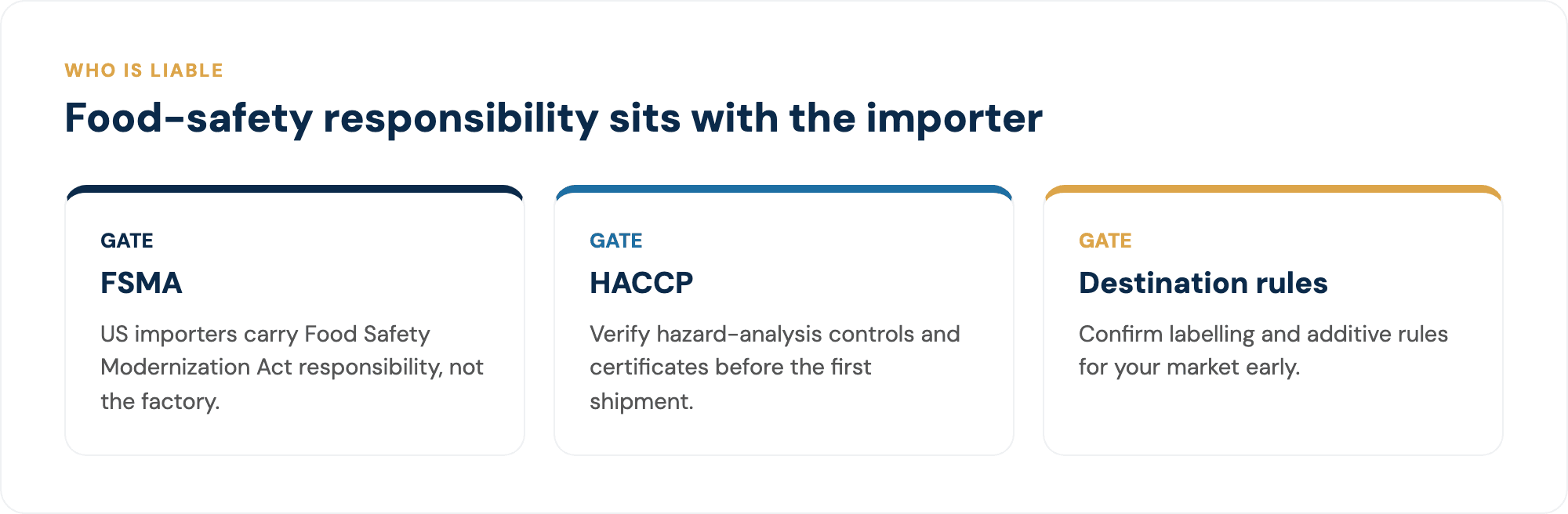
The compliance requirements that apply to your food import depend on: your destination country, the specific product category (HS code), whether the product is raw/primary or processed, and the intended end use (retail, food service, ingredient for further manufacturing).
United States:
The FDA Food Safety Modernization Act (FSMA) governs virtually all food imports to the US. Key requirements:
- Foreign Supplier Verification Program (FSVP): US importers must establish and maintain an FSVP for each foreign supplier and each food product. This means conducting hazard analysis, verifying the supplier’s food safety controls, and keeping records available for FDA inspection. The importer, not the Vietnamese factory, is legally responsible for this
- Facility registration: Vietnamese food processing facilities that export to the US must register with the FDA’s Food Facility Registration system (FoodCentric). Registration must be renewed every two years[4]. Ask your prospective supplier for their FDA registration number and verify it at access.fda.gov
- Prior Notice: All FDA-regulated food shipments to the US require Prior Notice submitted to FDA at least 4 hours before arrival for air or rail, 2 hours for road shipments, and 8 hours for ocean freight[6]
- Seafood HACCP: Under 21 CFR Part 123[5], all seafood processors exporting to the US must have an FDA-compliant HACCP plan. This is mandatory and enforcement is active, Vietnamese seafood facilities have received import alerts (21 CFR 1240.60) for non-compliance. Check FDA’s Import Alert system before signing a supply agreement with a seafood processor
European Union:
- EU General Food Law Regulation: Applies to all food imports. Requires traceability from farm/origin through processing to point of entry
- Official Controls Regulation (EC) 2017/625: EU conducts systematic border controls on food from countries on its high-risk list. Vietnam is not currently on the high-risk list for most categories, but seafood from Vietnam has historically received enhanced scrutiny from EU SPS authorities
- Maximum Residue Levels (MRLs): EU pesticide and antibiotic MRLs are among the strictest globally. Vietnamese coffee, tea, and pepper shipments have been rejected at EU borders for pesticide residue exceedances. Buyers must require pesticide residue test reports from accredited labs on each production batch, not annually but per shipment
- EVFTA[1] SPS Chapter: The EU-Vietnam FTA includes specific SPS (sanitary and phytosanitary) equivalence provisions. For export to the EU under EVFTA preferential tariff rates, the exporting facility must be on the EU-approved establishment list (food of animal origin)
UK:
Post-Brexit, UK applies its own MRL thresholds, which diverge from EU limits in some categories. UK importers of food must be registered as Food Business Operators (FBOs). Import of food of animal origin requires an IPAFFS (Import of Products, Animals, Food and Feed System) pre-notification.
Australia/New Zealand:
FSANZ (Food Standards Australia New Zealand) governs food standards. Importers must comply with biosecurity requirements managed by DAFF. Vietnamese seafood exports to Australia require health certificates from the Vietnam Food Safety Authority (VASF/MARD).
HACCP and Food Safety Certifications: What to Require and How to Verify
For processed food suppliers, the minimum acceptable certification is a valid HACCP plan with annual third-party review. For suppliers serving US retail or EU buyers at scale, FSSC 22000 (Food Safety System Certification) or BRC Global Standard for Food Safety (Issue 8+) are the market-standard certifications.
How to verify:
- HACCP: Ask for the HACCP plan document. It should identify specific hazards for the product you are buying, critical control points (CCPs), monitoring procedures, and corrective action records. A generic HACCP document that was not written for your product category is not compliant
- FSSC 22000: Verify at fssc22000.com/certified-organizations/, certificate number, scope, and expiry date must match what the supplier provides
- BRC: Verify at brcdirectory.com, search by company name and confirm the certificate covers your product category and is not suspended
For food of animal origin (seafood, meat, dairy): confirm the facility appears on the relevant approved establishment list for your destination market. EU approved establishments for seafood from Vietnam are published at ec.europa.eu/food/safety/international_affairs/trade/third-countries-establishments_en. FDA-registered facilities are searchable at FDA’s registration portal.
Rules of Origin for EVFTA: Food and Beverage Specifics
EU buyers sourcing from Vietnam can access EVFTA preferential duty rates, which reduce tariffs on food categories significantly, coffee to 0%, many seafood products to 0%, pepper to 0-5%. But preferential rates require origin compliance.
For most food products, EVFTA applies a “wholly obtained” rule: the product must be entirely grown, harvested, or caught in Vietnam. This is straightforward for primary agricultural products (coffee beans, fresh seafood, pepper) but becomes more complex for processed products.
For processed food (canned goods, condiments, ready meals), EVFTA uses a “substantial transformation” rule with value addition thresholds. The product must be sufficiently processed in Vietnam that it changes HS code classification, and non-originating inputs typically must not exceed 30% of the ex-works price.
Practical implication: if your Vietnamese supplier is importing ingredients from a third country and reprocessing, confirm the EVFTA ROO calculation before claiming preferential rates. EU customs will ask for proof of origin, typically an EUR.1 movement certificate or a supplier declaration. These are the supplier’s responsibility to provide but the importer’s responsibility to validate.
Testing Requirements: Per-Shipment vs Annual
This is the area where new buyers most commonly under-invest. Annual testing cycles are appropriate for some compliance purposes (allergen panel, nutritional analysis, initial registration) but are not adequate for pesticide residue, antibiotic residue, or heavy metals.
EU and US regulators expect evidence of per-batch testing for high-risk contaminant categories:
- Pesticide residues: Coffee, tea, pepper, dried spices, test every production lot. EU RASFF (Rapid Alert System for Food and Feed) notifications from Vietnam are most commonly pesticide residue-related
- Antibiotic residues: All seafood, test every production batch. Chloramphenicol, malachite green, and nitrofuran metabolites are the most commonly detected. FDA import alerts on Vietnamese seafood are predominantly antibiotic-related
- Heavy metals (lead, cadmium, mercury): Seafood, spices, and some herbal products, test by product category, annually at minimum, and whenever supply source changes
- Mycotoxins (aflatoxin, ochratoxin): Coffee, nuts, dried fruits, pepper, aflatoxin B1 limits are stricter in EU than US; test to the stricter standard if selling to both markets
Build test reporting requirements into your supply agreement before placing a commercial order. A clause requiring current (dated within 90 days) test reports from accredited third-party labs as a condition of each shipment is standard practice for professional food importers.
Labeling: What Vietnam’s Factories Can and Cannot Do
Vietnamese factories can produce product labels to your specification, but the label design, language content, and regulatory compliance for destination-market labeling is the buyer’s responsibility. Common mistakes:
- Allergen declarations: Ensure all 14 EU major allergens (or 9 FALCPA-required allergens for US) are declared if present. If your supplier adds an ingredient you did not spec, their factory batch record may not reflect it
- Nutritional information: Must be calculated from a certified laboratory analysis, not from a manufacturer’s ingredient database
- Country of origin: “Product of Vietnam” claims on food products must be accurate. For processed products with imported ingredients, the claimed origin may be contested under specific US or EU labeling rules depending on the degree of processing
- Health claims: Any health or functional claim on food packaging requires regulatory pre-approval in both the US and EU. Vietnamese suppliers sometimes propose label copy with unverified health claims that are not approvable in your destination market
Starting Your Food Sourcing Process in Vietnam
The most common first step Trade With Viet recommends for food buyers is a product-specific compliance pre-check before supplier selection. Know what certifications, test reports, and registration requirements your specific HS code needs in your destination market before you shortlist factories. This avoids the costly situation of a factory passing your commercial vetting but failing on a compliance requirement that was always going to block import.
VietConnect’s food and beverage supplier directory at tradewithviet.com/suppliers/food-beverage includes 98 verified suppliers with documented compliance status. For buyers entering the Vietnam food sourcing market for the first time, a sourcing consultation covers the compliance pre-check, supplier shortlist, and first-shipment documentation checklist. Book at tradewithviet.com/contact.
Sources
- European Commission: EU-Vietnam Free Trade Agreement
- U.S. FDA: Hazard Analysis Critical Control Point (HACCP)
- U.S. FDA: Food Safety Modernization Act (FSMA)
- U.S. FDA: Biennial Food Facility Registration Renewal
- U.S. FDA: Fish and Fishery Products HACCP (21 CFR Part 123)
- U.S. FDA: Prior Notice of Imported Food (21 CFR 1.279)
Source from Vietnam with an operating partner
Trade With Viet supports international buyers across 30+ countries with verified suppliers, compliance review, and first-order support, not just introductions.