
9 min read
In this guide
The Headline Cost Gap and What It Means for Your Program
The single biggest shift in global furniture sourcing over the past five years is the Section 301[3] tariff structure. Under the US Trade Representative’s Section 301 actions against China, most wood and upholstered furniture categories (HTS 9401, 9403) carry a 25% additional duty on top of the standard MFN rate. For a buyer importing $500,000 USD of dining furniture per year, that tariff alone represents $125,000 in additional cost with no functional return.
Vietnam-origin furniture enters the US at the standard MFN rate, currently 0% for most wood furniture categories under HTS 9403. The arithmetic is straightforward: a buyer who shifts a furniture program from China to Vietnam and holds all other costs equal reduces their US customs bill by a material amount on every shipment.
This is not a recent discovery. The migration began in earnest after the first round of Section 301 tariffs in 2018. What has changed by 2026 is that Vietnam’s factory capacity has matured to absorb that demand. We have worked with buyers who moved 40-foot container programs from Guangdong to Binh Duong and Dong Nai provinces, and the landed-cost math at volume has consistently favored Vietnam once tariffs and freight are modeled together.
Where the Gap Really Comes From: Labor, Tariffs, and Landed Cost
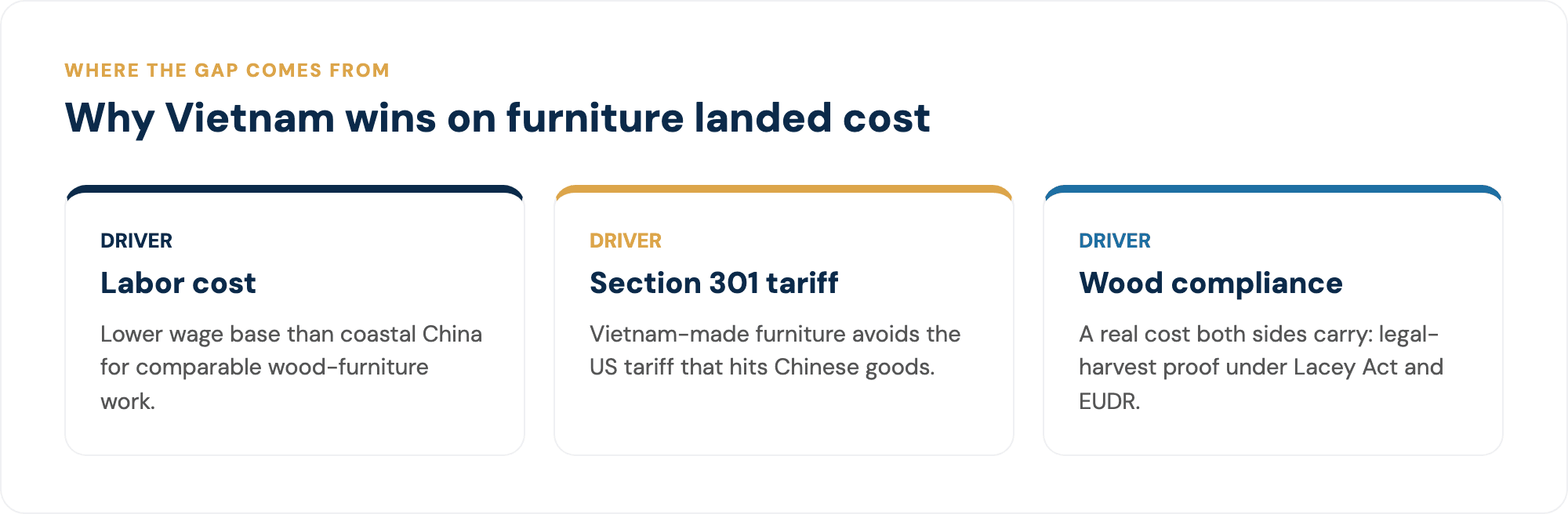
Three cost layers stack to create Vietnam’s landed-cost advantage.
Labor cost. Vietnam’s furniture manufacturing fully loaded labor costs (wages plus overhead) in 2026 run roughly $3.50 to $5.00 per hour for production workers, depending on province and facility type. Comparable Guangdong rates have risen to $6.00 to $8.50 per hour following successive minimum-wage adjustments. For labor-intensive categories such as solid wood dining sets, upholstered sofas, and rattan/cane pieces, this gap is significant. Highly automated commodity products narrow it.
Section 301 tariff exposure. As noted, 25% additional duty on Chinese-origin furniture is the structural cost penalty that no sourcing efficiency can fully offset on the China side. For buyers sourcing into the US market, this is the dominant variable in any total cost model.
Landed cost at volume. When you combine factory price, ocean freight, US customs duty, and port handling, Vietnamese furniture typically lands 18 to 28% cheaper than equivalent Chinese product on mid-volume orders (roughly 2 to 10 containers per month). At very high volumes (20+ containers per month), China’s supply chain density and logistics infrastructure begin to compress that gap, though the tariff differential remains.
Vietnam also offers preferential access to the EU under the EVFTA[1] (EU-Vietnam Free Trade Agreement), with furniture tariffs phased to 0% over the agreement’s schedule. EU buyers benefit from the same cost structure without the Section 301 factor, though they gain a separate tariff preference that Chinese-origin goods do not carry.
The Vietnam vs China Furniture Sourcing Comparison
| Factor | Vietnam | China |
|---|---|---|
| Labor cost (production) | $3.50 to $5.00/hr | $6.00 to $8.50/hr |
| US Section 301 tariff exposure | None (MFN rate applies) | +25% on most HTS 9401/9403 categories |
| Typical MOQ | 50 to 200 units per SKU | 200 to 500+ units per SKU (standard factories) |
| Lead time (production + shipping to US West Coast) | 60 to 90 days | 45 to 75 days |
| Wood-compliance burden (Lacey Act[5] / EUDR[4]) | Moderate; CITES-listed species present, documentation required | Higher; supply chain opacity increases audit complexity |
| Landed cost at volume (US, post-duty) | Lower by 18 to 28% on mid-volume orders | Higher due to Section 301; competitive at very high volume |
| Design and finish capability | Strong for solid wood, upholstery, rattan, lacquer finishes | Stronger for high-gloss lacquer, multi-material assembly, metal-wood hybrids |
| Component ecosystem depth | Growing, some gaps in hardware and foam | Deep; metal fittings, foam, fabric, glass all locally available |
Verdict: For US and EU buyers sourcing solid wood, upholstered, or natural-material furniture at mid-volume (2 to 10 containers per month), Vietnam delivers a structurally lower landed cost. The Section 301 tariff is not a negotiating variable; it is a fixed cost penalty on Chinese-origin goods. Vietnam’s labor cost advantage adds a second layer. China remains the stronger choice for buyers requiring very high-volume commodity production, complex multi-material assemblies, or component supply depth that Vietnam cannot yet match.
The Section 301 tariff makes China structurally expensive for US furniture imports regardless of factory-gate price. Model your landed cost with duty included before comparing quotes.
Where China Still Wins
Honest sourcing advice requires naming the categories where China retains a real advantage.
Component supply depth. China’s Pearl River Delta furniture cluster has decades of vertical integration. Metal fittings, drawer slides, foam grades, performance fabrics, tempered glass, and hardware are all available within a 100km radius of major factories. Vietnam imports a meaningful share of its furniture components from China, which creates supply chain linkage and means that a sharp RMB movement or Chinese export restriction can ripple into Vietnamese factory costs within one to two production cycles.
Very large runs. For buyers moving 30 or more containers per month of a standardized SKU, China’s factory scale, workforce depth, and logistics infrastructure remain hard to match. Vietnam’s capacity has grown substantially, but the largest Guangdong facilities still exceed anything available in Binh Duong or Dong Nai in terms of single-facility throughput.
Certain finishes and material combinations. High-gloss UV lacquer, complex metal-wood assemblies, and some injection-molded plastic furniture components are more consistently available in China. Vietnam’s finishing capability has improved, particularly for water-based lacquer and natural oil finishes, but buyers sourcing high-gloss bedroom or dining programs should audit Vietnamese samples carefully before committing volume.
Speed for reorders. China’s denser supply chain typically supports faster reorder fulfillment for catalog products. Lead times in Vietnam are competitive on initial production runs but can extend on rushed reorders if component availability is tight.
The Compliance Cost Most Buyers Miss
Wood-source compliance has become a material cost center for furniture buyers on both origins, but the risk profile differs.
The Lacey Act[8] (US) requires importers to declare the plant species, country of harvest, and quantity of all imported plant material, including wood in furniture. Non-compliant shipments can be seized, and civil or criminal penalties apply to knowing violations. The US Department of Justice has prosecuted cases under the Lacey Act where buyers relied on supplier declarations without independent verification.
The EUDR (EU Deforestation Regulation)[4], which applies to furniture containing wood from regulated ecosystems, requires operators to perform due diligence confirming that products are deforestation-free and produced in compliance with local laws in the country of harvest. The compliance timeline has been extended but enforcement is moving forward, and EU buyers sourcing wood furniture need documented supply chains from forest to factory.
For Vietnam-origin furniture, the primary compliance area is species documentation. Vietnam uses rubberwood (abundantly available, well-documented), acacia (plantation-grown, lower Lacey Act complexity), and imported tropical hardwoods including teak and some mahogany-family species (higher documentation burden, CITES considerations for some species). Reputable Vietnamese factories maintain FSC[6] certification or chain-of-custody documentation, but buyers should verify this at the factory level rather than assuming category-level coverage.
For China-origin furniture, the supply chain opacity challenge is structurally greater. Wood components often pass through multiple intermediaries before reaching the furniture factory, and verifying harvest-country documentation across that chain is harder. The EUDR’s geolocation and traceability requirements are particularly difficult to satisfy in opaque supply chains.
In our experience working with buyers across 30+ countries, wood compliance due diligence adds roughly $0.50 to $1.50 per unit in documentation and audit cost when done properly. Buyers who skip it are not saving money; they are accumulating regulatory risk that can halt shipments or require costly third-party audits after the fact.
You can browse 549+ verified Vietnam furniture suppliers with compliance documentation on file, or model your own landed cost scenario using the TradeWithViet landed-cost calculator.
Frequently Asked Questions
Q: Is Vietnamese furniture quality comparable to Chinese furniture at the same price point?
For solid wood, upholstered, and natural-material categories, yes. Vietnamese factories have supplied major US and EU retail chains for over a decade. Quality variance exists at the factory level, not the country level. The critical variable is factory selection and pre-production sample approval, not origin. Buyers moving programs from China to Vietnam should plan for a 2 to 3 sample round process before committing to production.
Q: How does CPTPP[2] affect furniture sourcing from Vietnam for non-US buyers?
CPTPP members (including Canada, Australia, Japan, and others) benefit from preferential tariff rates on Vietnamese-origin goods. For furniture, CPTPP progressively reduces import duties toward 0% across most member markets. Canadian buyers, for example, have seen meaningful duty reductions on wood furniture from Vietnam under CPTPP schedules. The agreement requires rules-of-origin compliance, meaning the furniture must meet a regional value content or tariff change threshold to qualify.
Q: What is the realistic minimum order quantity for a new Vietnam furniture supplier relationship?
Most mid-tier Vietnamese furniture factories set an initial MOQ of 50 to 200 units per SKU for new buyer relationships. This is lower than comparable Chinese factories, which typically require 200 to 500 units for production efficiency. The lower MOQ makes Vietnam accessible to buyers testing a new category or moving a program in phases. After the first production run establishes the relationship and QC baseline, many factories will accept reorders at lower quantities.
Q: How do I verify a Vietnamese furniture factory’s wood compliance documentation before placing an order?
Request the factory’s FSC certificate number and verify it directly on the FSC certificate database (info.fsc.org). For non-FSC factories, request species declarations by component with harvest country stated, and ask for the factory’s most recent third-party social and environmental audit if they supply major retailers. For EUDR purposes, buyers should request geolocation data for plantation or forest harvest areas. Factories supplying European retail chains are increasingly familiar with this requirement; factories that have not yet dealt with EU buyers may need coaching on documentation format.
Sources
- European Commission: EU-Vietnam Free Trade Agreement
- Government of Canada: CPTPP
- Office of the U.S. Trade Representative: Section 301, China
- European Commission: Deforestation-free products regulation (EUDR)
- USDA APHIS: Lacey Act
- Forest Stewardship Council
- USTR: Section 301 Tariff Actions
- USDA APHIS: Lacey Act declaration requirements
Source from Vietnam with an operating partner
Trade With Viet supports international buyers across 30+ countries with verified suppliers, compliance review, and first-order support, not just introductions.